
Myanmar Spring Chronicle – Scenes from July 17
(MoeMaKa), July 18, 2026
Starlink to Increase Fees for Users Operating Outside Their Authorized Country or RegionM
Since Myanmar’s 2021 military coup, access to phone and internet services has become increasingly unreliable. Telecommunications networks have been shut down, towers have been damaged or destroyed during armed conflict, and attacks on military-owned Mytel infrastructure have left many areas without mobile service, fiber internet, or mobile data connectivity.
Myanmar had already experienced one of the world’s longest internet blackouts during fighting between the Arakan Army and the military in Rakhine State in 2018–2019. After the coup, however, internet shutdowns spread across the country and became a common occurrence rather than an exception.
In the early stages of the conflict, both the military and, in some areas, resistance forces cut telecommunications infrastructure to prevent intelligence leaks. Over time, entire territories under resistance control lost access to mobile phone and internet services altogether.
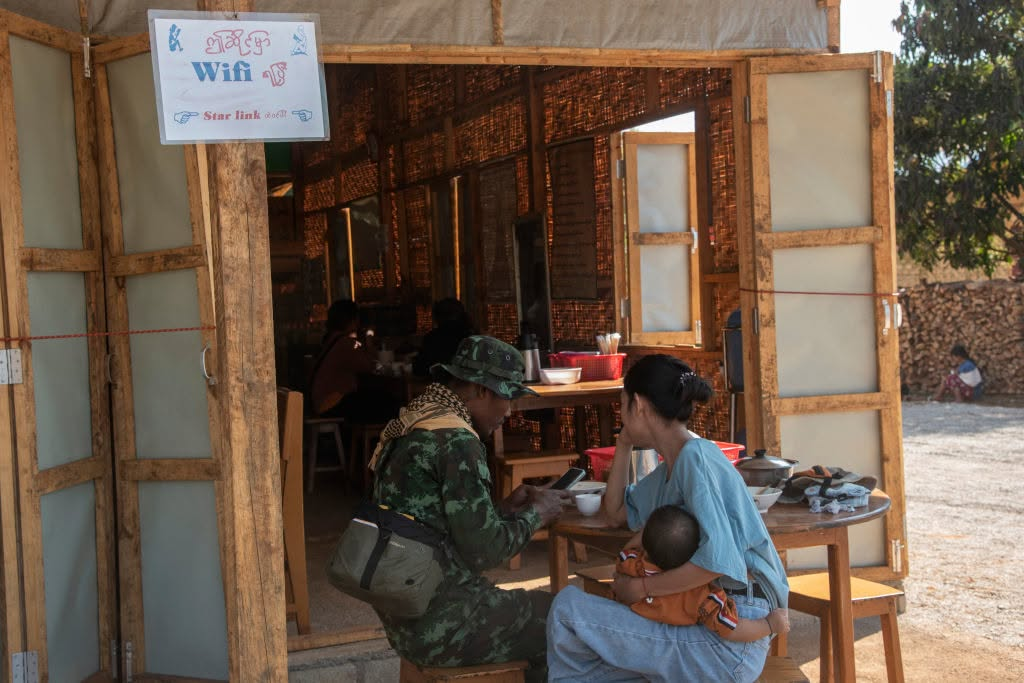
As a result, residents, armed organizations, healthcare providers, schools, and humanitarian groups in these areas increasingly turned to Starlink satellite internet to maintain communications. Beginning around 2022–2023, Starlink terminals were purchased through authorized distributors in countries such as the Philippines and Australia before being transported into Myanmar.
Although a Starlink terminal officially costs about US$500, by the time it reaches Myanmar through border routes—primarily via Thailand—it often sells for US$2,000 to US$3,000. Thailand has not officially approved Starlink equipment, meaning transporting the devices carries legal risks, contributing to their high prices inside Myanmar.
Starlink is used not only by civilians and resistance groups in areas without conventional internet access but also by Chinese-language online scam syndicates operating along the Myanmar-Thailand and Myanmar-China borders under the protection of armed groups. After Thailand cracked down on cross-border fiber-optic connections used by these scam operations in recent years, many criminal organizations increasingly shifted to Starlink for internet access.
Because of this, Starlink has faced growing pressure, particularly from U.S. authorities, to restrict the use of terminals operating illegally along the Myanmar-Thailand border. While individual Starlink units have occasionally been deactivated in the past, the company had never before introduced a major policy change affecting cross-border users.
That has now changed.
According to a recent notice sent by Starlink to customers, starting August 17, terminals being used outside their authorized country or region will no longer receive unlimited data under existing plans. Instead, users will be required to pay based on monthly data usage.
Under the new pricing structure, the lowest package—50 GB of data—will cost approximately US$256 per month. If users exceed that limit and purchase an additional 50 GB, they will have to pay another US$95.
Converted into Myanmar currency, the minimum monthly cost is roughly one million kyats. This will make it difficult for community internet providers in conflict areas, who currently charge around 500 to 2,000 kyats per hour, to continue operating under existing pricing.
In resistance-controlled territories and some contested areas, Starlink has become an essential communications tool for armed groups, humanitarian organizations, healthcare workers, educators, and local communities.
Today, internet access is no longer simply a convenience. It is essential for government administration, education, healthcare, financial support from family members living elsewhere, business transactions, and even military and political coordination. Internet connectivity has become deeply integrated into daily life.
For ordinary civilians living in conflict zones, reliable internet access can also be life-saving. It allows people to determine whether military columns are approaching, whether fighting has reached nearby towns or villages, and whether their current location remains safe.
Without internet connectivity, communication between communities, access to education, the functioning of local administration, and civilians’ ability to receive warnings about armed conflict or natural disasters will become significantly more difficult.