
Myanmar Spring Chronicle – Scenes from July 19
(MoeMaKa), July 20, 2026
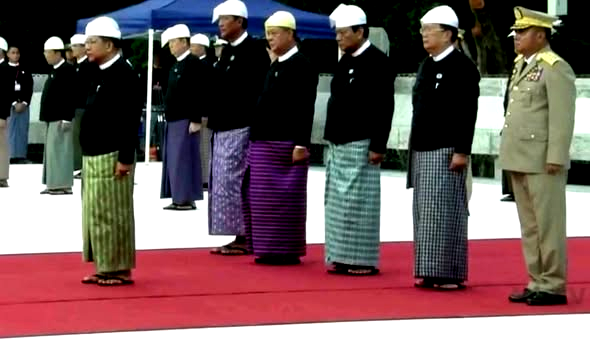
Martyrs’ Day Amid Political and Military Conflict, and the TNLA’s Visit to Naypyidaw
Seventy-nine years ago, on July 19, 1947, while Myanmar was still under British colonial rule and negotiations for independence were underway, General Aung San and several members of his cabinet were assassinated during a meeting at the Secretariat building in Yangon. The attack was orchestrated by former Prime Minister U Saw, who had served during the British colonial era. The assassination claimed the lives of several national leaders and has since been commemorated annually as Martyrs’ Day.
The assassination remains one of the darkest chapters in modern Myanmar’s political history. Although royal assassinations were not uncommon during the country’s feudal era, the killing of the nation’s emerging democratic leaders at the dawn of independence marked a tragic beginning to Myanmar’s modern political tradition.
Historical records show that some British military officers supplied the weapons used in the assassination. However, there is no conclusive evidence that the British government in London directly participated in the plot. What is clear is that a new generation of nationalist leaders, many of whom had emerged from the student movement and the Dobama Asiayone (We Burmans Association), had risen to prominence during World War II. After forming the Burma Independence Army (BIA) in 1942 with Japanese support, they returned to Burma alongside Japanese forces and became the country’s dominant political force after the war.
Following World War II, these younger nationalist leaders replaced the older political elite who had served under British colonial administration. Former Prime Minister U Saw, unwilling to accept this shift in political leadership, is widely believed to have planned the assassination of General Aung San and other leaders of the Anti-Fascist People’s Freedom League (AFPFL).
The pattern of eliminating political opponents through violence—or, when violence is not used, through politically motivated legal prosecutions—has continued throughout Myanmar’s modern history. Successive military governments, from General Ne Win’s BSPP era to the SLORC and SPDC governments under Generals Saw Maung and Than Shwe, and continuing under Senior General Min Aung Hlaing following the 2021 coup, have frequently imprisoned political opponents under broadly interpreted or controversial legal provisions rather than engaging them politically.
One prominent example is Daw Aung San Suu Kyi, the daughter of General Aung San. After entering politics following the 1988 pro-democracy uprising, she was first placed under house arrest in July 1989, shortly before Martyrs’ Day commemorations. Over the following two decades, she alternated between house arrest and imprisonment until her release in 2010.
Although she served as Myanmar’s de facto civilian leader between 2011 and the 2021 military coup, she has since spent more than five years in detention and remains imprisoned today.
Another noteworthy development reported today concerns the Ta’ang National Liberation Army (TNLA), one of the three members of the Northern Alliance. The TNLA leadership traveled to Naypyidaw for talks with the military government’s National Solidarity and Peacemaking Negotiation Committee (NSPNC).
Last October, following military offensives, airstrikes, and pressure from China, the TNLA agreed to a ceasefire with the military in Haigeng, Yunnan Province, and subsequently handed control of Mogok and Momeik back to the military. Even so, few observers expected the TNLA to participate in Naypyidaw’s recently announced 100-day peace initiative, making the meeting a significant development.
After last year’s ceasefire agreement, the military had continued demanding that the TNLA return other towns captured during the conflict. The TNLA rejected those demands, but has now arrived in Naypyidaw just weeks before the conclusion of the government’s 100-day peace initiative.
According to BBC Burmese, representatives of the TNLA and the NSPNC signed a six-point agreement following talks held on July 19. The agreement includes cooperation with the 100-day peace plan, reaffirmation of the Haigeng ceasefire agreement, implementation of existing ceasefire commitments, improving local livelihoods, seeking political solutions through political dialogue rather than armed conflict, continuing cooperation in the peace process, and promoting education, healthcare, infrastructure, and regional development.
The six-point agreement does not appear to contain major new concessions beyond those already reached in Haigeng. Instead, it largely reinforces and reaffirms the commitments made under last year’s ceasefire agreement.
Overall, relations between the military government and the TNLA now differ significantly from the situation immediately after the first phase of Operation 1027. Both sides appear to have a mutual interest in maintaining the ceasefire rather than returning to active hostilities.
Although northern Shan State has yet to regain full stability or restore normal transportation and commerce, the likelihood of renewed large-scale fighting between the military and the TNLA appears lower than before. As a result, armed conflict associated with Myanmar’s Spring Revolution is likely to remain concentrated in other parts of the country rather than returning to northern Shan State in the near term.