
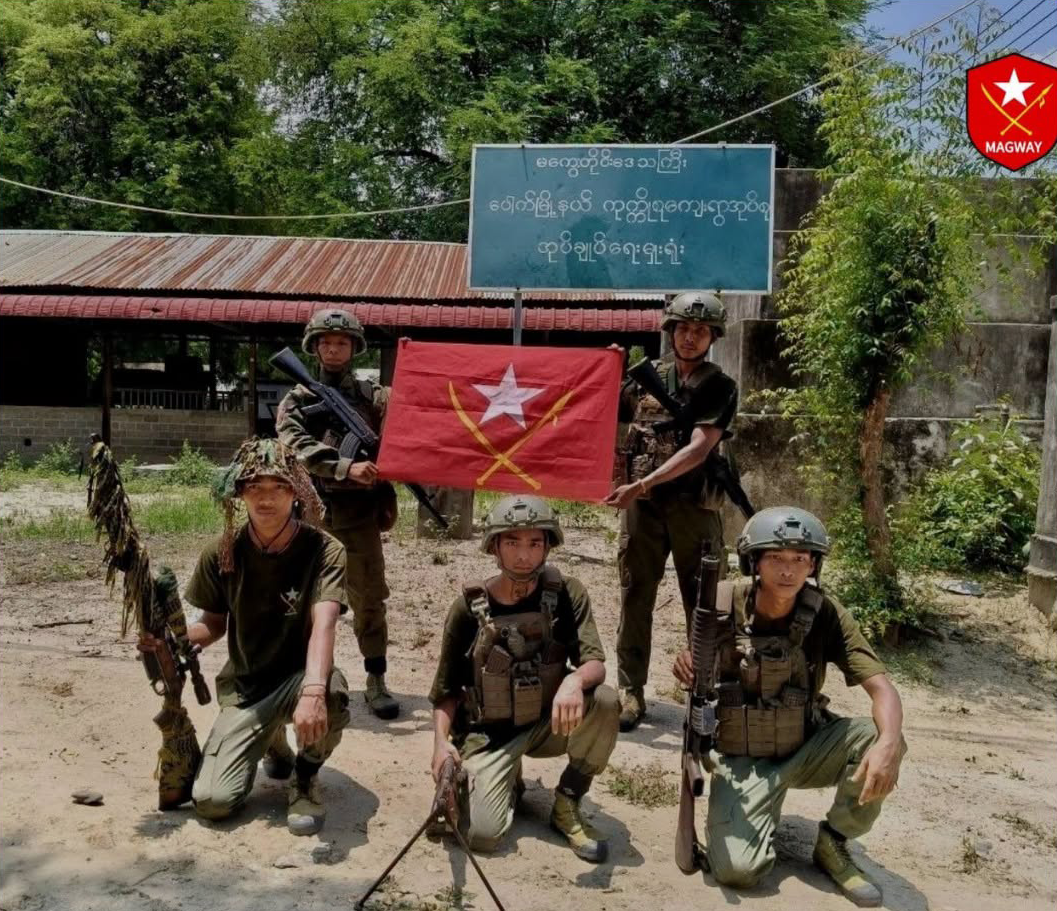
Myanmar Spring Chronicle – Scenes from June 30
(MoeMaKa), July 1, 2026
How Should the Problems in the Sagaing, Magway, and Mandalay Federal Units Be Resolved?
Earlier this year, an incident occurred in Pale Township, Yinmabin District, Sagaing Region, in which Bo Naga, the leader of the Burma National Revolutionary Army (BNRA), surrendered to Myanmar’s military junta.
At first, the incident sparked widespread concern that armed clashes might erupt between the BNRA and the NUG/PDF. However, within a matter of days, the BNRA leader contacted the Northwestern Regional Military Command based in Monywa and formally surrendered. Following this, weapons belonging to the battalion under Bo Naga’s command were confiscated, members of the unit were detained and interrogated, and most were later released.
After that incident, tensions arose in Myaing Township, Magway Region, between Bo Let Yar, who serves as the Defense Minister of the Magway Federal Unit Government, and NUG/PDF forces over disputes regarding tax revenues collected from local oil fields. The disagreement escalated to the point where military forces surrounded one another.
Prior to that, Mandalay PDF had already experienced internal leadership disputes. Two members of its political and military leadership committee were arrested on allegations that they had taken organization-owned gold and failed to return it. Within months of that controversy, MDY-PDF subsequently lost several towns under its control in Mandalay Region.
In recent weeks, another conflict occurred in Myingyan District, Mandalay Region, involving the People’s Liberation Army (PLA) and Myingyan District PDF units under the NUG Ministry of Defence over territorial administration. During a raid on a PLA base, NUG/PDF personnel struck landmines, resulting in the deaths of four fighters. The incident was followed by public disagreements between the PLA and NUG/PDF forces.
In June, another serious incident took place in Pale Township, Yinmabin District, Sagaing Region, where a PDF battalion commander was shot and killed at close range during a meeting by an individual identified as the personal aide to the Yinmabin District commander.
Only a few days later, on June 29, PDF battalions from Monywa District attacked a camp operated by the Monywa District People’s Security Force. The fighting reportedly resulted in the deaths of members of the People’s Security Force as well as at least two nearby civilians.
The incidents described above all occurred within the past six to eight months across Magway, Sagaing, and Mandalay Regions.
Since these are armed organizations, one could generally argue that military or administrative disputes are inevitable, whether between separate organizations or within a single organization. However, regarding the conflicts between the PLA and the NUG, and between the BNRA and NUG-affiliated forces, criticism has emerged both inside and outside the resistance movement that such disputes—occurring among allies in the Spring Revolution—should not be resolved through the use of force.
Meanwhile, in several parts of Upper Myanmar, there continue to exist locally organized PDF forces that are not under the NUG Ministry of Defence, similar to the BNRA. Some operate under names such as “Student Army,” while others have formed broader alliances by combining student forces with other local PDF units.
This raises an important question about how relations between these armed organizations and the NUG will evolve in the future.
Outside ethnic minority regions, the NUG has established administrative structures known as Federal Units, largely based on elected NLD parliamentarians and local NLD leaders. These structures consist of the so-called “Three Pillars” (Pa Thone Lone): defence, security, and administration. It appears that disputes have arisen between this administrative mechanism and non-NUG armed organizations operating in those areas over issues such as governance, taxation, and security.
Questions therefore arise as to whether the NUG intends to administer these areas in accordance with the Federal Democracy Charter drafted and adopted by the National Unity Consultative Council (NUCC), and how it plans to engage with LPDFs or other PDF groups that have independently captured and now administer territory.
This represents one challenge concerning the NUG’s relationship with armed organizations outside its direct command. Another challenge is how it will manage disputes arising within its own PDF forces or within the Three Pillars administrative system before they escalate into major conflicts.
Looking at incidents such as the Magway Federal Unit’s dispute over sharing oil-field tax revenues, the recent assassination of a PDF battalion commander in Yinmabin District, and the raid on the People’s Security Force camp in Monywa, one cannot help but ask whether there are established institutional procedures for resolving disputes involving armed groups. Are there standardized disciplinary mechanisms to address cases involving misconduct by military leaders—such as violations of procedures, corruption, bribery, or abuse of authority and public funds?
These incidents also raise broader questions about whether effective systems exist for filing complaints, applying laws and disciplinary procedures within armed organizations, or whether local commanders effectively exercise unchecked decision-making authority.
It is becoming increasingly urgent for NUG leaders and responsible officials to establish clear institutional frameworks, formally codify these mechanisms, and communicate them throughout all armed organizations under their authority.
This translation aims to preserve the article’s analytical tone while remaining neutral and faithful to the original text. If you’d like, I can also produce a more polished, publication-style English version suitable for international media or policy audiences.