
Myanmar Spring Chronicle – Scenes from July 8
(MoeMaKa), July 9, 2026
Floods and Landslides Add to the Suffering of War-Affected Communities
As Myanmar’s civil war enters its sixth year, communities already displaced and affected by conflict are now facing another crisis: severe flooding and landslides brought by the monsoon season.
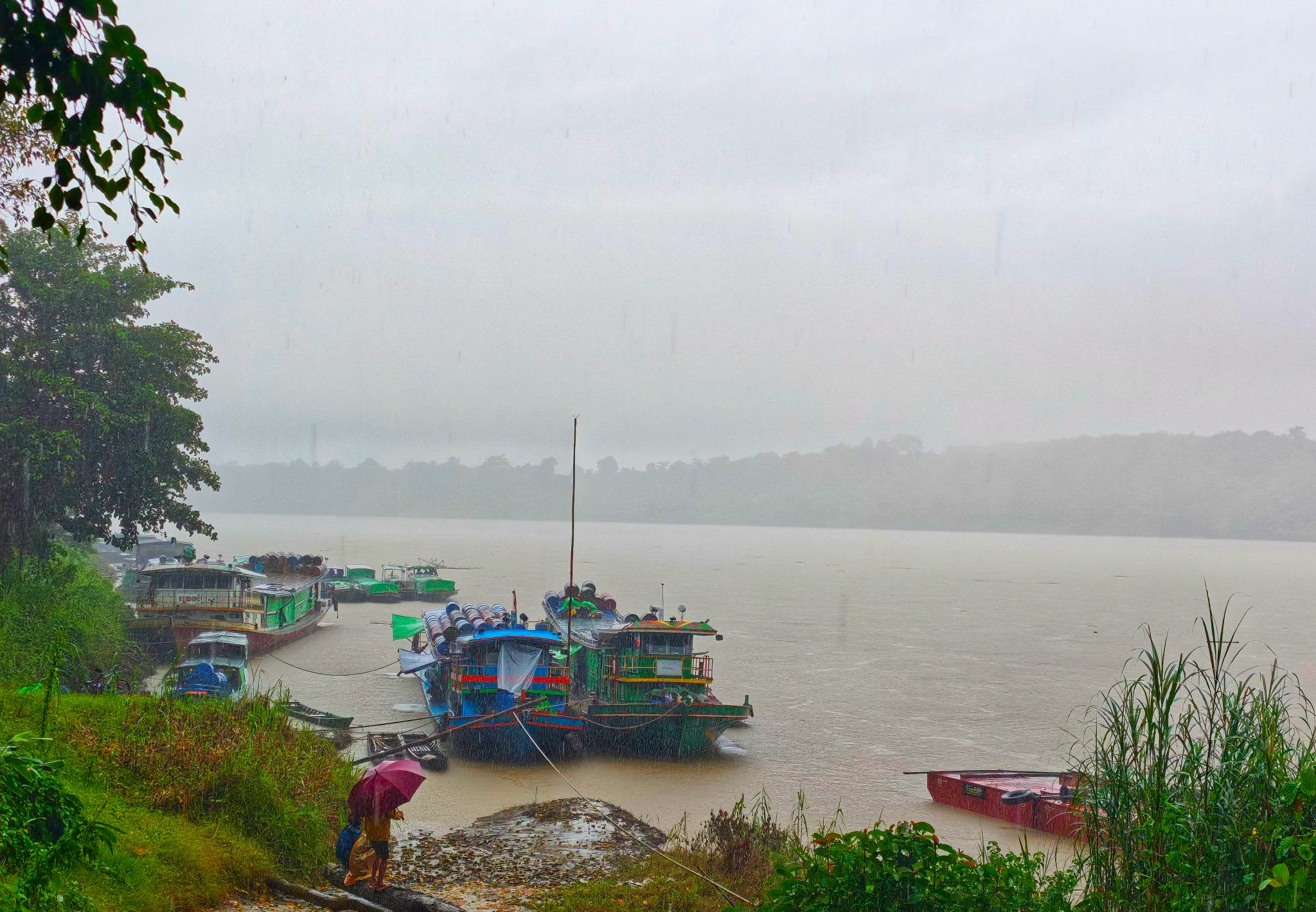
Heavy rains driven by weather systems over the Bay of Bengal have already begun affecting Rakhine State and Kachin State. As the monsoon reaches its peak, days of continuous rainfall have caused rivers and streams to swell, threatening to inundate towns and villages across both regions.
When Cyclone Mocha struck Rakhine State in May 2023, it caused widespread destruction while much of the state remained under the control of Myanmar’s military junta. Although the military authorities carried out some emergency relief operations after the cyclone, many affected communities received insufficient humanitarian assistance and reconstruction support.
Now, in the 2026 monsoon season, Rakhine is once again confronting serious flooding. Meteorologist U Win Naing has warned that flooding in the state could reach its highest level in two decades, according to Rakhine-based media. Photos circulating on social media already show floodwaters surrounding the Mahamuni Pagoda area in Kyauktaw Township in northern Rakhine.
The renewed flooding also raises a difficult question. Since the 2023 Cyclone Mocha disaster, Rakhine has increasingly faced restrictions on the movement of goods from central Myanmar. If major flooding worsens, how will residents obtain food, fuel, medicine, and other essential supplies? At present, there is no clear answer.
According to figures released by the military authorities following Cyclone Mocha in 2023, the storm damaged more than 180,000 homes, over 1,300 schools, around 300 government buildings, 220 hospitals and clinics, and more than 1,700 religious buildings, while 145 people reportedly lost their lives.
Following the Arakan Army’s major offensive in November 2023, the United League of Arakan/Arakan Army (ULA/AA) gained control of roughly 90 percent of Rakhine State. Since then, transportation of goods into Rakhine, exports from the state to the rest of Myanmar, and border trade with neighboring Bangladesh have been severely disrupted. As a result, residents have lived under significant economic isolation for nearly three years.
Against this backdrop, another important question emerges: when natural disasters strike conflict zones, who is responsible for disaster preparedness, emergency response, and reconstruction? And what governing institutions are capable of carrying out those responsibilities?
The ULA/AA has already established administrative structures in the areas it controls. However, managing large-scale disaster relief, securing emergency funding, and coordinating humanitarian assistance during an active armed conflict presents enormous challenges.
The impact of the monsoon is not limited to Rakhine. Northern Myanmar, particularly Kachin State, has also experienced severe flooding. In recent weeks, rising rivers have inundated residential neighborhoods around Mogaung in Mohnyin District.
In jade-mining areas such as Hpakant, rising streams, landslides, and fatalities during the rainy season have become recurring tragedies. Many observers believe these disasters are being made worse by environmental degradation caused by large-scale jade mining and mechanized gold dredging.
Along the Uru River, the upper Chindwin River, and other waterways, gold mining has altered river channels, while sediment accumulation has made rivers shallower. At the same time, accelerating deforestation in upstream areas increases the likelihood of flooding downstream.
Despite the ongoing civil war, extraction of gold, jade, and other natural resources has not slowed. Instead, many armed actors continue exploiting natural resources to finance the conflict, with few effective mechanisms to regulate or prevent environmental destruction.
As ecosystems deteriorate, the risk of natural disasters continues to rise. Environmental damage not only contaminates land and water but also increases the likelihood of floods and landslides.
This year’s monsoon season is expected to be especially volatile due to Super El Niño, bringing unusually high temperatures, unpredictable heavy rainfall, and an increased risk of tropical storms.
Countries at peace can generally prepare for these climate-related threats through coordinated planning between governments and the public. Myanmar, however, remains trapped in civil war. For millions of people already living under the burden of armed conflict, natural disasters have become yet another layer of hardship, compounding an already devastating humanitarian crisis.