
Myanmar Spring Chronicle – Scenes from June 10
(MoeMaKa), June 11, 2026
The Coup Regime’s New Propaganda Strategy
After holding an election widely regarded as neither free nor fair, the military regime installed by the coup formed a new government in early April, with coup leader Min Aung Hlaing assuming the presidency as many had anticipated. Since then, the new administration has begun implementing a revised information and propaganda strategy.
Under the previous two governments, positions such as spokespersons and heads of information teams were established within institutions including the Ministry of Information, the Tatmadaw True News Information Team, the President’s Office, and later the State Counsellor’s Office.
During President Thein Sein’s administration, U Ye Htut served as presidential spokesperson. Under the NLD government, U Zaw Htay held responsibilities as Director General of the President’s Office and later the newly established State Counsellor’s Office. On the military side, the Tatmadaw True News Information Team was led by officials from the Directorate of Public Relations and Psychological Warfare (commonly abbreviated as KaKaPya), who answered media inquiries, held press conferences, and issued official statements.
Following the military coup in 2021, the junta effectively merged the functions of government and military authority. As a result, Major General Zaw Min Tun—head of the Tatmadaw True News Information Team and the military’s chief spokesperson (often nicknamed “Zaw Mae Lone” by the public)—became the regime’s primary media representative. He handled media inquiries, explained official statements, and gave interviews to certain international news organizations on behalf of the military government.
Known as a central Myanmar native with an argumentative speaking style, a tendency toward provocative remarks, and frequent use of language aimed at discrediting opponents, Zaw Min Tun was widely viewed as someone who routinely justified the military’s human rights abuses and coup actions. However, in March of this year, he was reportedly disciplined over a tender-related issue and relieved of all his duties. Although another director from KaKaPya reportedly replaced him, that individual has yet to be seen actively engaging with journalists or responding to media questions.
Following the election held at the end of last year and the beginning of this year, a parliament dominated by representatives of the Union Solidarity and Development Party (USDP) was convened in March. Before the Thingyan holidays in early April, a presidential election was conducted, and a new government was subsequently formed.
In recent weeks, journalists and political observers have criticized the new administration for failing to appoint an official spokesperson to engage with the media.
At around the same time, following President Min Aung Hlaing’s return from a trip to India, the government assigned Dr. Khaing Khaing Soe, Deputy Minister of Immigration and Population, to act as the president’s spokesperson and answer questions from the media.
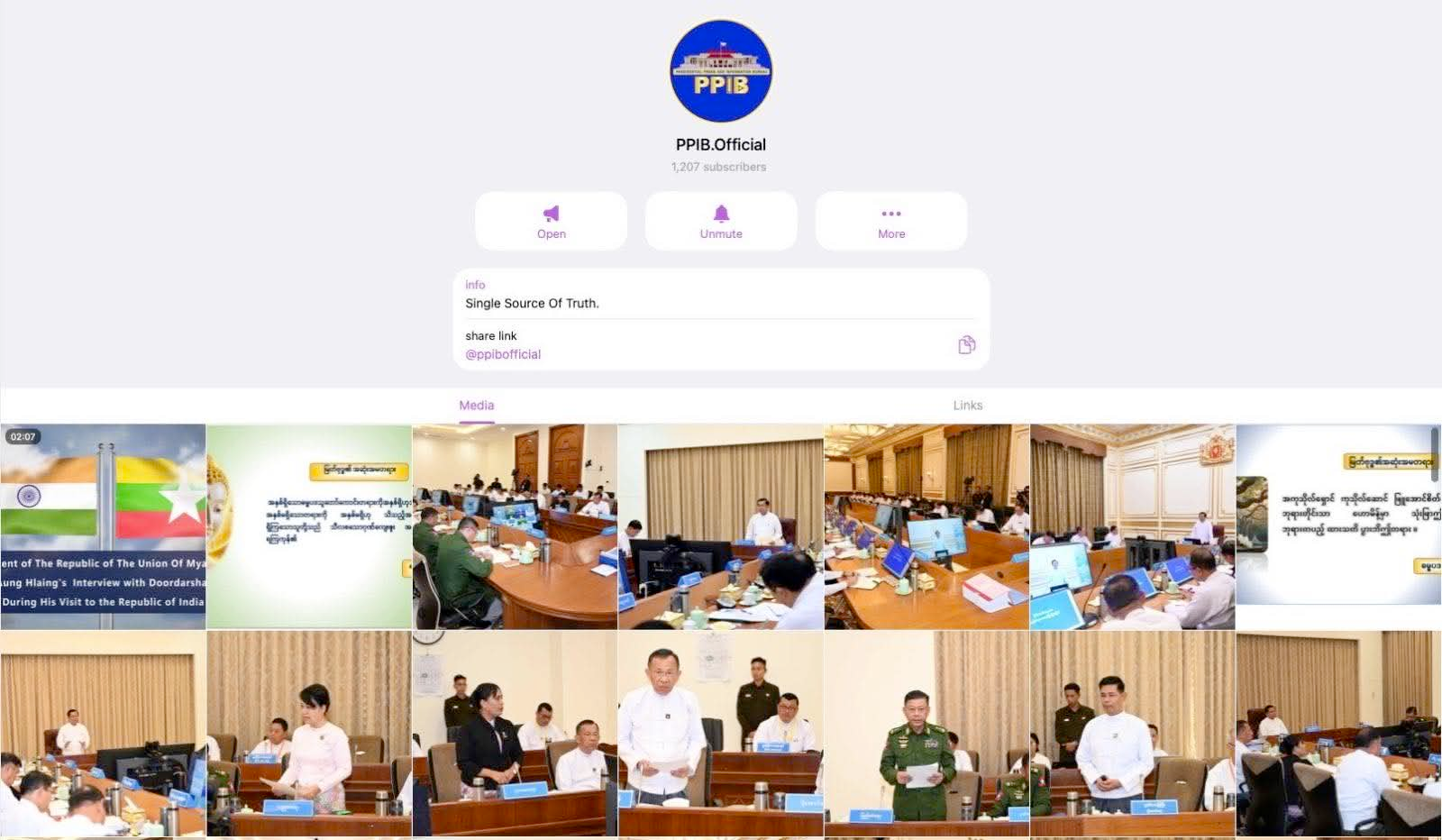
During these appearances, observers also noticed the emergence of a new information body called the Presidential Press and Information Bureau (PPIB). The name resembles institutions commonly found in countries such as India and Russia. The Min Aung Hlaing administration appears to have established this bureau as a presidential-level information organization.
Rather than relying solely on the Ministry of Information to manage government communications, the new administration has created a separate Presidential Press and Information Bureau under the presidency itself. Its apparent purpose is to function as a dedicated media outlet promoting and publicizing government activities.
To highlight the president’s activities, the bureau has launched channels on social media platforms such as Telegram and TikTok under the handle @t.me/ppibofficial. Since May 1, these channels have been publishing daily reports focused on the president’s trips, meetings, and other activities.
One recent example featured an interview between China’s ambassador and a female interviewer representing the PPIB. While no official Facebook page for the bureau has yet been observed, its content is being disseminated daily through platforms such as Telegram and TikTok, which generally do not remove military or regime propaganda content.
It is likely that military-related announcements will continue to be distributed through the Tatmadaw True News Information Team, while matters concerning President Min Aung Hlaing and the civilian government apparatus will increasingly be promoted through these newly established PPIB platforms.
The current Minister of Information under Min Aung Hlaing reportedly has little prior experience in media management or propaganda operations. Likewise, Deputy Minister U Ye Tint, who continues to serve in his post, is not known for experience in direct engagement with journalists or as a public spokesperson.
Taken together, these developments suggest a significant shift in the regime’s communications and media-relations strategy. Compared with the previous five years of direct military-rule messaging—where military generals themselves often served as public spokespersons—the new administration appears to be moving toward a model that separates presidential propaganda and public relations from the military’s own information apparatus. This can be interpreted as an effort to rebrand and institutionalize the regime’s messaging under a more civilian-looking government structure.