
Myanmar Spring Chronicle – Scenes from June 11
(MoeMaKa), June 12, 2026
Residents of Shwegu Facing Difficulties Evacuating the Town
On the night of June 8, a statement signed by the commander of Battalion No. 12, under a brigade of the Kachin Independence Army (KIA), was circulated on social media, notifying residents of Shwegu Township to leave the town and seek safety elsewhere.
According to the KIA announcement, beginning on June 8, most roads connecting to Shwegu were to be avoided. Residents were instructed to use only the Tawhlan–Lanku–Sitha–Mogaung–Sibwa route. Reports indicate that many residents are reluctant to evacuate because they are not allowed to use the main Shwegu–Ngwe Oh–Katha road, one of the town’s primary transportation links.
The two nearest towns to Shwegu are Bhamo and Katha. However, Bhamo has been largely uninhabitable due to an urban battle that has continued for more than a year and a half. Katha, meanwhile, only recently began recovering after a town-capture battle that took place four to five months ago. As a result, Shwegu residents have very limited options for relocation.
Some early reports also noted that not all residents were aware of the KIA statement, as many people do not regularly access information circulated through social media.
Even as awareness of the KIA warning has gradually spread among the public, leaving the town remains a difficult choice. According to one report, the military authorities have been meeting with teachers and parents, assuring them that there is no need for residents to flee Shwegu.
The same report quoted a member of a defense force who suggested that the military may wish to keep civilians in the town as a form of human shield. Whether or not that is the actual intention remains debatable, but residents must also consider how long they would have to remain displaced if they choose to leave.
Extended displacement lasting months or even years raises fears of losing homes, property, household belongings, businesses, and financial investments. Although people often say that nothing is more valuable than life itself, many have witnessed—either directly or through relatives and friends—how difficult it is to rebuild after towns and villages are devastated by battles. In recent years, after residents fled urban battles, numerous towns have experienced widespread looting, arson, and destruction of homes, shops, and markets.
Such acts have sometimes been committed by armed groups under military control, while in other cases they have been carried out by criminal elements known locally as “taw kyaut” (opportunistic looters), who exploit periods of instability and weakened governance. These incidents have become a recurring pattern across many parts of Myanmar following urban warfare and mass displacement.
Beyond livelihoods and survival, another major concern is the education of school-age children. The KIA warning came just over a week after the opening of the 2026–2027 academic year, placing parents in a difficult position. Many worry that fleeing conflict could disrupt their children’s education.
A similar situation occurred in Katha earlier this year during the town-capture battle. Since the fighting coincided with the end of the school year and examination period, schools in some neighborhoods continued operating and administered exams while clashes were ongoing in other parts of town.
Across Myanmar, civilians have increasingly been forced to adapt and find ways to continue living under the conditions created by ongoing civil war.
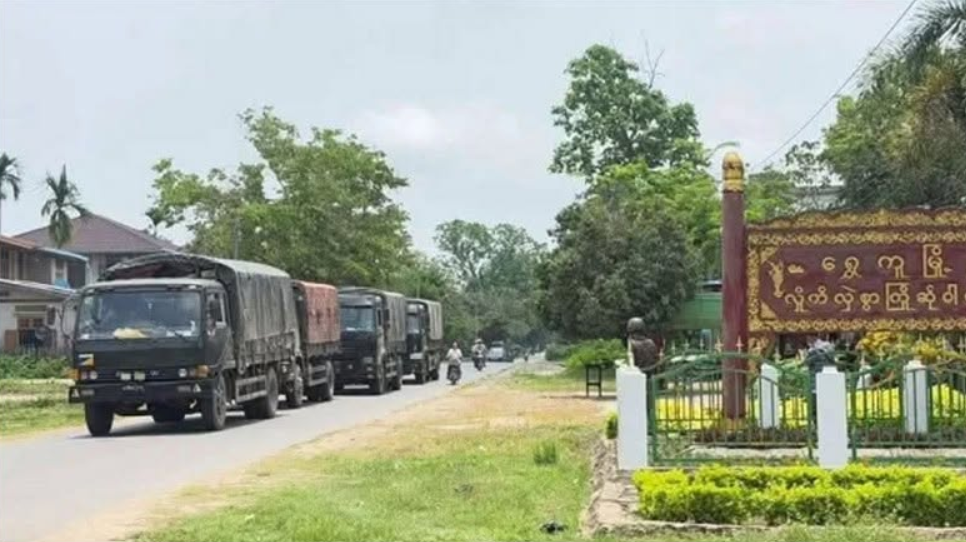
From the military’s perspective, the arrival of reinforcement troops from the Mabein area into Shwegu suggests preparations to fortify and defend the town.
The military may also intend to support operations related to the ongoing battle for Bhamo, which lies not far from Shwegu. At the same time, it appears to be reinforcing positions along the borders between Kachin State and Sagaing Region, as well as between Kachin State and northern Shan State, in preparation for defensive operations.
Given these developments, observers speculate that the situation in Shwegu—located on the western bank of the Ayeyarwady River—could undergo significant changes in the coming weeks.