
Myanmar Spring Chronicle – Scenes from June 8
(MoeMaKa), June 9, 2026
KIA Orders Residents of Shwegu to Evacuate the Town
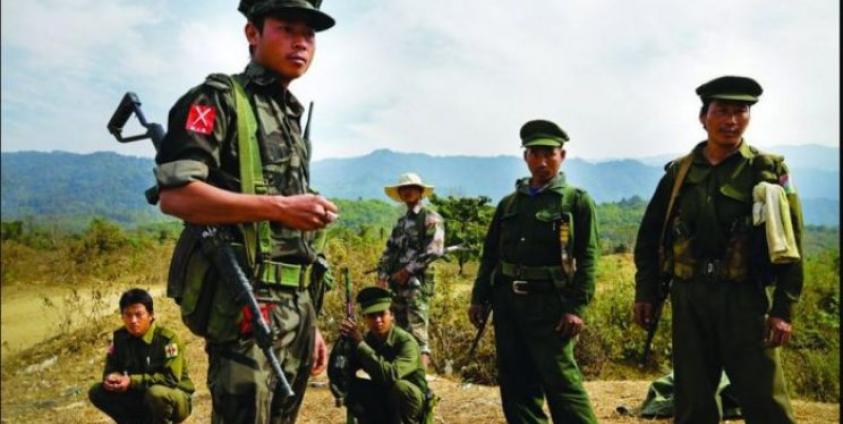
Following intense clashes in recent days between the Myanmar military and Kachin Independence Army (KIA) forces at the Paungzat Five-Way Junction near Shwegu, the KIA on June 8 issued an order instructing civilians to leave the town.
According to a statement signed by the commander of Battalion 12 under Brigade 11 of the KIA, access to Shwegu via the Shwegu entrance road and the Nga-Oe–Shwegu road has been closed. Residents have instead been instructed to evacuate using the Tawhlan–Lan Kuu–Seetha–Moekint–Seepwar route.
At present, Shwegu remains under the control of the military junta. Reports indicate that junta troops advancing from the Nga-Oe area between Mabein and Shwegu arrived in the town in recent days.
Shwegu Township is located in Bhamo District, Kachin State. According to 2019 demographic statistics, the township had a population of around 90,000 people, of whom more than 90 percent were ethnic Bamar, about 5 percent were Kachin, with the remainder belonging to other ethnic groups.
To the northwest of Shwegu lies Indaw, a town recently recaptured by junta forces after several months of fighting. To the east, further upstream along the Ayeyarwady River, is Bhamo, where KIA and junta forces have been engaged in prolonged fighting for more than a year and a half.
Over recent months, resistance forces managed to capture and control towns along the Mandalay–Mogok road and key transport routes east of the Ayeyarwady River. However, after the military later retook Tagaung, the current advance toward Shwegu appears aimed at establishing a contiguous area of control linking territory already held by the junta.
The battle for Bhamo, a larger district-level town than Shwegu, was launched by the KIA at the end of 2024. Despite sustained offensives, fierce resistance from junta forces has prevented either side from achieving complete control. As a result, much of Bhamo has been devastated by the prolonged conflict.
Approximately six months ago, shortly before the military-organized election, a joint force consisting of the KIA, People’s Defense Force (PDF), and All Burma Students’ Democratic Front (ABSDF) launched an offensive to seize Kawlin. Although they captured parts of the town, they were ultimately unable to maintain control and withdrew.
⸻
Could Urban Battles Reduce Public Support for the Revolution?
Following the 2021 military coup, resistance forces rapidly expanded their manpower and military capabilities, enabling them to launch offensives to capture towns. In Myanmar’s nearly eight decades of civil war, large-scale urban seizure campaigns have only occurred during two periods: the civil war under the AFPFL government between 1949 and 1952, and the current post-coup conflict known as the Spring Revolution.
During Operation 1027, which began on October 27, 2023, resistance forces achieved remarkable momentum, capturing military bases, battalion headquarters, and town after town. By mid-to-late 2024, the number of towns under resistance control reportedly reached between 90 and 100.
However, momentum slowed significantly after one of the Three Brotherhood Alliance members, the Myanmar National Democratic Alliance Army (MNDAA), reached a ceasefire agreement with the military junta and agreed to hand Lashio back to government administration. Since then, some previously captured towns have become bargaining chips in ceasefire negotiations and have been returned under various agreements.
From early 2025 through mid-2026, the military has launched counteroffensives and successfully recaptured several towns in Mandalay Region, northern Shan State, Sagaing Region, Chin State, and Karenni State.
Initially, local residents generally accepted the hardships associated with urban offensives and displacement. However, public criticism has increasingly emerged when resistance forces lose towns they had already captured, launch repeated offensives against the same locations, fail to achieve lasting control, or hold towns only briefly before withdrawing.
Many civilians believe that resistance forces should possess sufficient manpower, weapons, and strategic planning not only to capture towns but also to defend them from recapture. They worry that some offensives may be driven more by military maneuvering or political messaging—demonstrating that the junta cannot secure urban areas—rather than by realistic prospects of maintaining long-term control.
For civilians, every urban battle places lives, homes, livelihoods, livestock, and crops at risk. Even without major offensives, survival in war zones is already difficult. When residents are forced to flee, they often leave behind homes and possessions. Upon returning after fighting subsides, many must rebuild their lives from scratch.
While people may not object to evacuating once, repeated displacement due to recurring battles between opposing armed groups can be devastating. Entire neighborhoods, monasteries, churches, and other religious buildings may be destroyed.
Because of these realities, many civilians believe urban offensives should be launched only after careful assessment and when there is a realistic possibility of maintaining long-term control. Otherwise, repeated cycles of capture and loss could gradually erode public support for revolutionary forces.
Against this backdrop, questions are emerging among residents of the region: What does the KIA battalion commander’s evacuation order for Shwegu actually indicate? Is there a genuine plan to launch an offensive to capture the town? Or does it represent the opening of another front while the prolonged battle for Bhamo continues after nearly eighteen months of fighting?
These questions are increasingly being raised by people living in the area.