
Myanmar Spring Chronicle – Scenes from June 15
(MoeMaKa), June 16, 2026
Crimes Committed Amid Hardship and Displacement
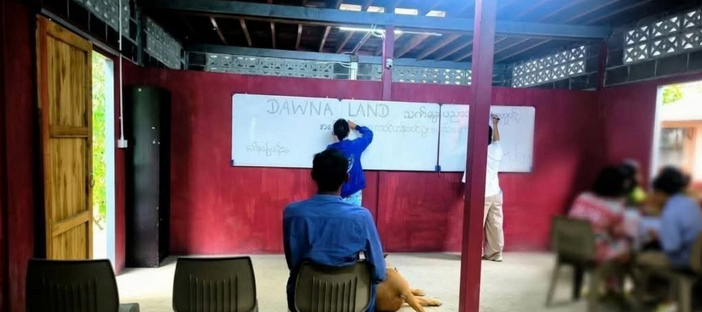
In recent days, reports have surfaced in the media and on social media alleging that the principal of Dawna Land School, a school near Mae Sot on the Thai–Myanmar border established to provide education for the children of Myanmar war-displaced families and migrant workers, sexually exploited several students.
According to news reports and social media discussions, some of the affected students initially came forward with complaints. The school’s administrative team and the school’s founder, Venerable Shwe Wara Ashin Thawara, reportedly handled the matter, but dissatisfaction remains regarding both the methods used to resolve the case and the statements made during the process.
There are now more than sixty, perhaps nearly seventy, schools and learning centers established to educate the children of Myanmar refugees and migrant workers in Thailand. For families facing language barriers, financial difficulties, and the inability to enroll their children in Thai government or private schools, these Myanmar-run schools often serve as their only educational option.
This situation is not new. Such schools and learning centers have existed since the period following 1988, when many Myanmar citizens fled to Thailand due to political circumstances and economic hardship. Following the 2021 military coup, the number of these institutions increased significantly as large numbers of people once again crossed the border seeking safety and stability.
Families fleeing armed conflict in their hometowns, political activists and politicians escaping arrest, and Civil Disobedience Movement (CDM) families often lack financial resources and legal residency documents. As a result, they have little choice but to depend on these schools for their children’s education.
Against this backdrop, reports of sexual exploitation linked to educational institutions have become increasingly troubling. Last year, for example, a teacher from Thway Thit School in Mae Sot, U Zaw Nyein Latt, was arrested by Mae Sot police following allegations of sexual abuse involving students at the school.
The current case represents another complaint of a similar nature, involving allegations that a school principal sexually abused students. Sexual exploitation and abuse occurring in a place such as a school is particularly disturbing. Community-run schools are entrusted by migrant workers and displaced families with the hope of providing a better future for their children. When such institutions become places where acts occur that can leave lifelong psychological scars, they betray that trust and contaminate something fundamentally valuable and sacred.
Furthermore, for displaced persons and migrant workers who lack legal status and financial means, alternative educational opportunities are often out of reach. When abuses repeatedly occur in the very schools upon which they depend, it amounts to further victimization of those who are already among the most vulnerable. It is akin to striking those who have already fallen or exploiting those who are already drowning.
Because these crimes target the children of people with limited resources, social connections, and institutional protection, they are not merely cases of sexual abuse. They are also examples of exploitation of power against individuals who are least able to defend themselves or seek justice.
Throughout the Spring Revolution period, as the rule of law has weakened, reports of sexual abuse and exploitation have emerged from various places. It is deeply regrettable that, because the focus remains on military and political struggles during this transitional period, issues such as sexual violence and exploitation are often not treated with the urgency they deserve in terms of prevention, accountability, and response.
The victims in these cases often belong to the most disadvantaged segments of society—people already struggling with immense hardship. Those who hold authority, influence, and decision-making power therefore bear a responsibility to ensure that such incidents do not recur. Even though these communities are located in a neighboring country, those who manage schools, learning centers, refugee camps, and community organizations within the Myanmar diaspora must establish strong policies, effective monitoring mechanisms, and prompt disciplinary procedures. Equally important, they must refrain from protecting perpetrators simply because they share political beliefs, organizational affiliations, or personal relationships.
Parents entrust schools with their children’s future because they view education as a place of hope and opportunity. If crimes of this nature continue to occur, parents may become reluctant to send their children to school at all, which would have consequences that resemble the destruction of those children’s future prospects.
For this reason, it is time for those responsible for managing and overseeing educational institutions to implement and strictly enforce clear safeguarding policies. Doing so is essential not only to prevent future abuses but also to protect the reputation and integrity of schools that were established with genuinely noble intentions.