
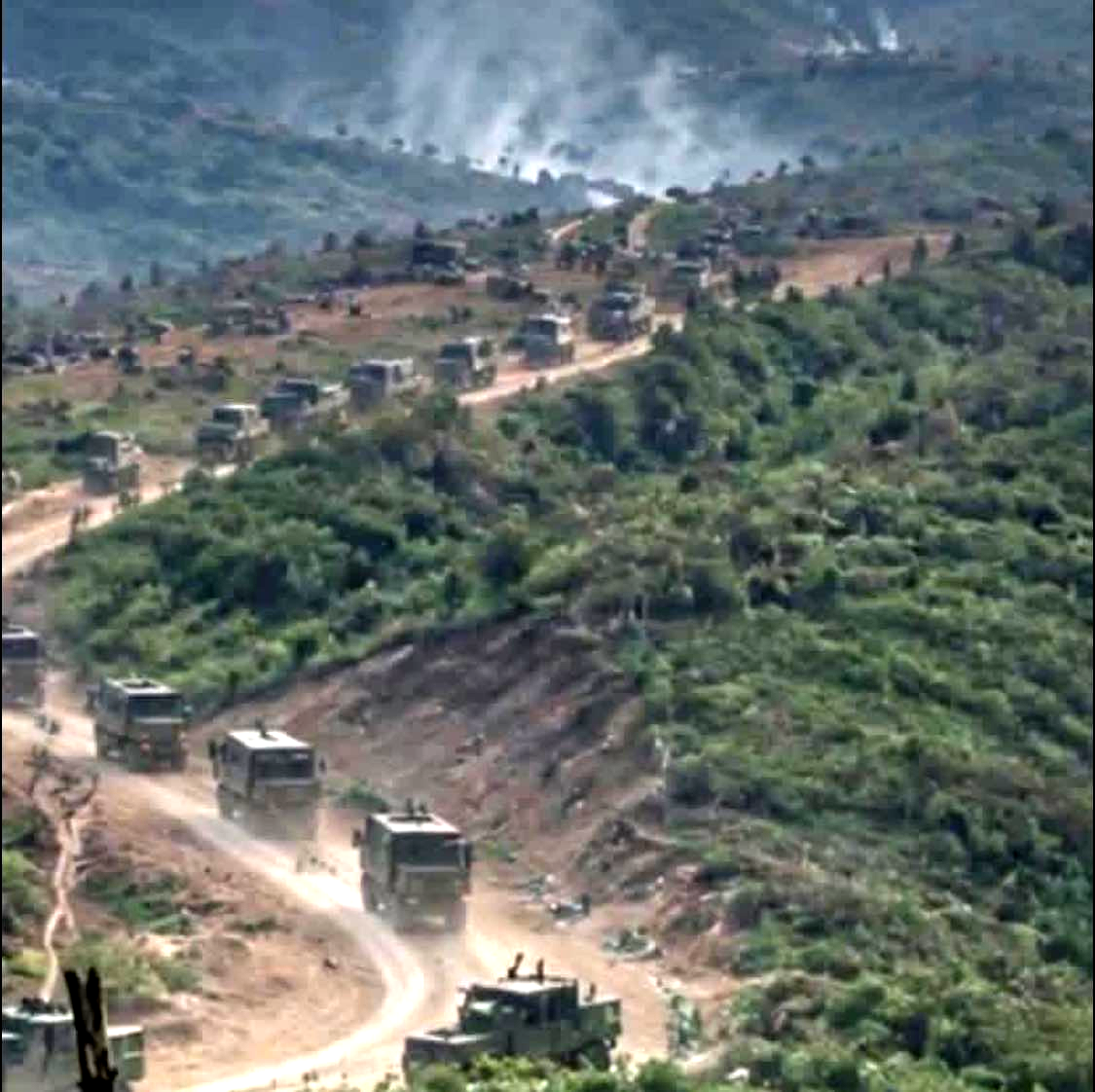
Myanmar Spring Chronicle – Scenes from May 23
(MoeMaKa), May 24, 2026
The Objectives Behind the Junta’s Chin State Offensive Involving Thousands of Troops
Both before and after the elections held at the end of last year, the offensives launched by Myanmar’s coup military have visibly shifted westward in recent months and weeks, moving from northeastern Myanmar and the country’s central regions toward the western front.
During the middle and latter part of last year, the junta attempted offensives to retake towns in northern Shan State, in northeastern Myanmar. While it managed to recapture some towns militarily, it also regained control of two towns through ceasefire agreements.
More than the military gains themselves, the ceasefire agreements appeared to provide crucial breathing room for the junta. In particular, ceasefire arrangements with the Kokang armed group and the Ta’ang armed group in northern Shan State allowed the military regime to consolidate forces more effectively in central and northern Myanmar.
Whether due to pressure from China or other factors, the junta’s ability to secure ceasefire agreements with the two northern Shan-based ethnic armed organizations enabled it to redirect greater attention toward Myanmar’s central and northern regions.
The MDY-PDF, which had achieved military success during the Mandalay–Shan operations, also began facing challenges after its allied TNLA forces entered into a ceasefire with the junta. Difficulties emerged in maintaining control over captured territory, while disagreements surfaced among senior leadership figures. Some leaders were detained, and the group subsequently faced a series of military setbacks.
After losing many towns along the Mandalay–Mogok road east of the Ayeyarwady River, the junta began organizing military columns from Kalay in Sagaing Region to launch offensives toward Falam in Chin State. After attempting to seize Falam, military movements later appeared to shift toward Yaw and Saw areas bordering southern Chin State.
Recent military movements suggest that the junta may be preparing to retake northern Chin towns and Indian border trade stations, while also attempting to penetrate northern Rakhine State through southern Chin State.
Yesterday, DVB News reported comments from an official of the Chin National Front (CNF), stating that the junta had deployed no fewer than 6,000 troops for offensives into Chin State.
According to the CNF spokesperson, around 3,000 troops are advancing from Kalay toward northern Chin State, while another roughly 3,000 troops — including local forces — are moving from Yaw and Saw toward southern Chin State. Combined, the junta is believed to be launching simultaneous offensives into both northern and southern Chin State with at least 6,000 personnel.
Unlike Kachin State or Rakhine State, Chin State does not possess major natural resources or substantial border trade tax revenues. Its mountainous geography and limited road access create serious operational challenges for the military. Nevertheless, after regaining a certain level of control in central Myanmar, the junta now appears to be attempting to penetrate Chin State and neighboring Rakhine State from the north.
Supported by air power, widespread drone usage, and large numbers of newly recruited conscripts — gathered through both rotational service and forced recruitment under the military conscription law — the junta’s current military strategy appears to have achieved a degree of effectiveness in recent months.
The junta’s military columns moving from Yaw and Saw areas in Magway Region are reportedly heading toward Kanpetlet in southern Chin State, with speculation that the campaign may later extend toward northern Rakhine State.
At present, the military is already engaged in defensive battles in Kyaukphyu and Sittwe in Rakhine State, while also fighting prolonged defensive operations in Laymyethna and Yekyi in Ayeyarwady Region, as well as in Oaktwin in Bago Region and Nat Yekan in Magway Region.
Because of this, some analysts believe the junta may be seeking to pressure the Arakan Army (AA) by opening another front through southern Chin State into northern Rakhine.
The AA itself has spent years engaged in offensive and defensive warfare across Ayeyarwady, western Bago, and Magway regions. The junta may therefore intend not only to stabilize existing battlefronts but also to create additional pressure on the AA by launching operations into northern Rakhine State.
As junta offensives move deeper into southern Chin State, Chin resistance forces are expected to coordinate defensive operations together with AA troops currently operating alongside the Chin Brotherhood alliance in southern Chin State.
How the revolutionary armed organizations will respond to the junta’s offensives toward northern and southern Chin State — particularly under heavy air support — and what strategies they will use to blunt or break the momentum of the offensive, remains a situation to watch closely.