
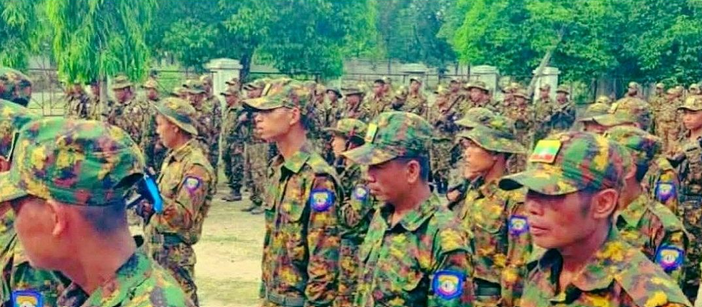
Myanmar Spring Chronicle – Scenes from May 16
(MoeMaKa), May 17, 2026
The Junta’s Strategy to Cut Off Chin and Rakhine States Is Gradually Becoming Clear
If we examine the military developments unfolding over recent weeks and months, it becomes evident that the Myanmar military junta has managed to fully regain control of the road linking central Myanmar’s Mandalay Region with Kachin State. At the same time, operating from central Myanmar, the junta has been attempting to reassert control over territories, transportation routes, and strategically important towns in Chin State and Rakhine State in the country’s western region — and has achieved some successes.
For example, in Chin State, the junta recently managed to retake Falam, the second-largest town after Hakha and an important transportation junction, from Chin resistance forces. Likewise, the military also regained control of Kennedy Peak along the Kalay–Tiddim road, the main route ascending from Kalay town into the Chin hills.
For nearly the past two years, the junta had been unable to launch major offensives or reclaim territory in the Chin hills. But now, it has begun retaking and reestablishing control over certain areas. There may be several reasons behind its ability to resume military operations and offensives in Chin State. One major factor is that the junta has moved beyond the phase where it was forced into intense defensive fighting in Mandalay, Sagaing, and northern Shan regions. In some areas, it is now able to conduct offensives and deploy mobile clearing operations, which has become a key condition enabling renewed offensives toward western Myanmar’s Chin State.
Although the junta has not yet been able to retake territory in Kachin State, it is no longer continuously losing ground there. The fact that it has regained control of some towns along the Sagaing–Kachin border indicates that the junta has gained a stronger position in Sagaing Region, which serves as a buffer zone for the Kachin Independence Army (KIA), compared to previous years.
The junta’s recent movements in areas bordering Mandalay Region, Sagaing Region, and Kachin State, as well as in Gangaw, Yaw, and Saw townships in Magway Region adjacent to Chin State, increasingly suggest an attempt to block and control the supply routes passing through Magway into southern Chin State.
In recent weeks, the junta has reportedly occupied several key junctions along the supply route through Mindat, Matupi, and Paletwa into Rakhine State, through which food supplies and consumer goods are transported. Reports indicate that the military deployed hundreds of troops to occupy Kan Gyi village on the Pakokku–Mindat road, causing all cargo transport vehicles traveling through Mindat toward Rakhine State to halt operations.
Kan Gyi village lies along the border between Magway Region and Chin State, and this also suggests that local People’s Defense Forces (PDFs) operating in the area may not currently be in a position strong enough to resist junta troops effectively.
Areas such as Mindat and Matupi are controlled by the Chin Brotherhood (CB) alliance, which is allied with the Arakan Army (AA). However, it remains unclear for now whether the junta will continue launching offensives deeper into southern Chin State.
At present, the junta is also fighting AA forces in Nat Yekan in Magway Region, Pantanaw Township in Bago Region, and Yekyi Township in Ayeyarwady Region. Inside Rakhine State, clashes continue near Sittwe as well as in places like Kyaukphyu and Manaung. On these fronts, the junta has not been winning but is instead engaged in intense defensive battles.
Under such circumstances, the junta has also begun attempting to cut off supplies headed into Rakhine State, including food, consumer goods, fuel, and other essential materials.
How revolutionary armed groups will respond to the junta’s blockade strategy is something that will likely become clearer in the coming months. Chin State, with its mountainous terrain and dependence on a single main road network, and its relatively sparse population and limited natural-resource tax revenues compared to other parts of Myanmar, is probably not an area the junta intends to fully control in its entirety.
However, southern Chin State borders Rakhine State, where the Arakan Army controls significant territory with substantial military strength. Therefore, it is likely that the junta’s strategy involves launching limited offensives and attempting to control parts of southern Chin State in order to isolate and cut off the AA.
The key question to watch will be how ethnic armed organizations, local People’s Defense Forces, and NUG-affiliated PDF forces coordinate and respond to the junta’s offensives and blockade efforts targeting Chin and Rakhine States.