
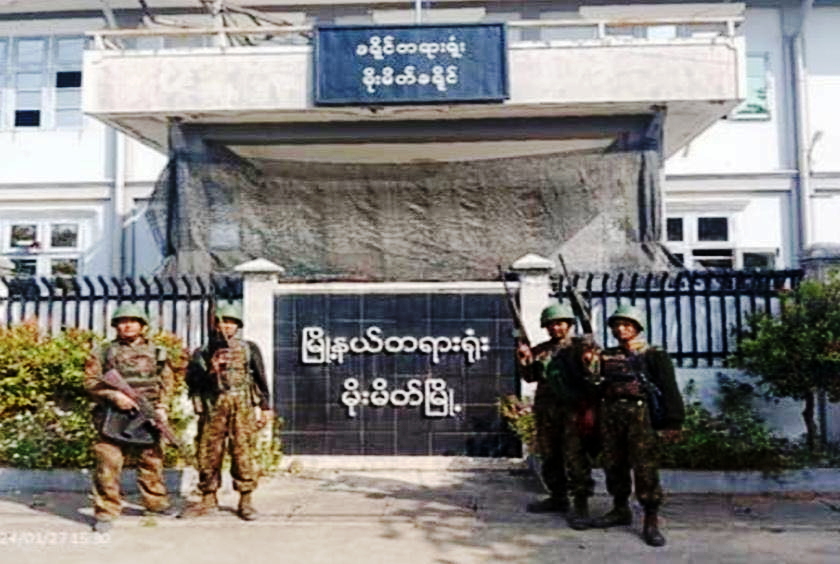
Myanmar Spring Chronicle – Scenes from May 2
(MoeMaKa), May 3, 2026
Myanmar’s Political and Military Situation and Strategy
The period from June 2024 to the end of 2024—marking the second phase of Operation 1027—can be regarded as the time when revolutionary armed groups reached their peak, both in terms of territorial control and their ability to launch offensives against the military junta.
It was the period of greatest military success, and a time when the morale of commanders and soldiers on the junta’s side had significantly deteriorated.
In northern Shan State and Rakhine State, hundreds to thousands of junta troops surrendered. Even officers as high-ranking as brigadier generals were among those who capitulated. Revolutionary forces were able to apply sustained pressure with full manpower and weaponry. At the same time, there were no significant internal conflicts among revolutionary armed groups—no major disagreements, clashes of interest, or disputes over territorial control. For these reasons, it can be described as the peak period of nationwide military and political success.
However, from that point onward, ceasefire agreements between opposing sides, arrangements to return certain captured towns, and disputes among allied forces over territorial control, taxation rights, and recruitment began to emerge.
On the junta’s side, since late 2024, it has become evident that they reassessed the weaknesses exposed during Operation 1027 and began trying to rapidly adapt—particularly in areas such as combat tactics and drone technology.
At this point, China’s role must also be considered. About two to three months after the second phase of Operation 1027 began, in August, China’s Foreign Minister visited Naypyidaw. Later that same month, China’s Special Envoy for Myanmar met with the United Wa State Party/Army and outlined China’s policies toward ethnic armed groups operating along the China-Myanmar border. By the end of 2024 and early January 2025, a ceasefire agreement was reached between the MNDAA and the junta.
In light of these developments, some observers believe China’s influence over Myanmar’s military and political situation is very strong, while others acknowledge its influence but emphasize that the positions and interests of ethnic armed organizations themselves must also be taken into account. In other words, it is important not to attribute everything solely to China’s influence while overlooking the agency and policies of the groups involved.
Setting aside China’s role for the moment, the key issue now is how revolutionary armed groups—having passed their peak of military success—can regain a similar high point, or at least prevent further losses from the current situation. This requires urgent preparation and strategic adjustment.
As mentioned earlier, the junta has clearly been making various adjustments since the peak period of Operation 1027 to better adapt to changing conditions.
In 2025, the junta managed to retake several key towns in northern Shan State. In Taung Kham, after prolonged fighting, they gradually advanced northeast in early 2025, capturing Nawnghkio, Kyaukme, and Hsipaw. Then, in October 2025, following a ceasefire with the TNLA, they regained control of Mogok and Momeik.
The recovery of Mogok and Momeik—and the ceasefire with the TNLA—created a situation in which the MDY-PDF, which had been fighting alongside the TNLA, became more isolated. The junta capitalized on this opportunity and attempted to retake the road corridor connecting Mandalay Region (east of the Ayeyarwady River) with northern Shan State.
Gradual control over the Mandalay–Mogok road east of the river represents a major strategic loss for revolutionary forces, as it is a key logistical and communication route.
This corridor is crucial for east-west movement: from northern Shan to Sagaing Region, then through Yaw and Gangaw to Chin State, and further west toward northern Rakhine State.
By April 2026, the junta had recaptured towns along the Mandalay–Mogok road, including Madaya, Thabeikkyin, Singu, and Tagaung.
After that, they began implementing strategies to cut off routes linking western regions (Chin and Rakhine) with central and southern Myanmar. There are clear signs of attempts to block supply routes from southern Chin State into Rakhine. In recent days, junta forces have taken control of Kankyi village along the road to Mindat. Similarly, after months of offensives, they recently recaptured Falam in Chin State.
In lower Sagaing Region—particularly in areas such as Pale and Yinmabin—offensive operations have intensified following the surrender of Bo Nagar. Sagaing Region itself is a central corridor linking eastern and western Myanmar.
Over the past year, the junta has not regained territory in Rakhine State. In Chin State, however, they have managed to retake some road sections, and unlike in 2024, revolutionary forces are no longer in a position to threaten lowland gateway areas such as Kale.
The junta is now clearly attempting to consolidate control over central Myanmar by securing road networks connecting to the western regions and by gaining control over routes linking northern Kachin State with central Myanmar. If the junta succeeds in strengthening control over central Myanmar, it could weaken military coordination between the northern, northeastern, and western fronts. This is an important strategic risk that needs to be carefully considered.