
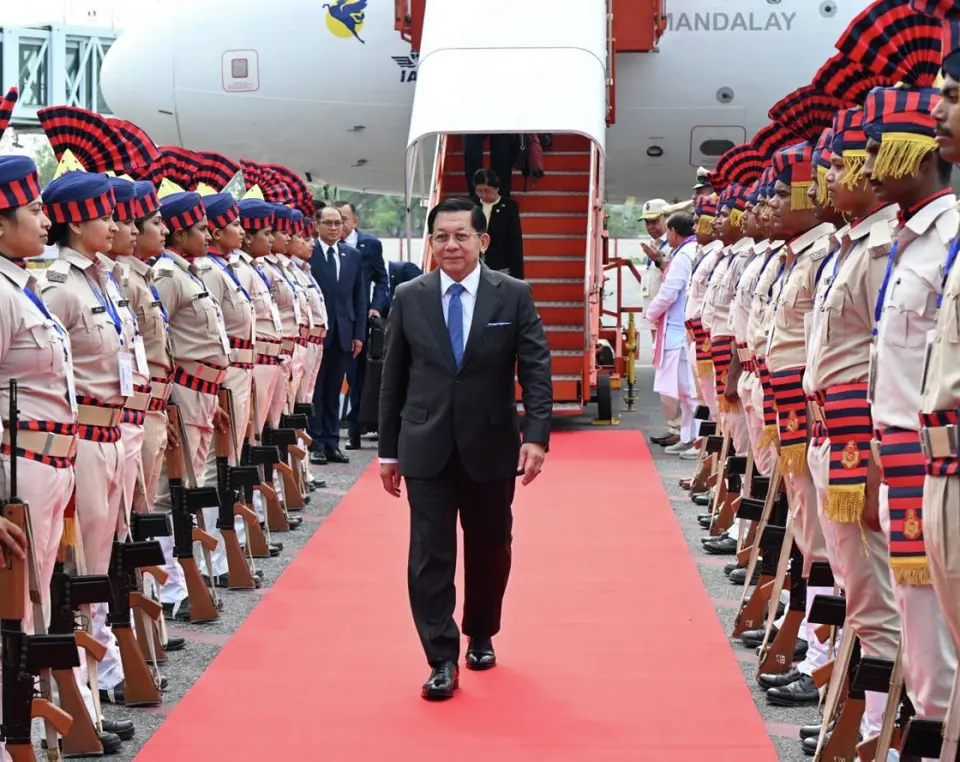
Myanmar Spring Chronicle – Scenes from May 30
(MoeMaKa), May 31, 2026
Myanmar Military Leader’s Visit to India
After Myanmar’s military seized power in February 2021, the country’s military leader was eventually invited to make an official visit to India only after holding an election, changing into civilian attire, and assuming the presidency. On May 30, he departed Naypyidaw for Gaya Airport in India.
During the five years in which he served as military commander after the coup, India had not extended such an official invitation. The fact that the invitation came only after an election had been held and he had assumed a civilian role raises questions about its significance. One interpretation is that India has decided to elevate Myanmar–India relations to a new level following the political transition. Another possibility is that changing geopolitical circumstances in Myanmar have prompted India to seek a more pragmatic relationship.
Since the February 2021 coup, democratic India has neither formally recognized nor completely isolated Myanmar’s military government. Instead, New Delhi maintained engagement, including military-to-military contacts.
Following the 1988 pro-democracy uprising and subsequent military takeover in Myanmar, the government of then-Indian Prime Minister Rajiv Gandhi openly supported Myanmar’s opposition forces. During that period, India’s All India Radio also broadcast programs critical of Myanmar’s military regime.
The situation after the 2021 coup has been different from that of the post-1988 era. Rather than severing ties with Myanmar’s military rulers, India adopted a policy of continued engagement and cooperation, including providing certain forms of assistance.
The current visit by Myanmar leader Min Aung Hlaing comes roughly four to five months after the election and less than two months after the formation of the new government. As the Indian government has officially invited him in his capacity as president, it is likely that Myanmar’s leader views the gesture with appreciation. India also reportedly assisted with voting machines for the election held late last year and, more recently, facilitated the dispatch of specialist doctors when Min Aung Hlaing underwent spinal surgery. These developments suggest a considerable degree of trust between India and Myanmar’s military leadership.
Although India is a democratic country, its approach toward neighboring and regional states tends to prioritize national interests over promoting democratic governance. Issues such as border stability, regional strategic balance, and cooperation from Myanmar in dealing with insurgent groups operating in India’s northeastern states appear to carry greater weight than questions of whether Myanmar is governed by a democratically elected administration.
In other words, India’s policy is often driven more by security concerns than by support for a particular political system.
Along the India–Myanmar border, particularly in Chin State adjacent to Mizoram, the central government in New Delhi has not exerted major pressure on the Mizoram state government regarding Chin resistance forces. Owing to close ethnic and linguistic ties, Mizoram authorities have provided humanitarian assistance, refuge, and educational opportunities to Chin civilians displaced by conflict. Conditions differ somewhat in the areas bordering Manipur State and the Tamu-Kabaw region of Sagaing Region.
During this official visit, discussions are expected to focus on strengthening bilateral relations, expanding trade and financial cooperation, and enhancing defense and military-technical collaboration.
The trip is expected to last five days, and reports indicate that Myanmar’s leader will meet both the President and Prime Minister of India. Another likely topic is the Kaladan Multi-Modal Transit Transport Project, which is intended to provide India’s northeastern states with access to the Bay of Bengal through Myanmar.
The Kaladan project, launched in 2010, is designed to connect Mizoram State with the port of Sittwe via the Kaladan River. While major port facilities at Sittwe have already been completed, additional work remains, including dredging the river to accommodate 300-ton vessels and constructing road links between Paletwa and the Indian border. Implementation has also been delayed by intense fighting in recent years between Myanmar’s military and the Arakan Army (AA), which now controls much of the Kaladan river basin region.
Although India maintained contacts with Myanmar’s military authorities throughout the past five years, this official invitation following the transition to a civilian-led government could be interpreted diplomatically as a form of fuller endorsement. As a result, greater cooperation between the two countries may become more visible in the near future.
For ethnic armed organizations and resistance groups operating along the India–Myanmar border, the evolving direction of Indian government policy is something that will require close and careful observation.
Compose.