
Myanmar Spring Chronicle – Scenes from May 20
(MoeMaKa), May 21, 2026
Malaysian Foreign Minister’s Visit to Naypyidaw
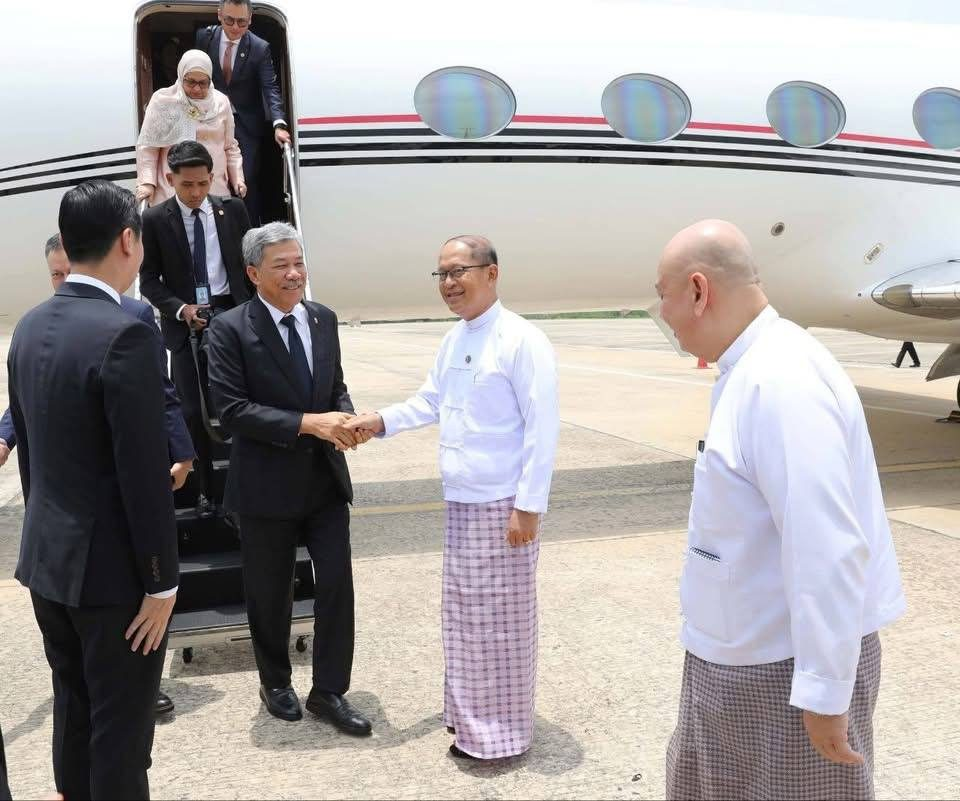
Following the recent ASEAN leaders’ summit held in Cebu, Philippines — a meeting that Myanmar Foreign Minister U Tin Maung Swe was not allowed to attend — Malaysian Foreign Minister Datuk Seri Mohamad Hasan paid a one-day visit to Naypyidaw to meet him.
The Malaysian foreign minister arrived in Naypyidaw on the afternoon of May 19 and held discussions with members of Myanmar’s newly formed government, including the foreign minister, before departing again the same day.
Upon returning from the trip, the Malaysian foreign minister briefed the media at the airport, stating that the visit should not be viewed merely as a bilateral trip between Malaysia and Myanmar, but rather as a mission undertaken in his capacity as the foreign minister of an ASEAN member state representing ASEAN.
The visit is understood to have been aimed at seeking solutions to Myanmar’s ongoing internal crisis — including the civil war, armed conflicts, political deadlock, and the continued failure to implement ASEAN’s Five-Point Consensus proposed in 2021.
According to Malaysian media reports, the Malaysian foreign minister stated that ASEAN foreign ministers had been tasked with engaging Myanmar’s foreign minister and assessing the situation in Myanmar in order to help ASEAN formulate a new approach toward the country.
This reporting makes clear that the trip was intended as an ASEAN-representative mission.
On the Myanmar government side, however, the visit was framed simply as a bilateral meeting between the foreign ministers of Myanmar and Malaysia, where they discussed strengthening cooperation in bilateral relations and ASEAN-related matters in an open and friendly manner.
During the visit, the Malaysian foreign minister may have attempted to raise the issue of Daw Aung San Suu Kyi’s release. However, it appears that the Myanmar side avoided substantive discussion on the matter and merely stated that she was in good health, according to some news reports.
Although ASEAN has not explicitly recognized Myanmar’s new government formed after the election, it appears to maintain the position that engagement is necessary in order to resolve Myanmar’s crisis. This stance likely explains the Malaysian foreign minister’s visit.
Reports also indicate that the Malaysian foreign minister urged Myanmar’s military leader — now serving as president — to extend the announced 100-day ceasefire for at least another six months.
Malaysia appears to be pursuing a dual-track engagement strategy by meeting both the Myanmar government formed with military backing and Myanmar opposition groups, with the apparent objective of finding solutions to the country’s armed conflicts.
This is not the first time ASEAN has pursued such an approach. In previous years, foreign ministers from countries serving as ASEAN chair — including Indonesia and Malaysia — have undertaken similar engagement efforts.
If one asks why this renewed engagement is happening now, it is likely because ASEAN wants to assess whether the new government that emerged after last year’s election — an election not formally recognized by many countries — has any new approaches or willingness to resolve the ongoing civil war.
At the ASEAN summit held in the Philippines earlier this month, no Myanmar political leaders were invited. Following remarks made by the Philippine president, who currently serves as ASEAN chair, Myanmar’s foreign ministry issued a statement accusing ASEAN of discriminatory treatment.
Myanmar’s foreign ministry further alleged that ASEAN was violating the bloc’s foundational principles by interfering in the internal affairs of a member state through criticism, commentary, and pressure.
The statement also noted that although ASEAN has yet to reach a common position regarding Myanmar, Myanmar continues to engage individually with ASEAN member states.
This wording appears to suggest that some ASEAN member states maintain relatively softer positions toward Myanmar’s military leadership.
Taken together, these developments suggest that ASEAN may be attempting to ease Senior General Min Aung Hlaing’s dissatisfaction and increasingly distant relations with ASEAN following the bloc’s refusal to recognize the new government formed after the 2025 election. From this perspective, the Malaysian foreign minister’s visit can be seen as part of ASEAN’s effort to soften tensions and re-engage Myanmar’s leadership.