
Myanmar Spring Chronicle – Scenes from May 19
(MoeMaKa), May 20, 2026
Junta Retakes Mawtaung and Tonzang; Defections and Surrenders Reported from Resistance Armed Groups
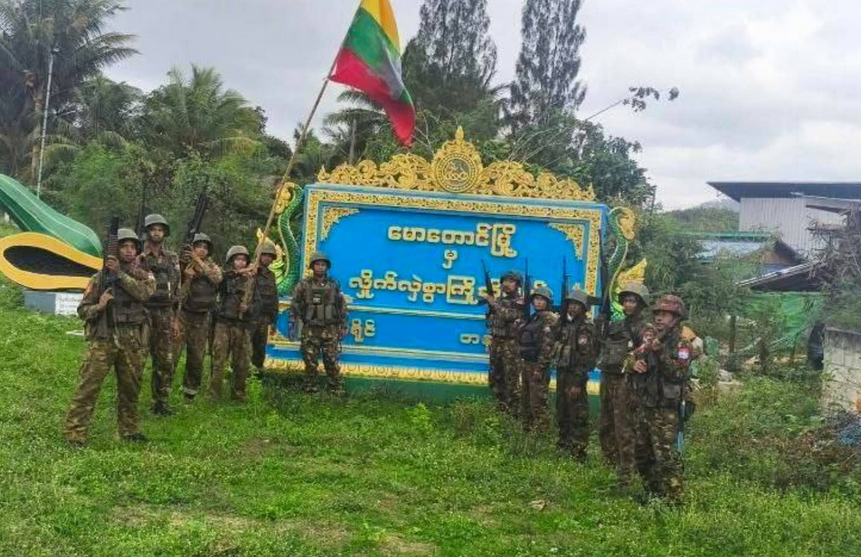
Myanmar’s military junta announced on May 19 that it had retaken Mawtaung, a Thai border trade town in Tanintharyi Region that had been seized around six months earlier by KNU/KNLA forces. According to the junta’s statement, the offensive to recapture Mawtaung began on May 5, and after two weeks of fighting, the entire town was brought back under military control on May 19.
In reality, the military had lost Mawtaung in mid-November and had already been launching operations to retake the border town since around mid-December 2025.
Mawtaung is located on the Myeik–Tanintharyi–Thai border route in Tanintharyi Region. The road distance from Myeik through Tanintharyi and Theinkhun to Mawtaung is about 123 miles. Across the border lies Thailand’s Singkhon checkpoint, which is only about 75 miles from Bangkok. Because of this strategic location, Mawtaung serves as one of the closest export routes for seafood products from Myeik to Thailand.
Although Tanintharyi Region — where KNLA Brigade 4 is based — has generally seen fewer offensives and clashes compared to Karen State or Bago Region, local media reported that after the battle for Mawtaung, junta forces launched a large-scale counteroffensive using significant troop strength, drones, and heavy artillery, forcing KNLA forces to withdraw from the town.
More than a year after the 1988 military coup, the then-military regime (SLORC/NORC) captured the Mawtaung border post from the KNU/KNLA and later established it as a town, eventually transforming it into a border trade station.
In Tanintharyi Region, the main Thai border trade points include Htee Khee checkpoint connected from Dawei, Mawtaung border checkpoint, and the southernmost Kawthaung maritime trade checkpoint.
One major reason behind the junta’s effort to retake Mawtaung may have been to cut off tax revenue routes that KNU/KNLA forces could obtain through border trade.
By late 2025, the junta had fully restored administrative and military control over Myawaddy. In recent months, it also reopened and secured the Kawkareik–Myawaddy Asian Highway. In addition, the military has retaken some border territories such as Lay Kay Kaw and has been conducting offensives to recover strategic bases along the border that it had lost in previous years. Fighting and military operations have also continued sporadically along the southern border areas near Myawaddy.
On the same day the junta retook Mawtaung, reports also emerged that the military had recaptured Tonzang in northern Chin State, which had been under the control of Chin resistance forces. Tonzang had been seized by Chinland Council joint forces since May 2024, but two years later the junta regained control of the town.
Before retaking Tonzang, junta forces had spent months launching offensives to recapture Falam, the second-largest town in Chin State. After securing Falam, the military continued its offensive toward Tonzang and eventually captured it. Reports also stated that the Zomi Revolutionary Army (ZRA), a local defense force, fought alongside junta troops during the operation to retake Tonzang.
After Operation 1027 began, the military had been forced to fight on multiple fronts simultaneously, allowing Chin resistance forces to capture numerous towns and gain control over key access roads into Chin State. However, following ceasefire agreements in 2025 with two members of the Brotherhood Alliance — the MNDAA and TNLA — the junta has increasingly attempted to retake territories it had previously lost, including some towns in Chin State.
Another notable issue today concerns defections and surrenders from resistance armed groups. Resistance organizations have increasingly begun publicly announcing the names, hometowns, and photos of members who deserted or surrendered to the junta. At the same time, the military has also intensified propaganda reports claiming that surrendered resistance fighters were “returned to their parents.”
Over the past six months alone, the military’s Central Regional Command based in Mandalay reportedly held three surrender ceremonies. Two of them involved more than 500 people each, while the third reportedly involved more than 300 individuals.
Although the numbers released by the junta are difficult to verify and likely exaggerated, it is clear that some members of resistance armed groups have indeed defected or surrendered. After the first and second surrender ceremonies, several resistance groups based in Upper Mandalay Region released statements identifying former members who had defected and surrendered, accusing them of later contacting former comrades to persuade them to surrender as well. These announcements often included names, fathers’ names, and photographs.
The fact that some resistance groups have issued “deserter” announcements following junta surrender ceremonies suggests that at least some level of attrition exists within the resistance forces.
There may be many reasons behind these defections: internal discrimination or dissatisfaction within organizations, tensions between commanders and rank-and-file members, insufficient funding, or the reality that the revolution has lasted much longer than many initially expected.
Resistance armed groups may now need to seriously reassess these issues and make necessary reforms in order to prevent further losses of manpower through defections and surrenders to the junta.