Myanmar Spring Chronicle – Scenes from April 11
(MoeMaKa), April 12, 2026
What can the SCEF actually achieve?
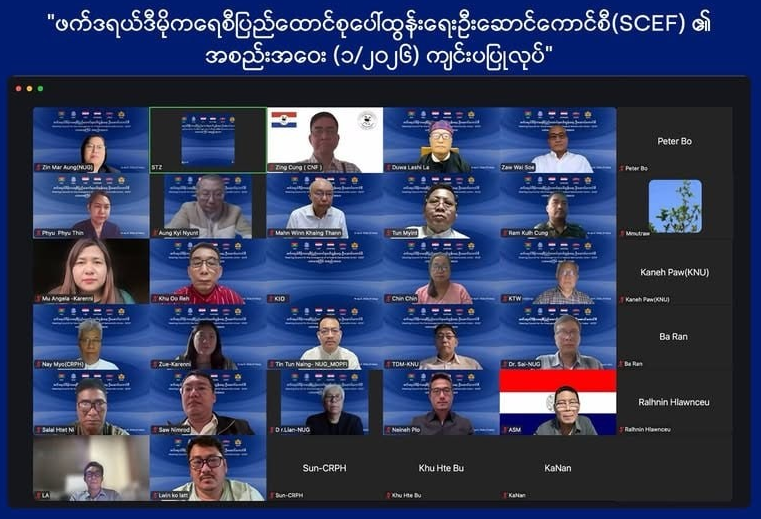
An organization named the State Coordination for the Emergence of a Federal Democratic Union (SCEF)—comprising ethnic armed organizations and interim state/federal units—was officially announced on March 30.
It is said to have been formed during the revolutionary period, prior to the implementation of transitional arrangements, and will be structured based on three pillars:
1. Representatives of states/federal units/EROs
2. Representatives of the public
3. Representatives of women
However, although it is described as being based on these three pillars, at present only the first pillar—four ethnic armed organizations—and the second pillar—the CRPH (Committee Representing the Pyidaungsu Hluttaw), said to represent the जनता—are participating. The women’s representation pillar has not yet been included.
At a press conference on April 11, SCEF leaders explained that criteria for participation have been set, but these still appear to be quite general. They also stated that efforts will continue to recruit more members.
There are more than a dozen ethnic revolutionary armed groups in existence, and some of the most powerful ones are unlikely to join SCEF due to geopolitical considerations or their own independent objectives. For example, there are no clear signs that groups such as the Arakan Army (AA), UWSA, MNDAA, or TNLA intend to participate.
The Arakan Army likely has its own distinct goals and is aligned instead with alliances like the Northern Alliance and the FPNCC. Meanwhile, the UWSA, which has maintained de facto autonomy for nearly three decades along with foreign relations, prioritizes avoiding direct conflict with the central government and maintaining stable relations with China—making participation in SCEF unlikely.
This raises the question: why create SCEF when a body like the NUCC (National Unity Consultative Council), formed shortly after the 2021 Spring Revolution began, already exists?
Looking at the composition of NUCC, it can be seen as structurally similar to SCEF. NUCC includes civil society organizations and general strike committees, which played a significant role in the early, urban phase of the Spring Revolution.
However, after five years, as the armed resistance has become the primary strategy, the role of general strike committees and civil society organizations may be seen as less central. This shift could explain why the NUG, CRPH, and some ethnic armed groups may no longer wish to rely on NUCC. In fact, within the past year, some ethnic armed groups now participating in SCEF had already announced a suspension of their participation in NUCC.
Given these developments, SCEF can be interpreted as a body intended to replace NUCC.
SCEF states that its main objective is to coordinate military and political activities and to provide leadership and direction for achieving the الثورة’s success.
The key question now is: how much impact can SCEF actually have on the armed struggle to completely dismantle the military dictatorship?
After the peak of Operation 1027’s military successes in mid to late 2024, changes in China’s strategic approach toward Myanmar have occurred, and some ethnic armed groups in the northeast have already signed ceasefire agreements with the military regime.
Within SCEF, the group often referred to as the “K3C”—comprising the KIA, KNLA, KA, and CNF, along with NUG-aligned PDF forces—now faces an important question: how will they adjust and sustain military momentum under this new framework?