
Myanmar Spring Chronicle – Scenes from April 17
(MoeMaKa), April 18, 2026
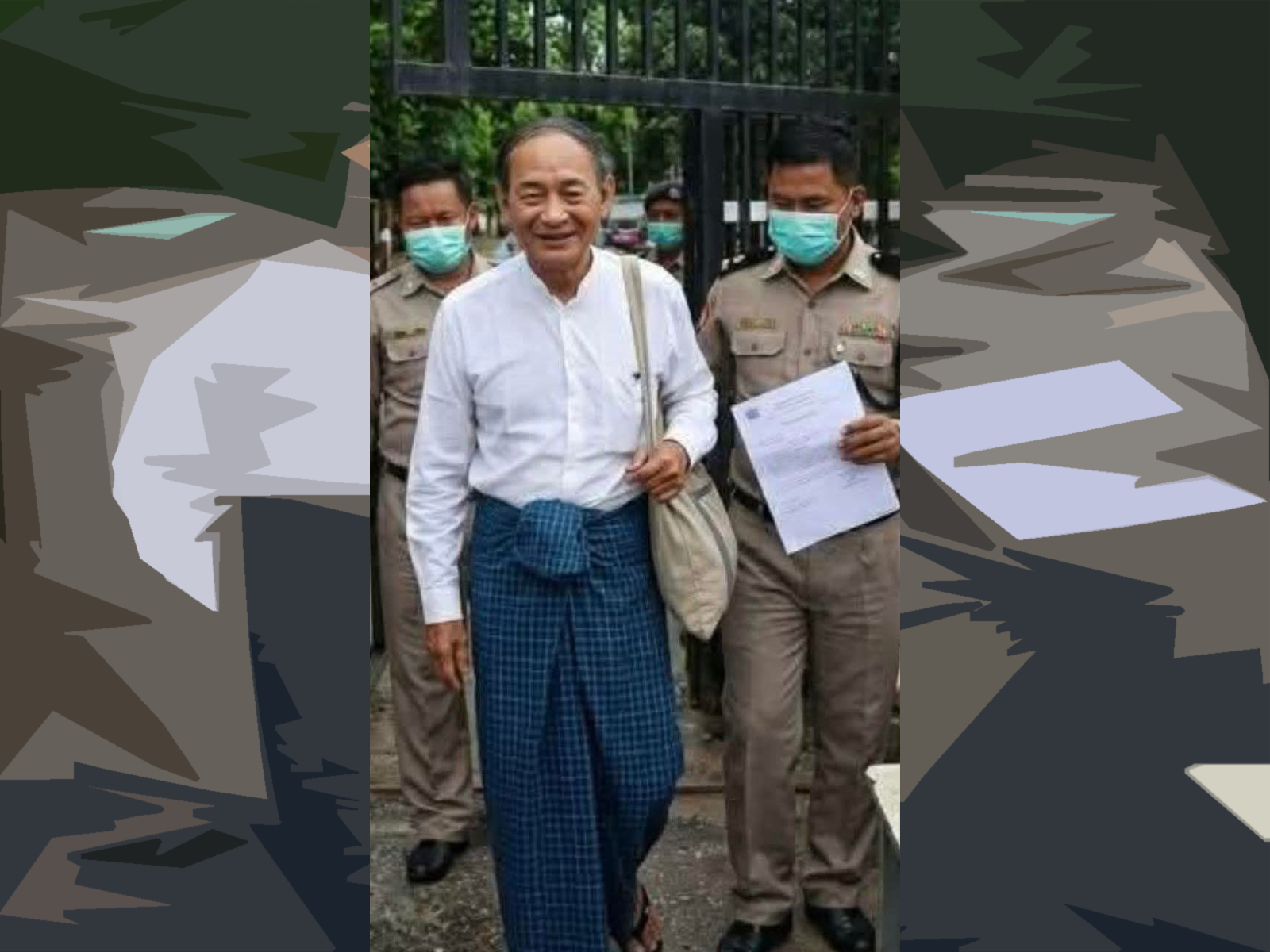
President U Win Myint was released on Myanmar New Year’s Day
Myanmar media outlets based abroad refer to him as President U Win Myint, while the coup military neither uses the term former president nor, even as a matter of basic courtesy, addresses him as U. Instead, in its separate announcement granting amnesty on the first day of the New Year, it referred to him in the manner used for prisoners, as Win Myint, son of …, and issued a separate statement specifically for President U Win Myint alone.
International media, on the other hand, have been using descriptions such as “the ousted president” and “former president U Win Myint.” There are also differing usages and recognitions, such as the National Unity Government (NUG) continuing to designate U Win Myint as president, and the United Nations continuing to list him officially as president.
However, in practical terms and in the actual situation on the ground, questions remain as to whether U Win Myint himself accepts or agrees with his continued designation as president by the NUG. As a politician who has just been released from prison while still under the control of the coup military, it can be assumed that it would be difficult for him to immediately clarify or answer such questions at this moment.
Since amnesties are customarily announced every year on April 17, the first day of the Myanmar New Year, many had already expected that an amnesty announcement would also come this year. In addition, this year’s New Year amnesty came after the 2025/26 election had been completed and a government had been formed, at a time when coup leader Min Aung Hlaing appeared intent on taking full state power and assuming the title of president. For that reason, many speculated that this year’s amnesty might be more unusual than in previous years, as a way for him to display confidence and present it as an achievement now that he had become the president he wanted to be.
Following the 2010 election, the former military government released Daw Aung San Suu Kyi, who had been under house arrest for nearly seven years, just a few days later. Then, after U Thein Sein’s government was formed in 2011, political prisoners were released in successive waves. Based on those precedents, many had assumed that after the parliament approved the president and cabinet in April 2026, political prisoners would be released either as a sign of political confidence or as part of an effort to persuade foreign governments diplomatically. At that point, there had also been discussion over how far such releases might go, and whether Daw Aung San Suu Kyi, who still enjoys the support of the majority of the public, would also be released.
In the end, however, Daw Aung San Suu Kyi was not released; only former president U Win Myint was released on April 17. U Win Myint, who had been imprisoned in Taungoo Prison, was taken out of prison on April 17 and released under Section 401, subsection (1) of the Code of Criminal Procedure, with the condition that if he were to commit another offense, he would have to serve not only that punishment but also the remainder of the sentence still outstanding against him.
The fact that U Win Myint alone was released, while Daw Aung San Suu Kyi—the chair of the NLD and State Counsellor from 2016 to 2020, who had appeared alongside him in court and was sentenced in the same judicial process—was not, suggests that coup leader Min Aung Hlaing was not in a position where he dared release her. There had also been reports that Daw Aung San Suu Kyi would be transferred to house arrest on New Year’s Day, but although April 17 has now passed, no evidence has been found that she was transferred to house arrest at any residence.
Min Aung Hlaing’s decision to release U Win Myint may also be an attempt to show that the regime is getting closer to restoring a so-called normal situation in which opposition in above-ground domestic politics can be managed. At the same time, it may also be understood as part of an effort to re-engage diplomatically with the international community.
Another perspective is that releasing U Win Myint may be an experiment aimed at shifting the balance in the domestic political landscape and in the position of the armed revolutionary forces. What kind of stance will U Win Myint take toward the NUG and the CRPH? Although he may not be someone who can make final decisions in the same way as Daw Aung San Suu Kyi, he still carries more influence within the party than the NLD leaders currently leading the NUG and CRPH. Because of that, some speculate that U Win Myint’s views could shake up the underground political landscape.
It is also possible that, as a first step, the authorities released U Win Myint in order to observe the resulting impacts and the changes in the political situation, and then, at a later stage, reassess and decide whether or not to release Daw Aung San Suu Kyi as well.
To be frank, the NUG and CRPH arrangements were not something the NLD had foreseen in the days before the military coup, nor were they structures created through prior consultation and division of responsibilities. For that reason, it is almost certain that the NUG and CRPH will now be paying especially close attention to U Win Myint’s comments and positions following his release.