
Myanmar Spring Chronicle – Scenes from April 10
(MoeMaKa), April 11, 2026
When a military leader’s ambition to become president is fulfilled—this is the nation’s fate
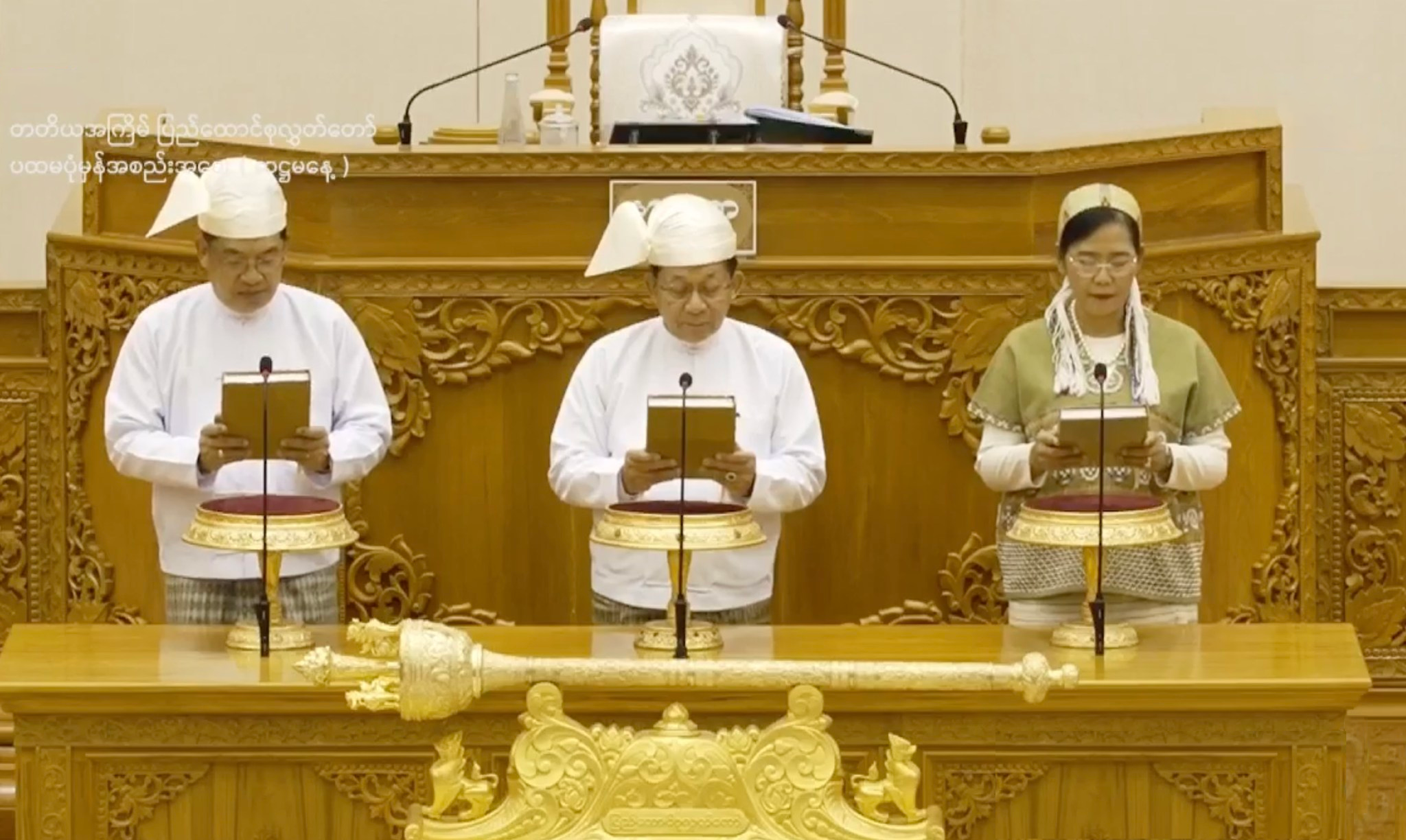
After holding onto the position of Commander-in-Chief for 15 years, and after seizing political power by alleging fraud in the 2020 election, the military leader has now, more than five years and two months after the coup, formally taken the position of President by taking the oath inside the parliamentary hall.
Looking back at the country more than five years after the coup, tens of thousands have lost their lives in the civil war, and tens of thousands more have been injured. Hundreds of thousands of homes have been burned down. Food supplies and agricultural crops have been destroyed by fires or left unharvested, leaving large numbers of farmers, agricultural workers, and livestock breeders without livelihoods.
Beyond those directly killed in the war, it is estimated that thousands more have died due to poverty, food shortages, and lack of access to healthcare.
In order to sustain the civil war, the country’s natural resources—gold mining, gemstone extraction, mineral exploitation, and excessive logging—have led to the destruction of river systems and widespread damage to farmland. Environmental impacts, including water resource degradation and climate-related changes, have become increasingly visible even to ordinary civilians.
Hundreds of thousands of schoolchildren lack access to education and vaccinations.
Under such conditions, the 2025/26 election was engineered—laws were amended and restrictions placed on other political parties and politicians—to ensure a desired outcome. The USDP was made to win by a landslide, and everything was systematically arranged so that military leader Min Aung Hlaing would be selected as president. As a result, today (April 10), he has assumed the title of “elected president” (in name).
It would not be wrong to say that the 2021 coup was decided by Min Aung Hlaing based on the relationship between the military and the NLD government during its 2015–2020 term, including his relationship with Daw Aung San Suu Kyi.
However, from 2021 to 2026, over more than five years, Min Aung Hlaing likely did not foresee the situation he would face. It is believed that during the transition on February 1, when parliament was to convene with elected representatives, he aimed to arrest President U Win Myint and other NLD leaders, ministers, and regional chief ministers simultaneously, annul the election results, and hold a new election tailored to ensure a USDP victory.
What he actually encountered was armed resistance and one of the most intense civil wars in nearly 70–80 years.
In an attempt to win this war, the military has burned villages, carried out arbitrary arrests and killings, and committed mass killings of civilians suspected of supporting People’s Defense Forces (PDF) across the country. While such atrocities—killings, village burnings, sexual violence, looting, and destruction of civilian property—had occurred during decades of conflict with ethnic armed groups, central regions predominantly inhabited by the Bamar majority had not previously experienced such warfare. Since 2021, however, these central regions have become some of the most brutal battlegrounds, with widespread destruction and mass casualties.
No one can deny that all these events stem from the military coup.
And if we ask why the coup happened, the fundamental reason is the military’s refusal to accept a situation in which it would have to completely relinquish power in Myanmar.
For decades, civil war has persisted due to the lack of self-determination and autonomy in ethnic regions. This ongoing conflict has also allowed the military to maintain a position of greater importance than civilian politicians.
On April 10, domestic media pages were filled with coverage of the oath-taking ceremony of the President and two Vice Presidents, speeches, announcements forming executive, legislative, and judicial bodies, and official notifications.
Soe Win, who served as Deputy Commander-in-Chief throughout Min Aung Hlaing’s tenure, has been appointed chairman of the Union Advisory Council, effectively removing him from both the government and the military and sidelining him from daily administration.
Min Aung Hlaing, who did not relinquish his military post until the day before the oath-taking ceremony, has now formally stepped down as Commander-in-Chief upon assuming the presidency. However, there is little doubt that he will continue to control the military through his close subordinate, the newly appointed commander.
The Union Advisory Council chaired by Soe Win includes former 88 Generation student leader and People’s Party chairman Ko Ko Gyi, as well as Daw Cho Cho Kyaw Nyein, daughter of AFPFL-era political leader U Kyaw Nyein. After the 2021 coup, figures such as Mann Nyein Maung, U Thein Nyunt, and U Khin Maung Swe were included in the SAC for a time; currently, only Mann Nyein Maung remains.
The Union Advisory Council appears to be more of a symbolic body for appearances rather than one with real authority in day-to-day governance.
In reality, the country will continue to be run by the military-backed USDP, led by former generals, and active-duty military leaders. Under such circumstances, it is difficult to conclude that the country’s trajectory will improve in the near future.