
Maung Lu Hmwe – Racing Against the Cicadas
MoeMaKa, April 4, 2026
“Teacher, have you abandoned our little village?”
A message like that came from a teacher in charge of a school for displaced children.
Maung Lu Hmwe replied that he was currently traveling for summer-related work and would come when the school term began. He also sent a link where he had been posting reading materials online, encouraging the teachers to spend the summer reading.
The teacher who wrote to him is someone deeply committed to her role and passionate about education. But because of the constant threat of airstrikes, the proximity to front-line areas, and the lack of sufficient support from parents and relevant stakeholders, the school has had to close repeatedly. As a result, her educational goals for the year have been shattered.
In many villages across revolutionary areas, every academic year brings a host of worries. How to prevent the number of teachers from declining, how to recruit more teachers, how to keep children from dropping out, how to deal with school buildings and finances—these concerns are endless.
“Teacher, our little school has collapsed,”
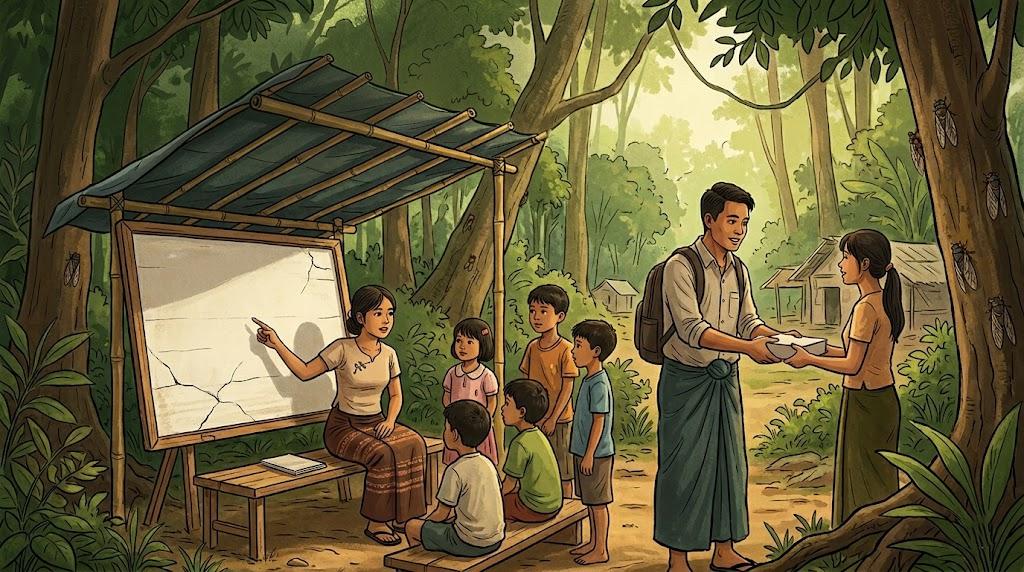
The voice from a phone call after last month’s storm still echoes in Maung Lu Hmwe’s mind. The school had not been particularly strong to begin with, so how could it withstand a real storm? Not only did the building collapse, but the whiteboards were shattered and broken in half.
The three young teachers running that small school are only around twenty years old. If they stop teaching, the children in that remote forest area will fall into chaos, and their parents will surely suffer deeply. In such a situation—where even going to a displacement area to teach is difficult, and where people are too afraid to even stay overnight because of its proximity to the frontlines—how could Maung Lu Hmwe and others possibly find fully trained, certified teachers?
Another concern is a displaced-persons’ school that Maung Lu Hmwe has supported throughout the year. With no resources of its own, the camp survives only on donations from others. If people like Maung Lu Hmwe do not help, the education there will quickly fall into disarray. When a school collapses into dysfunction, it means the future of its children is being destroyed. Even as he tries to encourage them for the coming academic year, he remains deeply worried.
Now, as he writes this at midnight, the sound of cicadas fills the place where he is staying. Their cries are so loud and piercing that people call them “heart-splitting cicadas.” Maung Lu Hmwe finds himself thinking—perhaps if they, too, had as many companions as these cicadas, raising their voices together for education, their voices would also grow louder.
Tomorrow, he must go back into the forest. In the height of summer, he will travel to difficult areas to share knowledge with teachers there. To help them teach effectively, to help them learn, to ensure that the next generation does not grow up without education, and to encourage collective support for education—Maung Lu Hmwe and Mrs. Hmwe will spend the entire summer competing in voice with the cicadas of the forest.