
Myanmar Spring Chronicle – Scenes from April 9
(MoeMaKa), April 10, 2026
KIA Deputy Commander-in-Chief Gun Maw’s Trip to Northern Shan State
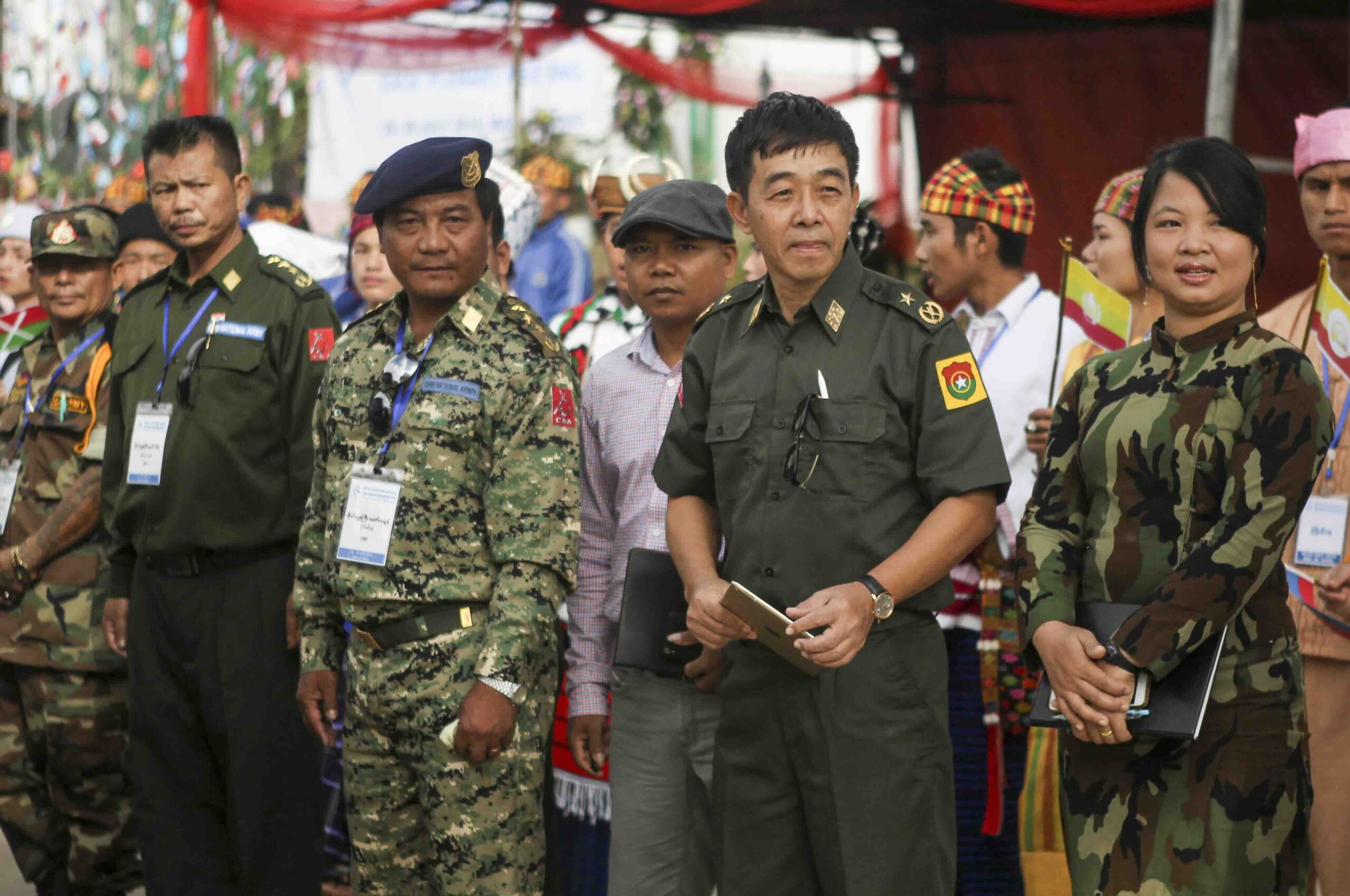
Lieutenant General Gun Maw, the military and political leader of the Kachin Independence Army (KIA)—an ethnic armed organization active in northeastern and northern Myanmar—along with the KIO/KIA Minister of Home Affairs, recently traveled to areas in northern Shan State bordering Kachin State, including Namkham, Namphatka, and the Kaungkha area near Kutkai. During the trip, they also met with leaders of Shan, Kokang, and Ta’ang ethnic armed organizations operating in these regions.
This visit can be considered somewhat unusual. The Kutkai area in northern Shan State had been designated as the “Kachin Sub-state” since the British colonial administrative period, and even after independence it continued to be officially recognized as such by the Shan State government. This Kachin Sub-state was located in the northern part of the Theinni (Hseni) region, with Kutkai as its central town. However, this designation was reportedly abolished by the BSPP government in the 1970s.
Thus, Gun Maw’s visit can be seen as a return to a historically Kachin-majority sub-state area. The term “Kachin Sub-state” itself has now become largely unfamiliar in contemporary usage.
Before the launch of Operation 1027 on October 27, 2023, there were already some tensions among ethnic armed groups in northern Shan State regarding territorial control. However, issues related to historical claims, population distribution, natural resource extraction, and recruitment were not at the forefront. What unified most groups was their shared objective of fighting the common enemy—the military junta—which served as a strong basis for cohesion. The success of Operation 1027 was built on this shared interest.
However, the rapid success of Operation 1027 has brought new challenges. Control over territory, administrative authority, access to natural resources, and taxation rights have become sources of division and potential conflict among allied forces.
While ethnic armed groups were united against the junta, there had been little incentive for territorial disputes in adjacent areas. But as military victories accumulated, the lack of clear political agreements on how to share governance and administration between groups has emerged as a key underlying issue.
Another factor is the lack of clearly articulated political visions and policies among some ethnic armed organizations. While many broadly claim to support federalism and democracy, in practice, when it comes to territorial control, some groups assert exclusive authority based on military conquest. This reflects a military-first mindset without a strong political foundation. Some observers describe this as “warlordism”—where power is based primarily on military strength, with weaker emphasis on political organization, public engagement, and coexistence among ethnic communities.
Northern Shan State is historically a multi-ethnic region. Rather than relying on ancient history, it is important to consider more recent historical developments over the past 100–150 years, including demographic changes and patterns of settlement.
Equally important are the views and aspirations of local populations who have lived in these areas for decades or even over a century. Their perspectives should be taken into account.
Over the past year, there have been conflicts between two or three ethnic armed groups in northern Shan State. Initially, tensions between KIO/KIA and PSLF/TNLA arose over issues such as passing through checkpoints and establishing local administrative offices, leading to repeated clashes between lower-level troops. TNLA also restricted KIA activities in Kutkai, including the raising of flags and the presence of personnel, at times using force to remove them. Although these incidents occurred at the rank-and-file level, they reflect deeper disagreements in leadership and policy between the two organizations.
About a year later, tensions also emerged between TNLA and MNDAA. What began as sporadic lower-level disputes escalated in mid-March, when MNDAA launched attacks on Kutkai and other TNLA-controlled areas, detaining some personnel and confiscating weapons. The use of small arms, drones, and heavy weapons in these clashes underscored the seriousness of inter-ethnic armed group tensions in northern Shan State.
In this context, Gun Maw’s visit may be aimed at seeking solutions through dialogue and negotiation rather than conflict. Reports indicate that he met with local communities and encouraged peaceful coexistence. In reality, the conflicts are not between civilians, but rather stem from friction among armed groups over governance, taxation, and recruitment.
Ultimately, meaningful negotiations must take place among the armed organizations controlling these areas. Civilians generally lack the ability to express their views independently of these groups, making inter-group relations critically important.
Ethnic armed organizations must also recognize that national liberation and democratic governance are inseparable and deeply interconnected.