
Myanmar Spring Chronicle – Scenes from March 31
(MoeMaKa), April 1, 2026
Myawaddy–Kawkareik Asia Highway to Reopen; Military Regains Control of Areas Near Htee Khee
According to reports citing official directives, the military junta is planning to reopen the Myawaddy–Kawkareik section of the Asia Highway on April 2, after it had been closed since December 2023. The Kawkareik–Myawaddy road, which crosses the Dawna mountain range, had been shut for over two years due to fighting between the junta forces and joint KNU/KNLA and PDF troops in late 2023.
During the closure, border trade and the transport of essential goods to Myawaddy Township relied on alternative routes that bypassed the Asia Highway, including the old Dawna mountain road, Hto Kaw Koe road, Kyat Oo Taung road, and Route 1018.
In 2023, as KNU/KNLA and PDF joint forces intensified their offensives, they destroyed several bridges along the key Thailand–Myanmar trade corridor to prevent reinforcements from easily reaching junta troops, effectively rendering the Asia Highway unusable.
With the highway blocked for military reasons, trade, goods transportation, and travel were forced to rely mainly on the old Dawna road and Hto Kaw Koe route. Along these routes, various armed groups established checkpoints and collected taxes for road maintenance and organizational funding.
Many of these bypass routes—particularly Hto Kaw Koe, Kyat Oo Taung, and Route 1018—are unpaved and became muddy and difficult during the rainy season. Combined with high transportation costs and taxes imposed by armed groups, this led to increased prices of goods in Myawaddy and disruptions to Thailand–Myanmar trade.
In 2025, the junta, with assistance from some Karen armed groups, managed to retake certain military outposts and battalion bases in Myawaddy Township that it had previously lost, and began efforts to regain control of the Asia Highway.
After losing control of the Asia Highway in late 2023, much of the tax revenue from Thailand–Myanmar border trade reportedly flowed to Karen armed groups and some PDFs controlling the routes. In response, the junta attempted to cut or reduce this income by closing Friendship Bridge No. 2 between Myawaddy and Mae Sot, and by blocking and seizing Thai goods entering through Kawkareik and Kyone Doe at Hpa-An in Karen State. These actions significantly reduced border trade volume and led to shortages and sharp price increases of Thai goods inside Myanmar over the past year.
The junta’s efforts to block revolutionary groups from collecting taxes and to reduce foreign currency outflows, along with its recent territorial gains and regained control over Myawaddy’s security, appear to have led to the decision to reopen the Asia Highway.
It remains unclear whether Thailand–Myanmar border trade will fully normalize or whether Friendship Bridge No. 2 will reopen. However, given the junta’s relatively good relations with both the Thai military and government, the move may be intended to project an image of returning stability.
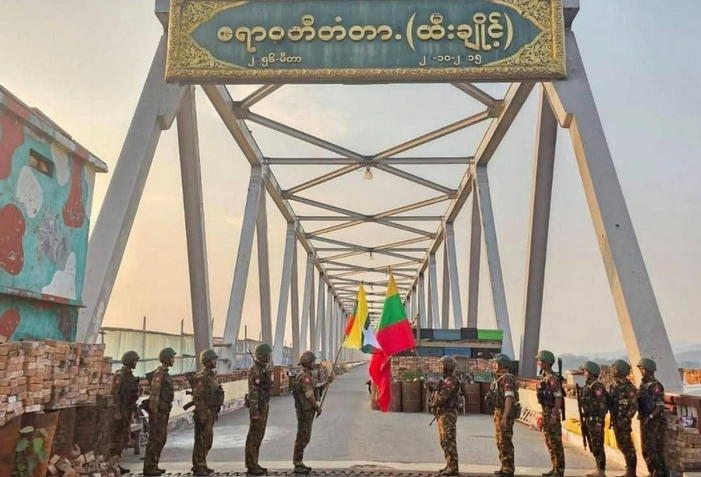
While preparations are underway to reopen the Myawaddy–Kawkareik Asia Highway in southern Karen State, reports also indicate that in northern Myanmar, the junta has recently regained control of Htee Khee town in Sagaing Region via the Htee Khee bridge.
Htee Khee, administratively part of Sagaing Region, borders Mandalay Region and northern Shan State. In late 2023, resistance forces launched offensives and attempted to capture the town. However, they were unable to fully control it, resulting in a prolonged stalemate lasting over two years.
In recent months, after the junta recaptured a سلسلة of towns along the Mandalay–Mogok road on the eastern bank of the Ayeyarwady River, it advanced further north and eventually reached and took control of Htee Khee.
Following the capture, reports have emerged that junta forces are reinforcing troops toward the Kathar area, where a town-seizure battle took place in late December.
Some analysts suggest that internal divisions within Mandalay PDF forces under the NUG—including disagreements and the detention of certain leaders—as well as the TNLA (which had been cooperating with MDY PDF) entering into a ceasefire with the junta, contributed to the loss of gold-rich territories along the upper Ayeyarwady River in Mandalay Region.
At a recent Kachin revolutionary event, KIA Deputy Commander-in-Chief Lt-Gen Gun Maw stated that Kathar, Kawlin, and Kanbalu in Sagaing Region serve as gateways to Kachin State and must be closely monitored and defended.
Although revolutionary armed groups operating in these areas are under the NUG Ministry of Defense, their lack of independent supply routes for weapons, ammunition, and military experience may be a significant कमजություն.
While the junta remains stalled militarily in Rakhine State and border areas of Magway and Bago Regions, it has shifted from defensive to offensive operations in parts of Mandalay Region, Karen State, Karenni State, and Sagaing Region—something resistance forces need to take seriously.