
Myanmar Spring Chronicle – Scenes from March 22
(MoeMaKa), March 23, 2026
TNLA and MNDAA Reach Ceasefire Agreement
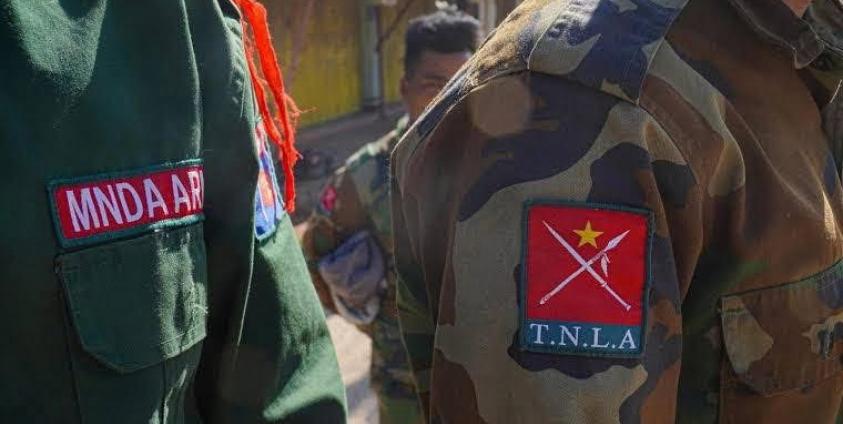
On the morning of March 14, the Kokang armed group MNDAA launched simultaneous attacks on positions held by the Ta’ang National Liberation Army (TNLA) in and around Kutkai. MNDAA subsequently took control of Kutkai, raising speculation that it might continue offensives toward Namhpatka and Namkham. Amid these concerns, leaders of the two allied groups met in Laukkai and, on the second day of talks, agreed to a ceasefire.
Discussions began on March 17, and by the evening of March 18, both sides had agreed to halt hostilities. According to some reports, they continued negotiations the following day to finalize additional agreements and formally signed the deal.
A TNLA spokesperson told media that both sides agreed to place Kutkai under MNDAA administration, to exchange detained personnel and seized weapons, and to continue maintaining their alliance.
Prior to this incident, tensions had already surfaced. On February 13, TNLA forces removed CCTV cameras installed by MNDAA in Kutkai and reportedly engaged in physical altercations with some MNDAA members. This escalated into the March 14 surprise offensive by MNDAA, which seized control of Kutkai and appeared aimed at preventing TNLA from establishing bases or security checkpoints along the Lashio–Muse road. On the same day, MNDAA also detained TNLA personnel near the 105-Mile Kyin San Kyawt checkpoint outside Muse and confiscated weapons. In the following days, MNDAA reopened the route from Lashio to the 105-Mile area for travel.
In the days leading up to the attack, reports had already emerged that Kokang forces were advancing toward Kutkai from multiple directions within the Kokang Self-Administered Zone. However, TNLA did not appear to anticipate a large-scale assault. When the attack began on March 14, there was little evidence of strong resistance. Within two days, TNLA had lost control of Kutkai, and reports indicated a withdrawal toward Namkham and Namtu. Sources also noted that TNLA commanders had not ordered counteroffensives beyond defensive responses.
There were also speculations that MNDAA might extend its offensive toward Namkham, a town along the Shweli River bordering China, as MNDAA troops were observed moving along routes in that direction.
Given that Kutkai fell within just two to three days, it suggests that MNDAA had planned and executed a coordinated offensive to capture targeted areas.
Why did two allied forces that fought together in Operation 1027 end up clashing like enemies?
Some observers believe the conflict was influenced by China’s behind-the-scenes involvement. As China seeks stability along the China–Myanmar border—an important trade corridor and part of its Belt and Road Initiative (BRI)—it may prefer control by armed groups that are more aligned with its interests. From this perspective, MNDAA may have been used to “clear” and stabilize these strategic routes.
Supporters of this view also point out that although the Kokang are officially recognized as an ethnic group in Myanmar, they are culturally and linguistically closer to China, leading to perceptions that they are more responsive to Chinese influence compared to other ethnic groups.
The Kokang force, led by Peng Deren (son of Peng Jiasheng), has historically maintained closer linguistic, geographic, and economic ties with China than with central Myanmar—similar to previous Kokang leadership.
Another interpretation is that the root cause lies in the nature of alliances themselves. While these armed groups shared military objectives, they lacked unified political goals or a common ideological foundation. In other words, there was no shared political framework or consensus on governance.
As long as they were achieving military victories against their common enemy—the military junta—serious internal conflicts did not emerge. However, once it came to governing captured territories, issues such as ethnic nationalism, military dominance, resource control, and taxation created friction. The absence of agreed political systems or frameworks among allies became a fundamental source of conflict.
Tensions over territorial access, checkpoints, taxation, education systems, and language use had already occurred in previous years between TNLA and KIA. More recently, disputes between MNDAA and TNLA over administration of Kutkai triggered the current conflict.
For ethnic armed organizations, addressing these underlying issues has become increasingly urgent. Without resolving them, there remains a persistent risk of falling back into cycles of armed conflict.
Write to Maung May