
Myanmar Spring Chronicle – Scenes from March 30
(MoeMaKa), March 30, 2026
The military that seized power selects a Vice President; the NUG and ethnic armed groups form a leadership committee; some domestic political figures announce the formation of a negotiation body.
It would not be wrong to say that March 30 was a day when Myanmar’s political and military forces moved in parallel.
On this single day, the military—which seized power five years ago—carried out leadership reshuffles at the highest levels and held a parliamentary session to select a Vice President. At the same time, while attention was focused on these developments, the National Unity Government (NUG) and several ethnic armed organizations opposing the junta announced the formation of a joint body called the SCEF (Steering Committee for the Emergence of a Federal Democratic Union).
The day after these two events, some domestic political forces that did not participate in past elections also issued their first statement announcing the formation of a political negotiation body called PCB.
These significant political developments occurring—or being announced—on the same day are unlikely to be mere coincidence.
Since the February 1, 2021 coup, military leader Min Aung Hlaing has spent the past five years attempting to secure the position of President he desires. During this time, he has waged civil war, violently suppressed armed resistance by civilians, conducted daily aerial bombardments, burned homes and villages, arrested and tortured those suspected of opposing the regime—often to death—and carried out retaliatory killings.
Over these five years, the junta has not only targeted opposition forces but also arrested and punished some of its own senior officers on allegations of corruption and abuse of power.
Although Min Aung Hlaing may have preferred to assume the presidency without holding elections, domestic and international conditions did not allow such a move. As a result, amid an ongoing nationwide conflict, the military planned and staged an election designed to ensure victory for the Union Solidarity and Development Party (USDP), ultimately leading to the appointment of a President. These preparations have been underway for over a year.
To carry out the election, the military launched offensives to seize territory, conducted arrests and killings, burned homes, blockaded food and fuel supplies to resistance-held areas, and carried out airstrikes. Following these actions, on March 30, the military and the USDP selected a Vice President as planned.
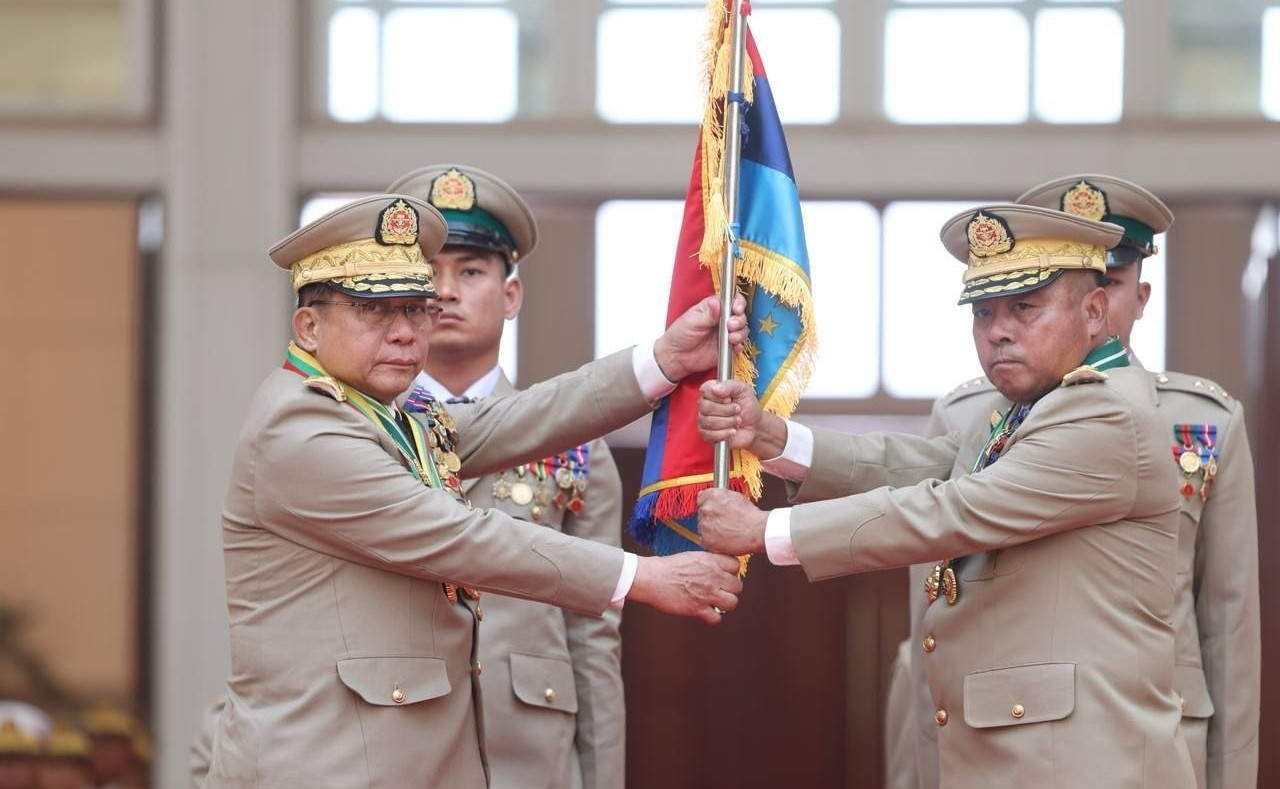
On the same day, Min Aung Hlaing formally stepped down as Commander-in-Chief—a position he had held for 15 years during which Myanmar descended into a second civil war—and transferred authority to a trusted successor.
These were the political and military steps taken by the junta on March 30.
On that same day, the NUG and four ethnic armed organizations announced the formation of the SCEF.
The four participating ethnic armed groups are:
• KNPP/KA (Karenni)
• KNU/KNLA (Karen)
• CNF (Chin)
• KIO/KIA (Kachin)
On the NUG side, the Committee Representing the Pyidaungsu Hluttaw (CRPH) is included, but the National Unity Consultative Council (NUCC), formed earlier in the Spring Revolution, is not part of this body. In simple terms, this can be seen as a new coalition structure formed between the NUG and certain ethnic armed groups.
The committee has outlined six objectives, including:
• Advancing the revolution to the next phase and successfully forming a transitional government
• Completely ending the military’s role in politics
• Placing all armed organizations under the authority of a democratically elected civilian government
Discussions to form this body reportedly began around January of last year. Its objectives combine both military and political aims, encompassing short-term goals as well as long-term visions for building a future federal union.
It is not entirely clear whether the committee was formed primarily for immediate military coordination against the junta, or for reaching political agreements with ethnic armed groups on building a future federal system.
The representation structure includes:
1. States/federal units/ethnic armed organizations
2. Public representatives
3. Women’s representatives
At present, only the four ethnic armed groups, the NUG, and the CRPH have been announced as members. This raises questions about whether the announcement was made before the formation process was fully complete, possibly as a response to the junta’s political moves such as forming a parliament and selecting leadership.
Myanmar’s recent political history shows many such alliances being formed—often without formal dissolution, eventually becoming inactive. Examples include:
• UNFC (pre-NCA period)
• PPST (post-NCA period)
• FPNCC and Northern Alliance groups
• NCA EAOs and later the 7 EAO Alliance
These alliances often function actively for a period but later fade without formal disbandment when political or military conditions change—something worth reflecting on.
On March 31, another group of domestic political figures—including 88 Generation leader Ko Mya Aye, SNLD chairman Sai Nyunt Lwin, and U Tha Tun Hla—announced the formation of a political negotiation body.
This group consists of politicians not affiliated with political parties and aims to collaborate with organizations and individuals who share common policies to address the country’s root problems and build a federal union.
Their statement emphasizes the need for inclusive political dialogue involving all stakeholders to resolve ongoing conflicts.
The group, known as PCB, also released nine key positions, including:
• Immediate and unconditional release of all political prisoners, including Daw Aung San Suu Kyi and U Win Myint
• Guarantees of freedom of association and expression
• An end to forced conscription
• Avoiding attacks on schools, religious buildings, and hospitals
• No punitive action against CDM civil servants
It remains unclear how the junta will respond to this development. There are also doubts about whether the new government led by Min Aung Hlaing—who has just stepped down as military chief—will tolerate or take seriously initiatives led by domestic political actors.
As the military prepares to form a government at the end of March, other forces also appear to be laying down their own strategies. It resembles a reshuffling of the political playing field after five years—like setting up a new game after the previous one collapsed.