
Myanmar Spring Chronicle – Scenes from March 5
(MoeMaKa), March 4, 2026
The military regime has begun reshuffling key positions.
Ahead of the convening of parliament in just over a week, junta leader Min Aung Hlaing has started making changes within the military, positioning trusted figures in key posts both in the armed forces and in the government that will be formed after parliament convenes.
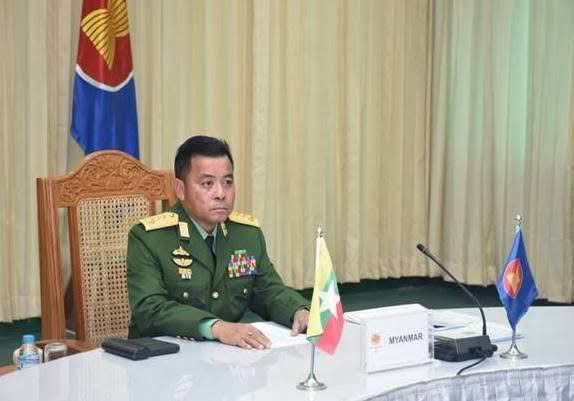
Lieutenant General Ye Win Oo, who currently serves as chief of the military’s Office of the Chief of Military Security Affairs (commonly known as military intelligence), has been reassigned as Commander-in-Chief (Army). Deputy Commander-in-Chief Soe Win, who had been serving concurrently as Commander-in-Chief (Army), has transferred that role to Ye Win Oo, retaining one of his two previous posts. It remains unclear whether Soe Win will continue serving within the military or assume a senior position in the Union-level advisory council, but many are speculating that he is likely to move from the military to the council.
In recent weeks, meetings have reportedly been held between leaders of the Union Solidarity and Development Party (USDP)—the party declared the winner of the military-organized election—and current military leaders to divide key positions, according to BBC Burmese.
Parliament is scheduled to convene on March 16, and it is expected that in early April the USDP will announce the formation of a new government.
After staging the coup, Min Aung Hlaing assumed the role of Chairman of the State Administration Council. In August 2021, he reconstituted the administration under the name “caretaker government,” created the post of prime minister, and took that position himself. In mid-2024, when President U Myint Swe fell ill, Min Aung Hlaing also assumed the role of acting president—a position he continues to hold.
Although he has already served as acting president, it is clear that Min Aung Hlaing still aspires to formally become president. Therefore, it is widely assumed that under the upcoming government, with a USDP-majority parliament, he will seek the title and prestige of president through parliamentary appointment.
Having already served more than 15 years as Commander-in-Chief, the presidency is likely his ultimate ambition. After the NLD’s victory in the 2015 election, he may have dreamed of becoming president in a subsequent term. However, the NLD’s landslide win again in the 2020 election was likely one of the main triggers for the coup. It would not be unreasonable to conclude that he was unwilling to accept or be satisfied with retiring solely as Commander-in-Chief.
On election day in Naypyitaw, when he emerged after casting his vote and was asked by a journalist whether he intended to become president, his facial expression and demeanor appeared unable to conceal his inner desire and ambition.
Given these circumstances, it seems certain that he believes he can avoid the fate of former junta leader Senior General Than Shwe—who led the SLORC/SPDC after 2010—only by securing the presidency, the highest office in the upcoming government, and ensuring that loyalists occupy the Commander-in-Chief post and other critical positions within the military for a defined period.
In 2009–2010, Than Shwe retired simultaneously from his positions as Commander-in-Chief and chairman of the SPDC, and also made his deputy, Vice Senior General Maung Aye, retire at the same time. However, his successor as Commander-in-Chief, Min Aung Hlaing, did not remain loyal to him or heed his advice.
Than Shwe stepped down in 2010 in order to avoid a chaotic power struggle or an unplanned exit from authority. Yet the loyalty he expected to endure did not last as long as he had hoped. This is undoubtedly a lesson for Min Aung Hlaing. Nevertheless, the nature of power—and the reality that no authoritarian ruler can hold it indefinitely—remains an inescapable and undeniable truth.