Myanmar Spring Chronicle – Scenes from March 3
(MoeMaKa), March 4, 2026
The Israel + United States–Iran War Shockwaves Have Reached Myanmar
On February 28, Israel and the United States launched airstrikes against Iran. As a result, oil production facilities and oil transportation routes in Middle Eastern countries have been attacked or disrupted. This has affected many countries around the world that depend on oil imports. Myanmar has also begun to feel the impact.
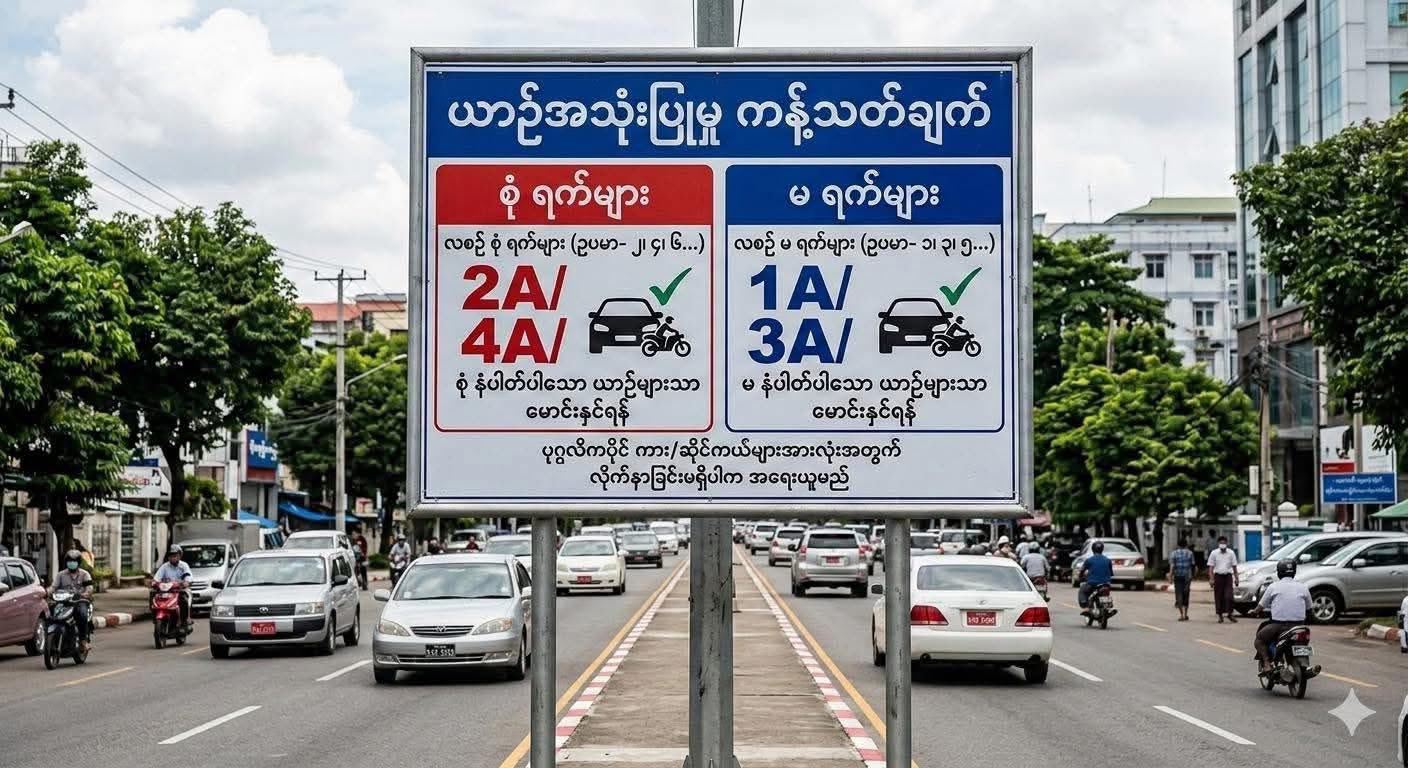
Even before fuel shortages occur, authorities issued orders restricting the use of fuel-powered vehicles. With the exception of commercial vehicles such as taxis, cargo trucks, fuel tankers, passenger buses, ambulances, and municipal garbage trucks, privately owned vehicles will now be subject to an alternating usage system.
Under the order issued by the military regime, vehicles with license plates ending in even numbers may operate on even-numbered days, and vehicles ending in odd numbers may operate on odd-numbered days.
Rather than carefully assessing the situation and considering measures to minimize economic and social consequences, the military followed its usual top-down approach—issuing directives for the public to comply with.
The announcement, issued on the night of March 3, states that the alternating vehicle-use system will begin on March 7.
Instead of imposing fuel ration quotas, the regime has effectively limited private vehicles (black license plates) to operating only 15 days per month, assuming they are not essential for economic activities.
The duration of these restrictions will depend on how long the war in the Middle East lasts and how long the Strait of Hormuz—controlled by Iran—remains restricted.
However, not all privately owned vehicles with black plates are unrelated to economic, educational, or healthcare sectors. Many are used for school transportation, private education staff, and service-related work that is not categorized as cargo transport. Restricting such vehicles to 50% usage could create serious disruptions.
Assuming that private vehicles are not used for essential daily needs such as business, education, or healthcare could create further hardships.
Although Myanmar, like many other countries, cannot influence or stop the Middle East conflict, it will nonetheless suffer its consequences.
Myanmar is already facing multiple crises due to ongoing civil war. Now, it may also face additional fuel shortages.
Even before these global events, certain conflict areas within Myanmar were already experiencing blockades of fuel, food, and medicine imposed by the military regime and some armed groups.
For example, in Rakhine State, the military has long restricted fuel, food supplies, consumer goods, and medicines. Similarly, during the later stages of Operation 1027, China reportedly imposed trade restrictions on certain ethnic armed groups along its border, pressuring them to cease fighting and agree to ceasefires with the military regime.
For people living in blockaded regions, there have already been periods when fuel prices soared to tens of thousands of kyats per liter.
Currently, in areas such as Rakhine, Sagaing, Kachin, and northern Shan, both the military regime and some armed groups—including MNDAA—continue to use restrictions on goods, fuel, and medicine as tools of leverage to force opposing armed groups and political forces into submission or negotiation.
In regions like Kachin State, essential goods transported from Yangon and Mandalay become significantly more expensive because various armed groups collect taxes along the routes. As a result, residents pay far higher prices than those in Yangon or Mandalay.
With the added impact of the Middle East war potentially driving fuel prices even higher, civilians in conflict-affected areas may face yet another layer of hardship.