
Myanmar Spring Chronicle – Scenes from March 10
(MoeMaKa), March 11, 2026
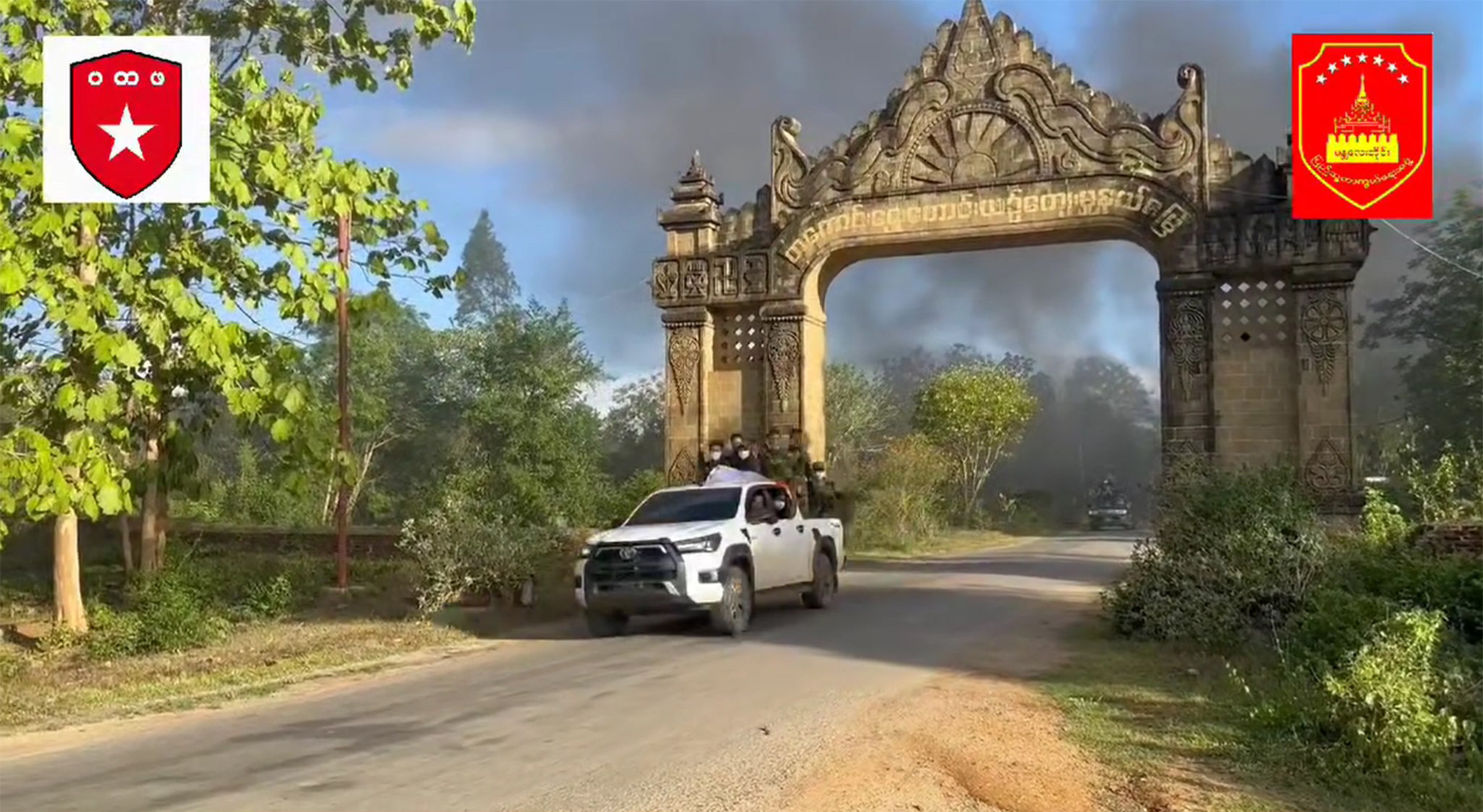
Tagaung, a town in Mandalay Region that had been under PDF control, has been lost.
According to some news outlets, on March 10 junta forces regained control of Tagaung, the last remaining town in Mandalay Region that had been under the control of the People’s Defense Forces (PDF). The revolutionary armed group known as the Mandalay PDF (MDY-PDF), operating under the Ministry of Defense of the National Unity Government (NUG), had captured and controlled towns in northern Mandalay Region along the Ayeyarwady River — including Tagaung, Thabeikkyin, Singu, and Madaya — after the launch of Operation 1027 in October 2023.
On the map, Tagaung Township is the northernmost, while Madaya Township is the southernmost before reaching Mandalay city. The areas seized and controlled by MDY-PDF in Mandalay Region lie between northern Shan State to the east and Sagaing Region to the west, stretching north–south along the Mandalay–Bhamo road and the Ayeyarwady River.
To the east, the adjacent areas bordering northern Shan State are controlled by the powerful Ta’ang National Liberation Army (TNLA). Due to territorial proximity, MDY-PDF had engaged in extensive cooperation with the TNLA.
In recent months, when the TNLA reached a ceasefire agreement with the military, it became necessary to return control of Mogok, which TNLA had been holding. Subsequently, the junta launched successive offensives to recapture Singu and Tagaung — areas under MDY-PDF control — one town after another.
Madaya, Thabeikkyin, and Singu are regions rich in gold mines and generate substantial revenue. During the period when PDF forces captured and controlled these areas, they were also able to control the gold mines, and tax revenues from them reportedly enabled the armed groups to purchase significant quantities of weapons and ammunition. One of the key motivations behind the junta’s renewed offensives to retake these areas appears to be regaining control over the gold mines that had been providing substantial funding to the PDFs.
A second important factor is that this region — with towns aligned north–south along the Mandalay–Mogok–Bhamo road — lies on a strategic corridor linking revolutionary armed groups based in Shan State and Karenni (Kayah) areas with those operating in central and western Myanmar, including Yaw, Gangaw, Chin State, Magway Region, and western Sagaing Region.
From a military strategic perspective, the junta undoubtedly understands that to sever the east–west corridor across Upper Myanmar, it must control areas where Mandalay Region borders northern Shan State, as well as where upper Sagaing Region meets northern Shan State. Losing this Upper Myanmar corridor means losing the communication link between eastern and western Myanmar. For the revolutionary armed forces fighting the military dictatorship, it also represents the loss of a strategic advantage gained since the beginning of Operation 1027.
It is important for the National Unity Government’s Ministry of Defense, as well as other revolutionary armed groups, to reassess the reasons behind the loss of towns along the Ayeyarwady River in northern Mandalay Region.
During the early and middle phases of Operation 1027, issues such as administrative authority, taxation rights, and recruitment in captured territories did not create friction among revolutionary forces.
However, in the later stages of Operation 1027, these issues in the controlled territories led to clashes of interest among allied revolutionary groups and cooled alliance relations.
Among the reasons for losing northern Mandalay Region, it would not be wrong to say that key factors include the TNLA’s growing operational limitations and its decision to pursue a ceasefire with the junta.
Given the close relationship between the TNLA and MDY-PDF, once TNLA forces were unable to advance beyond Hsipaw (or further north) and had to withdraw, losing towns such as Nawnghkio, Kyaukme, and Hsipaw, they eventually decided on a ceasefire and returned Mogok and Momeik. After the junta regained Mogok in the north, it advanced northward from the south through Thabeikkyin and Singu.
Nearly two and a half years after the launch of Operation 1027, unity and coordinated joint operations among revolutionary armed groups have weakened, and territories and towns captured during the first and second phases of the operation have been lost again.
Although it is often said that war naturally involves advances and retreats, the cutting off of key funding sources for sustaining warfare and the loss of strategically vital territories and corridors go beyond tactical setbacks — they risk becoming strategic defeats. This is something that must be carefully acknowledged.
Write to Maung May