
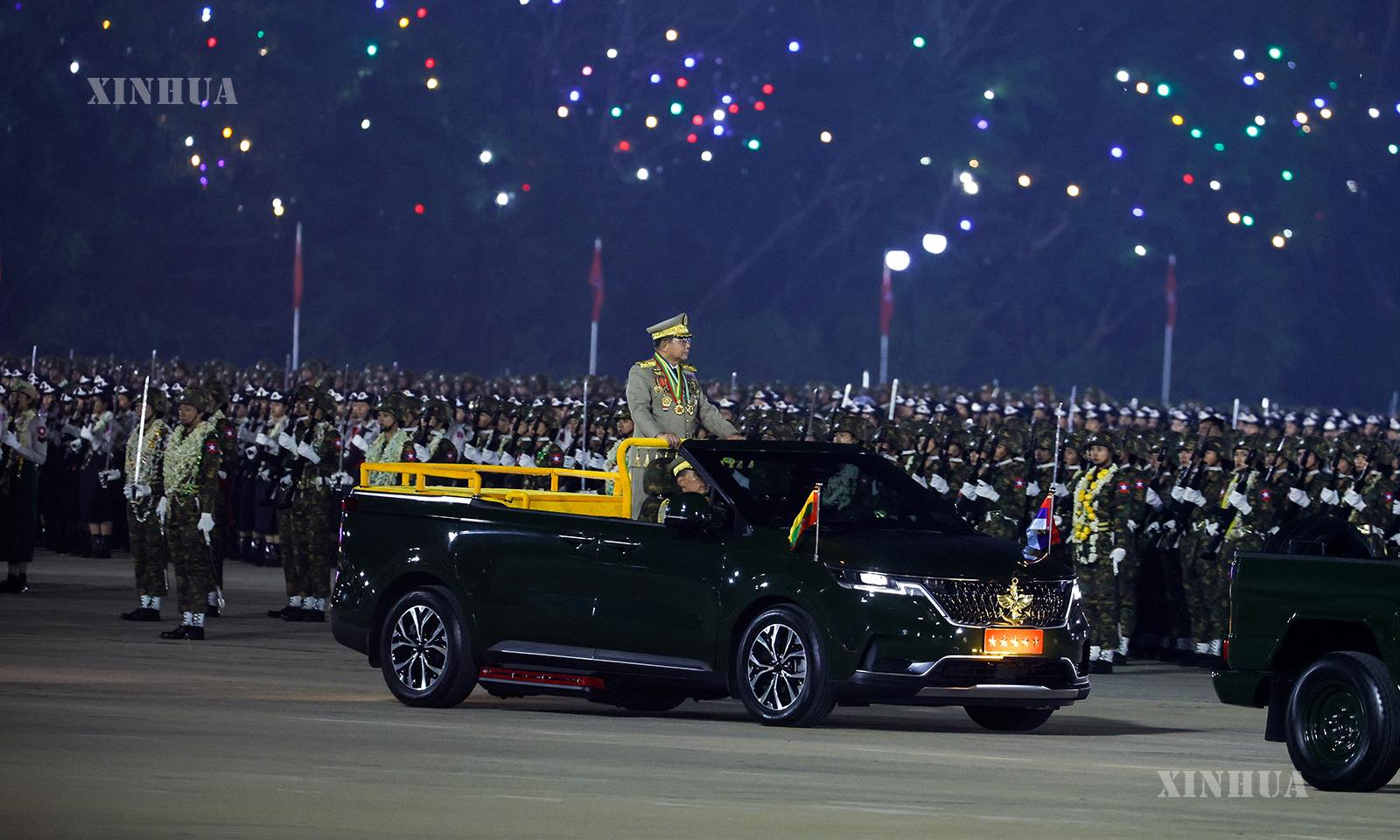
Myanmar Spring Chronicle – Scenes from March 27
(MoeMaKa), March 28, 2026
Myanmar’s History: From the Anti-Fascist Revolution to a Military Dictatorship
March 27, 1945—when resistance against Japanese fascist rule began—was commemorated for decades as Revolution Day. However, during the BSPP era led by Ne Win, who seized power in a 1962 coup, it was renamed “Armed Forces Day,” distorting its historical meaning.
This year, March 27 marks a moment when Senior General Min Aung Hlaing—who made the key decision to stage the 2021 coup—is preparing to transition into the leadership of a USDP-backed government expected to be formed soon, while positioning himself to continue controlling the military from a civilian role.
In previous years, Min Aung Hlaing, as commander-in-chief, personally greeted retired senior generals attending Armed Forces Day ceremonies. This year, however, he delegated that duty to the deputy commander-in-chief and did not attend. Notably, although he reportedly underwent emergency spinal surgery last week with specialist doctors from India due to a nerve condition, he has still been able to attend recent meetings and events.
Having served as the military’s top leader for 15 years since the formation of the post-2010 election government, and having refused to retire even after reaching retirement age, Min Aung Hlaing—long reluctant to relinquish control of the military—may find March 27 to be a particularly momentous day.
At the same time, he appears unwilling to entrust even the presidency—the highest position in the new government, formed as a result of elections held amid ongoing civil war—to anyone else. Driven by a strong desire to retain power, he now faces an unavoidable transitional step.
During the Armed Forces Day ceremony held on the evening of March 27, he also praised former military leaders from Myanmar’s two previous coup eras—the BSPP period and the SLORC/SPDC period. This included General Ne Win (1962 coup), General Saw Maung (who seized power after crushing the 1988 uprising), and Senior General Than Shwe (who succeeded him and retired after the 2010 elections). His remarks suggest he sees himself as part of the same lineage.
In modern Myanmar history, military coups are widely regarded as turning points that triggered the country’s economic, political, and social decline. Instead of resolving political crises through political means, the military has repeatedly seized power, imposing authoritarian rule, closing the economy, exploiting natural resources, restricting ethnic equality and self-determination, and intensifying armed conflicts.
Each time it seized power, the military justified its actions by claiming the country was on the brink of collapse, often accompanied by intelligence operations that created instability to support narratives of anarchy.
Once supported by the public during the independence struggle, the Myanmar military has since gained a deeply tarnished reputation due to repeated coups and abuses against ethnic populations during civil wars. Rather than embodying democratic values, human rights, and rule of law, it is often seen as inheriting the legacy and influence of fascist Japanese military traditions instilled during its formative period.
In contemporary Myanmar, the military is widely regarded as an institution responsible for torture, killings, sexual violence against women, arson of homes, and forced displacement of entire villages during internal conflicts. Beyond abuses committed during the 1949–1952 civil war, the 1958–1960 caretaker government, and successive BSPP and SLORC/SPDC eras, the military has also been accused at the International Court of Justice (ICJ) of committing genocide against the Rohingya minority as recently as 2017. While the case is formally brought against the state, the alleged perpetrators are the Myanmar military.
Given this long history—of coups, war crimes, and indiscriminate attacks on both armed groups and civilians, including airstrikes and village burnings—the question arises: why does the military still remain in power?
There is no single answer. However, one key reason may be the lack of strong unity, political consensus, and shared strategic goals among the various resistance forces fighting against a centralized, authoritarian military system.
Controlling only individual ethnic regions or parts of the country may not be sufficient to overthrow a deeply entrenched military institution that has developed strong centralized control, organizational structure, and state-like authority over decades. Recognizing this reality may be an essential lesson moving forward.