
Myanmar Spring Chronicle – Scenes from March 20
(MoeMaKa), March 21, 2026
Monastery Bombed in Katha Kills Dozens; Domestic Flights Suspended Due to Fuel Shortages
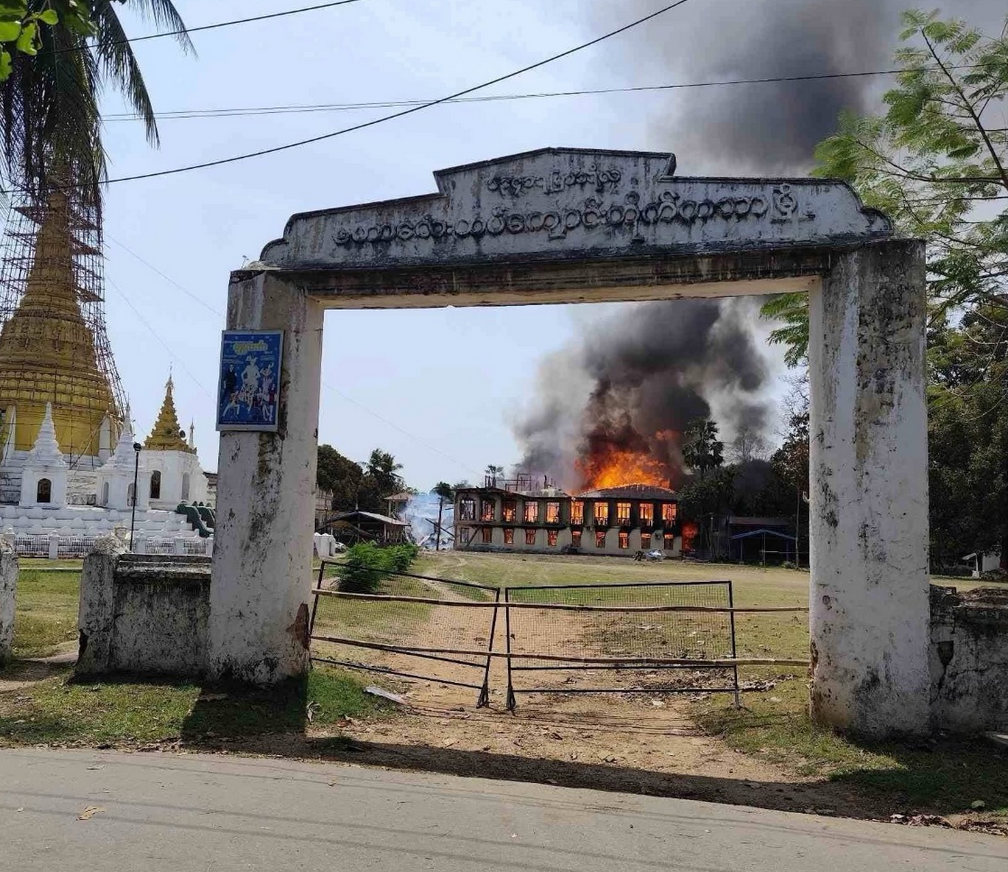
A Buddhist monastery in Katha Township, upper Sagaing Region—where fighting between the military junta and joint PDF/KIA forces is ongoing—was bombed by military aircraft on the morning of March 20. Reports quickly emerged that dozens of people, including monks and displaced civilians, were killed in the attack.
The monastery, known as the Maha Lay Htat Monastery, had been sheltering people fleeing the conflict.
Fighting for control of Katha had been underway for over two and a half months. Joint forces of the People’s Defense Forces (PDF) under the National Unity Government (NUG) and the Kachin Independence Army (KIA) began their offensive late last year, just days before the planned elections. Despite the prolonged fighting, the military carried out this latest airstrike directly on a religious site within the town.
Photos circulating in the media show the monastery engulfed in flames. Images of victims shared on social media are deeply disturbing, including scenes of bodies torn apart by the blast, highlighting the brutality of the attack.
When fighting first broke out in Katha, some residents fled. However, many chose to remain in the town, fearing the loss or destruction of their homes and belongings if they left.
Although PDF and allied forces have captured parts of the town, they have not yet been able to fully take control of Katha, even after more than two months of fighting.
Katha is strategically located along the Ayeyarwady River in northern Sagaing Region, bordering Kachin State. Recently, KIA Deputy Commander-in-Chief Major General Gun Maw referred to Katha, Kawlin, and Kanbalu as the “Ka Three” strategic area, emphasizing that these locations are key gateways into Kachin State.
Among these towns, Katha is the northernmost. Kawlin, located to the southwest, had previously been captured by NUG-aligned forces but was later retaken by the military.
Due to its strategic military and geographic importance, it is expected that the junta will fiercely defend Katha. Similar to the prolonged battle in nearby Bhamo, which has dragged on for over a year without a decisive outcome, Katha is likely to remain a contested battlefield.
Many residents who could not afford to flee have remained in the town. Others stayed to prevent their homes from being looted or destroyed while they were displaced.
At the same time, while the global fuel crisis is affecting many countries, the military junta continues to conduct daily airstrikes using aircraft, demonstrating that it still prioritizes military operations.
Meanwhile, domestic air travel is being severely affected.
On March 20, Myanmar Airways International (MAI) announced that most domestic flights would be suspended starting March 21 due to fuel shortages. The suspension includes routes from Yangon and Mandalay to major destinations such as:
Myitkyina and Kalay (north)
Tachileik and Heho (east)
Sittwe (west)
Dawei, Myeik, and Kawthaung (south)
Just days earlier, airlines had already restricted excess baggage on international routes such as Yangon–Bangkok and Yangon–Chiang Mai, reportedly to conserve fuel for return flights.
These developments indicate that civilian airlines are now facing serious fuel limitations.
The suspension of domestic flights will have significant consequences:
Road travel remains unsafe due to conflict
Travel times are now three to four times longer than normal
People relying on flights—especially for medical treatment—will face severe hardship
At a time when civilians are being urged to conserve fuel and endure travel restrictions, the military continues its airstrikes without pause.
This contrast makes one thing clear:
For the junta, maintaining power takes priority above all else—even above the safety and suffering of the people.