
Maung Lu Hmwe – When the War Reaches the Dinner Table
(MoeMaKa) March 12, 2026
“The petrol price is unbearable, teacher. Once fuel prices go up, everything else follows,” a parent complained in front of Maung Lu Hmwe yesterday.
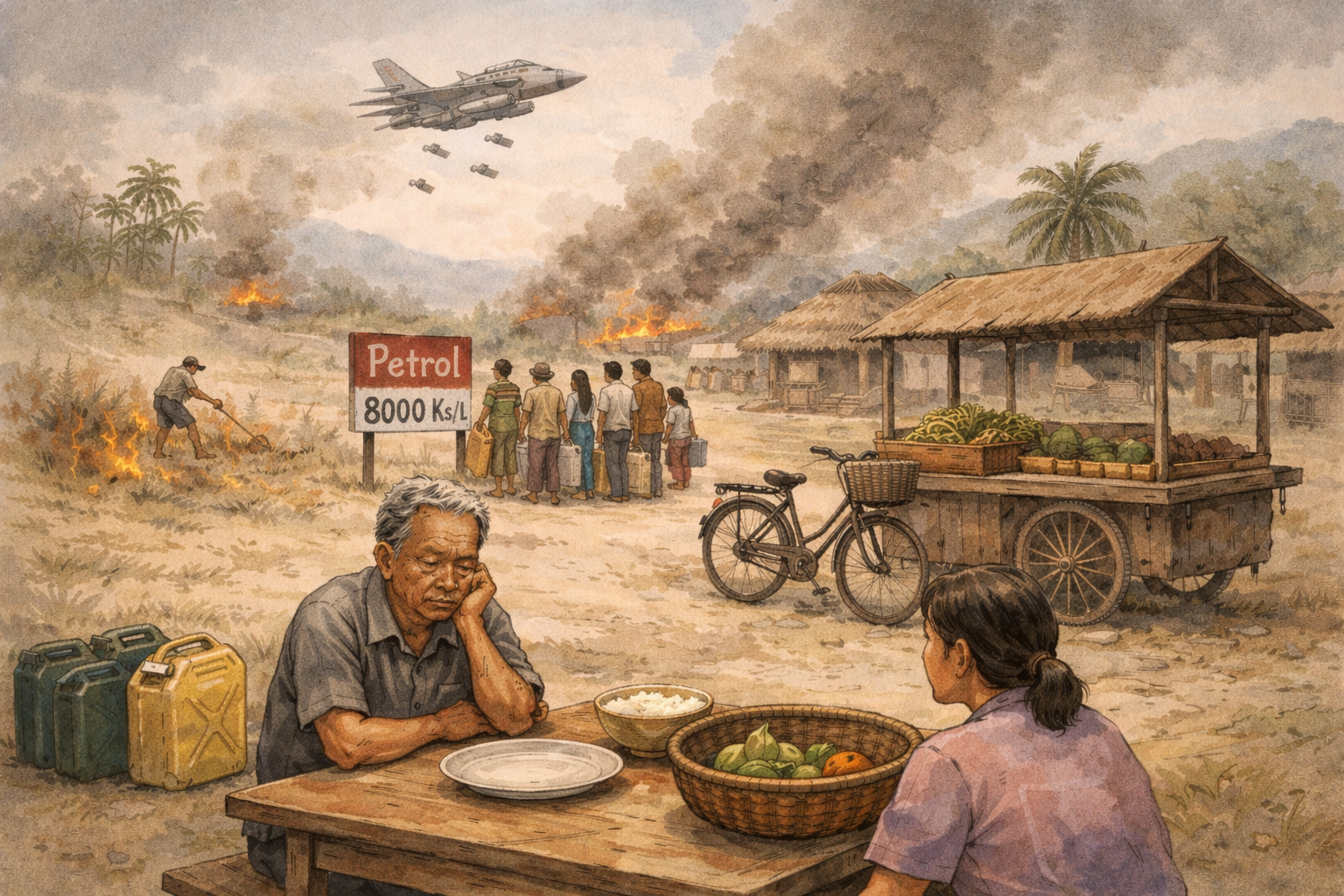
Petrol, which used to cost five thousand kyats per liter, suddenly jumped to eight thousand kyats per liter due to the Iran war.
Although Maung Lu Hmwe lives in a rural area, people there are no longer cut off from the world. After hearing news that global fuel prices might surge because of the Iran conflict, villagers rushed to buy petrol in large and small containers. Of course, no one could afford to buy much. Those who could buy three one-liter bottles bought three; those who could manage four bought four. But even that small wave of panic buying was enough to empty the fuel supplies at the tiny roadside shops.
It is early summer now, and in Maung Lu Hmwe’s countryside, forest fires have begun. Smoke fills the air, and riding a motorbike stings the eyes until tears well up. Villages take preventive measures against wildfires by creating “firebreaks” — deliberately burning combustible debris around the village to stop spreading flames. During this fire-prone season, nearly every household tries to keep at least a small reserve of petrol at home. One can only hope that no fire breaks out.
Amid frustration over rising petrol prices, some villagers found a strange source of comfort. “Now that Iran is at war, the junta will have trouble getting fuel. Maybe they won’t be able to bomb us because of aviation fuel shortages,” they said hopefully.
But that hope quickly proved wrong. News of continued airstrikes made it clear that the military cannot be underestimated. If civilians have no fuel to travel, so be it — but for the sake of maintaining power, the junta will find fuel if it must.
Even as fuel prices soar because of the Iran war, the bombing has not stopped.
Yet while petrol prices rise, bean prices have fallen.
“At this price, we’re already losing money. Now that it’s dropped even more, we can’t survive like this. Maybe we’ll have to feed the beans to pigs,” one farmer joked bitterly. It was the laughter of someone who has grown used to hardship and can no longer resist it.
Butter bean prices fell from sixty-five thousand kyats to sixty thousand kyats. Farmers rarely have the luxury of waiting for better prices. Once harvest comes, they must sell immediately at whatever rate is offered to cover fuel costs and wages. The same happened with paddy: during harvest, it sold for fifteen thousand kyats per basket. Now that rice prices are high and paddy sells for twenty-five thousand kyats, they have none left to sell. They are always on the losing side.
And yet, despite all this, they continue riding motorbikes fueled by expensive petrol — now priced higher because of the Iran war — into the forest to work. Maung Lu Hmwe feels deeply indebted to them. After all, it is the produce from their land that keeps him alive.
This morning, when he woke up and stepped outside, the motorbike vendor who usually sells vegetables had not arrived. Miss Hmwe, who normally waits by the gate to buy ingredients for cooking, had nothing to purchase.
“She said with petrol prices like this, she can’t afford to ride around selling goods anymore. She’ll try coming by bicycle,” Miss Hmwe explained.
But carrying meat and vegetables dangling from a bicycle and pedaling nearly ten miles over dirt roads is no easy task, Maung Lu Hmwe thought. Most households in their area rely on that one vendor for daily cooking supplies.
Within just one week of the Iran war, its ripple effects had already reached Maung Lu Hmwe’s dinner table.