
Maung Lu Hmwe – The Sound of the People’s Breath (Essay)
(Moemaka – March 17, 2026)
“My younger brother… we are also getting exhausted from constantly having to contribute money for bullets. And it’s not just us. The comrades who are fighting are exhausted too. Everyone is exhausted,” Maung Lu Hmwe’s cousin confided, sharing the hardships of life during the revolution.
Maung Lu Hmwe’s cousin is a simple man with little formal education. All he could really express was that people are tired; he could not fully articulate everything else he felt.
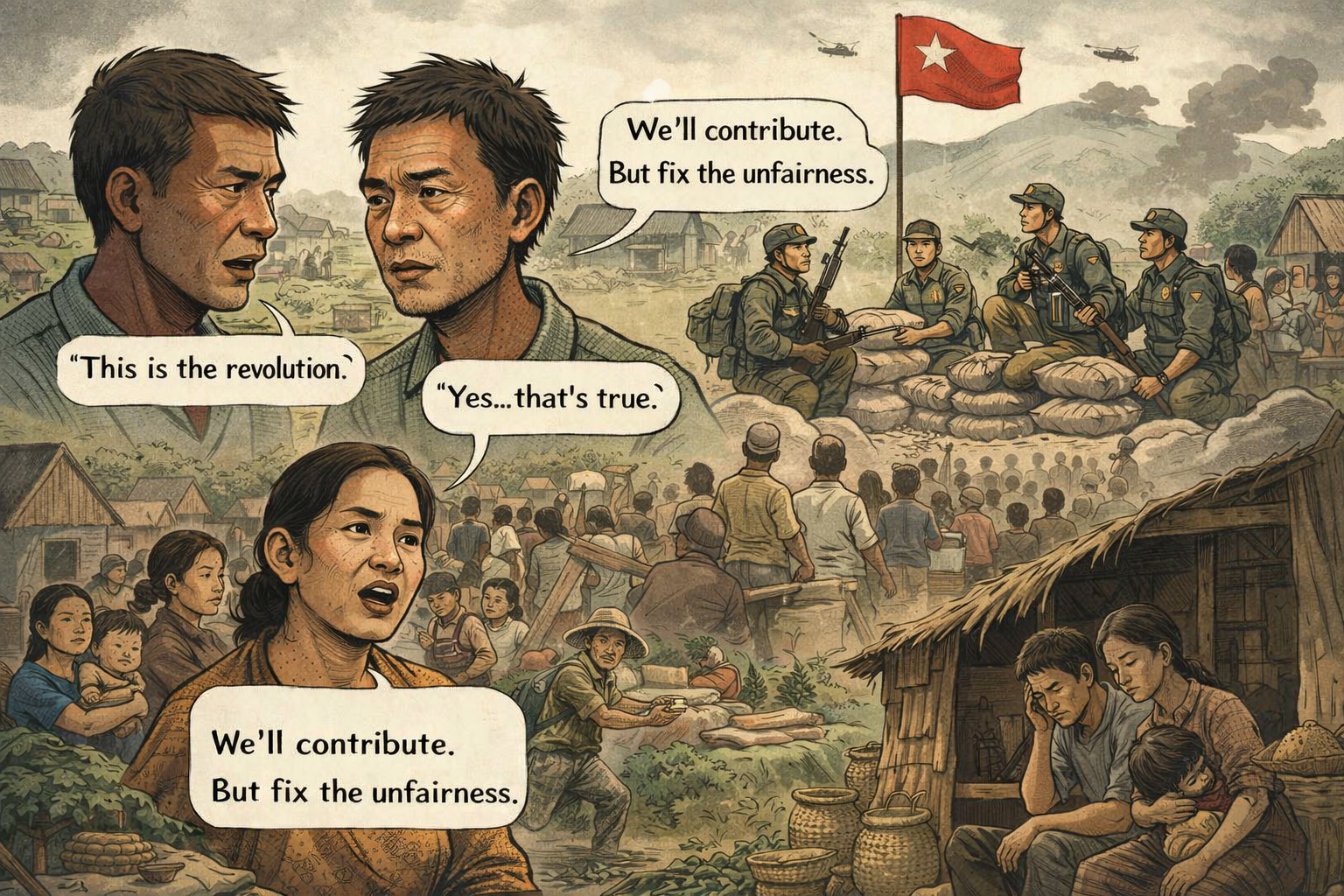
When Maung Lu Hmwe said, “Well, this is the revolution,”
his cousin smiled and replied, “Yes… that’s true.”
Another cousin of Maung Lu Hmwe who personally delivered packed meals to the resistance fighters said:
“It’s quite dangerous delivering food all the way to the frontlines. I only reach those dangerous places on the days and at the times I go to deliver food. But the comrades have to stay there all the time.”
In the voices of both men, one could clearly hear their deep empathy for the fighters risking their lives against the military dictatorship.
One day, a village held a meeting to raise funds for the revolution.
During the meeting, a woman criticized the quota system used to collect revolutionary funds. She felt the village administration had divided the financial contributions among households unfairly.
She asked why such an unequal quota system had been imposed and requested that it be revised in a fairer way.
When she finished speaking, a village official stood up and responded sharply:
“The comrades are risking their lives fighting. Surely we can at least contribute this much.”
But as he finished speaking, several women began to speak out at once.
“We know we have to contribute. We understand that. We will contribute. What we’re saying is that the unfairness should be corrected.”
Their voices rose together, and the meeting became noisy.
In reality, the people understand that they must struggle as much as they can for the revolution.
The Spring Revolution itself began because the people refused to accept the military’s seizure of power.
The people have already given their children—their sons and daughters—to the revolution. They have given their sweat-earned money, and they are still giving.
So the question arises:
Do these people who have sacrificed so much really need to be lectured about “sympathizing with the comrades”?
The people may not always be able to explain the revolution in words, but they understand it deeply in their hearts.
“Last year we harvested 150 baskets of paddy. Since the comrades were constantly coming and going and eating here, we had to buy about ten extra baskets of rice. This year we harvested only 120 baskets. We even have about ten baskets of rice left over. Now that the comrades don’t come anymore, it feels empty inside—like something is missing. My wife feels it even more deeply; she really misses them.”
This was the heartfelt confession of a man who owned a small hut in the forest, where revolutionary fighters used to frequently stop by to eat.
Maung Lu Hmwe himself was occasionally among those who stopped by that hut.
Because the villagers knew that the fighters who came and went were truly engaged in the struggle and were free from corruption, they felt proud to feed them. When troop movements meant that the fighters could no longer stop by, the couple felt a deep sense of loss.
Among the people in revolutionary areas—the farmers working their fields, the day laborers surviving through manual work, the displaced civilians struggling to live while fleeing war—the breath of all of them carries the sound of the revolution.
Maung Lu Hmwe hears that sound of breath wherever he travels.
To hear the true breath of the people, one must listen beyond the small group who remain superficially comfortable.
Poor management practices and the tendency to treat revolutionary fundraising like marketing or promotional campaigns should be corrected as much as possible. What is needed is to truly listen to the people’s breath.
Even though the people are exhausted—breathing heavily from hardship—the sound of the revolution still echoes in every breath they take.
But if the people become disillusioned, if their breath no longer carries the sound of revolution…
If the revolutionary voice within the people falls silent…
The consequences would be unimaginable.
We must understand this.