
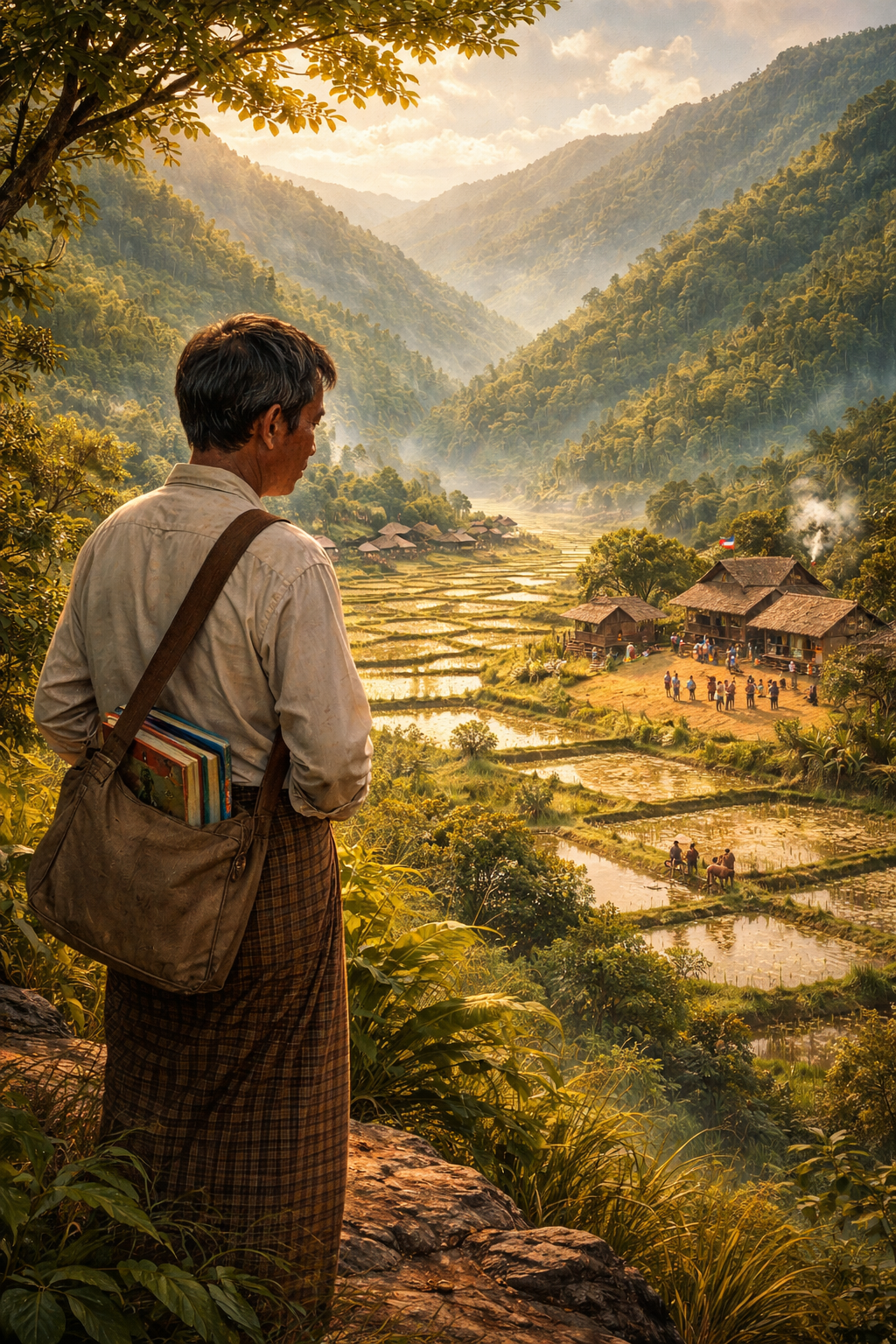
Maung Lu Hmwe – The Lonely Valley
(MoeMaKa) March 6, 2026
Mountains rise on all four sides. Maung Lu Hmwe sleeps in a small hut beside a rice field. There is no phone signal here. Even internet access is difficult in this remote corner of the world where he now finds himself.
“Our fields,” a young man with an engineering degree from the region tells Maung Lu Hmwe, “were built in the time of our fathers and grandfathers—with buffaloes and their own hands. Some fields took one year to build, some two years, and some even five years. We name them according to how long they took—two-year fields, three-year fields, and so on.”
The valley is surrounded by mountains, making travel difficult and isolating the community from the outside world. Yet despite its remoteness, the place has long been known as “the most educated-producing” area in the region. Ironically, most of those educated individuals rarely stayed in the village. After the military coup, even the remaining educated residents gradually left. The valley was left behind—isolated and alone.
Being a valley, the farmland is not wide and expansive. Instead, the rice paddies climb the slopes in tiers like steps. One field leads to another in narrow succession—some shrinking, some widening, some curving or tapering off. Perfect square fields are almost nonexistent.
“Even these fields—we no longer have enough people to work them all. Some have had to be abandoned,” the young local explains. Many of the valley’s young people and educated residents have left behind the lands their ancestors painstakingly built.
It is the beginning of summer. The fields lie dry, their surfaces cracked and split. The villages in this valley—deprived of those skilled in education and healthcare—feel parched and silent.
Yet when the rainy season comes, the remaining villagers plow those cracked fields and plant again. With the limited human resources left, they continue running schools and healthcare services. At the same time, they shoulder the heavy burden that geography and history have placed upon them—the responsibility of resisting military dictatorship.
“We’d like you to speak a few words to our teachers and students,” village officials ask Maung Lu Hmwe.
On the morning of his departure, Maung Lu Hmwe speaks words of encouragement to the children and their teachers. In return, he receives their smiles as gifts. He believes that only education can prevent the lonely valley from remaining lonely—only education can bring it vitality and hope.
He remembers the words of an elder friend: “No matter how famous or accomplished you become in the world, if you do nothing for your homeland, it is all meaningless.” He is heartened to learn that people from this valley, even those living far away, continue to support their homeland as best they can.
What the valley needs most are young people willing to till the fields. It needs teachers to educate its children. It needs healthcare workers to care for the sick. It needs capable leaders who can organize and govern wisely.
Will the young teachers Maung Lu Hmwe met in one of the villages also leave one day? Among the children who laughed so innocently at his jokes, how many will grow up to become educated—and of those, how many will remain in their homeland? And how will policymakers support educated individuals so they can build meaningful careers at home?
Riding his motorcycle along the uneven dirt road—full of dips and ridges—Maung Lu Hmwe reflects on these questions. The answers, he realizes, are what will determine whether this lonely valley can one day become a place that is lonely no more.