Maung Lu Hmwe – The Health of the Villages
MoeMaKa, March 27, 2026
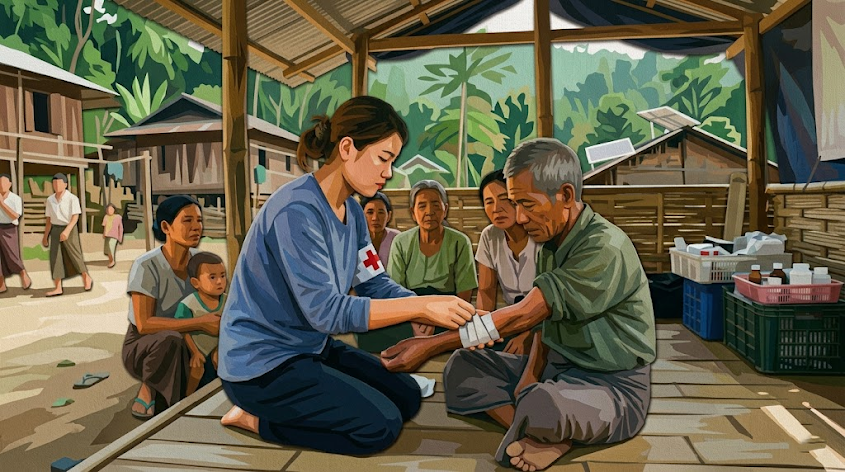
Who is looking after the health of the villages in revolutionary areas? Well, to answer honestly: it is CDM nurses, young people who have attended medical training through revolutionary forces, and local people who know how to handle injections.
“In truth, we are not actually allowed to treat patients. But in the current situation, we cannot avoid treating them either. And people’s health knowledge is so limited. It’s really worrying,” said a senior nurse who runs a clinic in a large village. She is a retired veteran nurse who spent decades working under senior doctors in major hospitals, so she is highly experienced and well trained. You can see in her the steadiness of a seasoned nurse, the ability to identify illnesses correctly and provide treatment, and the gentle skill with which she handles children.
And yet even a veteran nurse like her does not have formal legal authority to practice medicine. She says she can only carry out treatment according to doctors’ guidance. If that is the case, how could young CDM nurses, medical trainees from revolutionary areas, or those once dismissed as “quack doctors” and “backdoor injectors” possibly be recognized as having the right to treat patients? And yet, in reality, the health of these villages now depends on them.
As for doctors, it would not be an exaggeration to say that people in villages like Maung Lu Hmwe’s have gone a long time without even seeing one. Wherever there is a doctor or a clinic, the coup military marks it as a target and attacks it from the air. One younger doctor, a friend of Maung Lu Hmwe’s, has already survived two bombings. Two hospitals and clinics where he had been providing treatment, in two different regions, were both bombed. By sheer luck, he is still alive. Last year, because of a junta airstrike, an entire doctor’s family in Maung Lu Hmwe’s area was killed. When the military keeps bombing clinics where doctors are present, how many doctors would dare to openly run clinics in villages?
There are still some courageous doctors who dare to open clinics for local communities. One woman doctor, for example, does not charge a single coin for consultations or treatment. Patients only have to buy medicine. And she does not sell the medicine herself; patients buy the medicines she prescribes at pharmacies. Even the place where this remarkable woman doctor was treating people was bombed by the military at night. Although the bombing did not cause major damage, the village where she lived no longer wanted her to run a clinic there. That woman doctor, who had been a light for the community, had to leave for a distant place. When serious health problems arise in the villages, their only reliable source of help has disappeared.
At this point, Maung Lu Hmwe is reminded of one of his former students. She is a nurse who trained both in Myanmar and in Singapore. She serves as the medical officer for the People’s Defense Team in her township. She treats displaced people free of charge. For villagers, she asks only for the cost of medicine and no treatment fee. Yet all eight places where she opened a small clinic and treated patients were followed and bombed by the military. After that, no village wanted a clinic built near them anymore. So this former student of Maung Lu Hmwe, a young nurse, became someone who had to travel from village to village providing treatment.
In reality, not every community has a CDM nurse. Usually they are found only in larger villages. For smaller villages, when it comes to common seasonal illnesses and everyday health problems, they mainly have to rely on local revolutionary-era medical trainees and people who know how to give injections. Most villagers also believe that illnesses only go away if they receive an injection, so in a way, it fits the local reality.
In the past, people who treated patients without being doctors—those who carried syringes and gave injections—were condemned as dangerous, even branded as killers. But now, whatever the long-term consequences may be, people endure fever and pain only until they can no longer bear it, and then they turn to them for treatment. After all, for the moment, many of those current illnesses do seem to go away.
And it is not only health care. In Maung Lu Hmwe’s revolutionary areas, education, administration, and other sectors function in much the same way. One CDM teacher once said that, in health care, there are people who die because of reckless treatment, but that it is difficult to speak openly about it. In his heart, Maung Lu Hmwe replied: “Still, teacher, they are probably not as many as those who die because of reckless politics and reckless revolution.”