
Maung Lu Hmwe – The Frontline House of a Small Village (Essay)
(Moemaka, March 19, 2026)
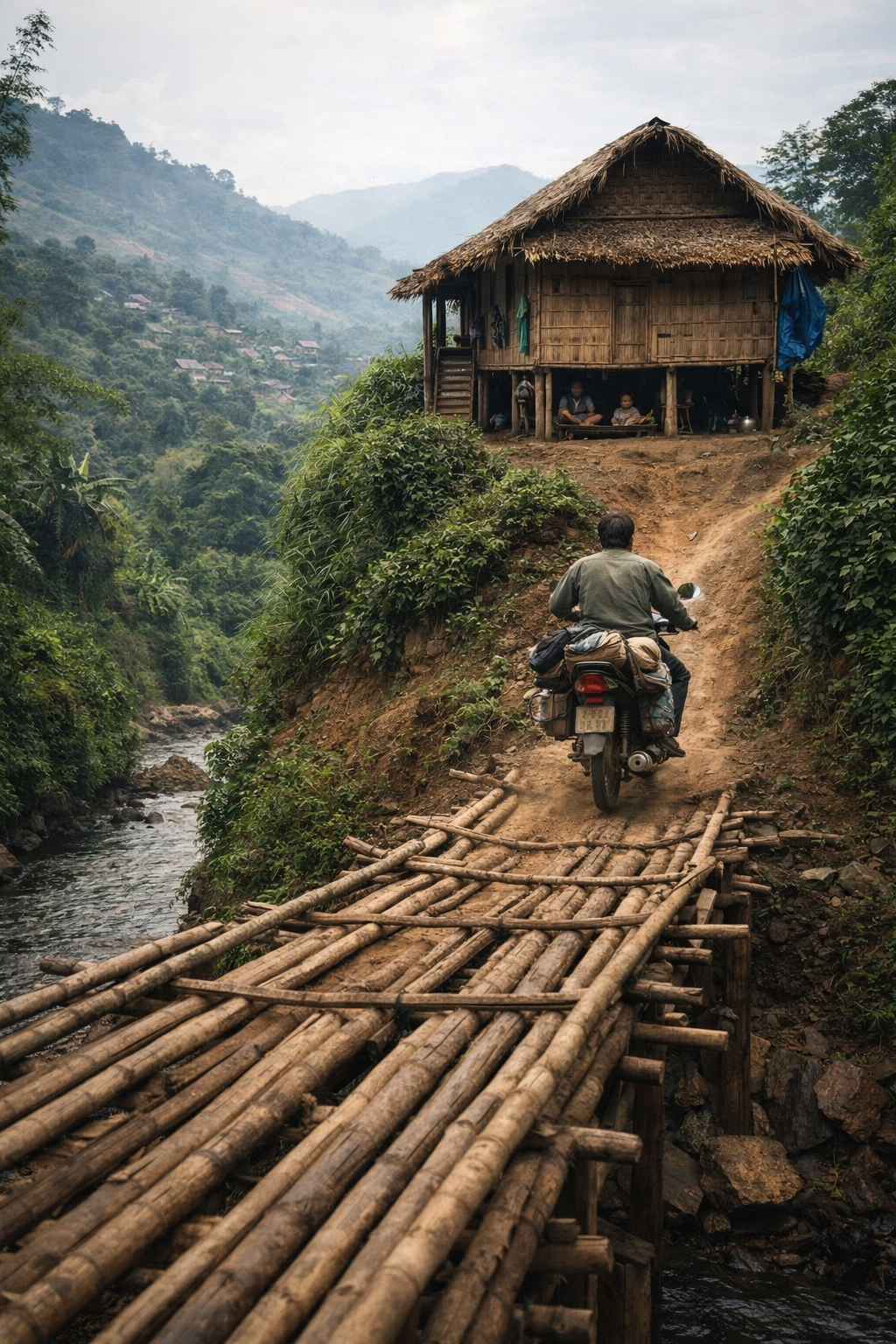
You have to ride a motorbike across a shaky bamboo bridge to cross the river. Once you get off the bridge and reach the bank, you must climb a steep slope until the motorbike roars loudly. After crossing the river and following the road, you pass over a small hill—and suddenly, the village appears.
At the top of the hill at the village entrance stands a small house. That is the home of Maung Lu Hmwe’s “Phalay” and “Lay Lay.” Since childhood, he has called his father’s youngest brother “Phalay,” and his uncle’s wife “Lay Lay.”
Among his father’s siblings, Phalay is the youngest—and also the poorest. Instead of staying in their native village where most of his siblings live, he moved to his wife’s village. There, at the edge of the village, he bought a cheap plot of land and built his home. That is why his house sits at the hilltop at the entrance of the village.
After the military coup, when troops advanced into their village, a group of young men ambushed the incoming soldiers from in front of his house using homemade guns. Then they had to flee.
When the military entered the village, because the attack had come from his house’s front, they burned his house down.
The sturdy wooden house that Phalay and his sons had spent nearly a decade building was reduced to ashes.
The house Maung Lu Hmwe visits now is a small bamboo house that Phalay rebuilt.
When he arrives, Phalay is lying on a bamboo bed placed directly on the ground under a makeshift roof.
“A farmer gets nothing. But in four or five days, I’ll go back to the forest again. I’ve already cleared some land—I still need to burn it,” Phalay says.
Then he adds,
“Your younger brother has been shot in both legs.”
The youngest son—Maung Lu Hmwe’s cousin—is a resistance fighter on the frontlines.
“It wasn’t gunshots,” Lay Lay explains. “It was shrapnel. He was hit when they bombed from the air. They said his legs don’t need to be amputated. An officer from his unit came and told us. It happened during fighting in Chin State. We still haven’t been able to speak to him directly.”
Phalay lies quietly on the bamboo bed, staring blankly.
In his eyes, there is little color left of hope.
In that fragile bamboo house live:
- two grandchildren without parents,
- an eldest son who can no longer work due to trauma,
- and the elderly couple themselves.
The house trembles with even a single step on the ladder.
How much more must their hearts tremble, knowing their youngest son has been wounded in war?
“I’ll go to the forest and do whatever I can,” says Phalay, nearly sixty, speaking softly as if making a quiet vow.
They are poor.
They built their home at the edge of the village.
It was in front of their house that the first gunfire of the village’s resistance was heard.
And so, their home was burned.
Now, their youngest son fights on the frontlines against the same military that burned their home—and the homes of many others.
“I had managed to buy two phones,” Phalay says.
“When your brother came, he didn’t have one, so he took them. In the fighting, phones get broken all the time. I can’t afford to buy more, so I just leave it as it is.”
He also mentions that last month his wife was seriously ill and required treatment.
“Luckily, she recovered,” he says.
Maung Lu Hmwe notices that both of them look older than their years.
This is the first time Maung Lu Hmwe has returned to visit his youngest uncle’s home since the coup.
After saying goodbye to the family, he leaves.
As he exits the village, he turns back to look at the small house once more.
Under the harsh summer sun, the house crouches there—
worn, faded, and fragile.
This…
is the frontline house of a small village.
And there are countless houses like this
across Myanmar.