
Maung Lu Hmwe – If the Educated Become Discouraged
MoeMaKa, March 25, 2026
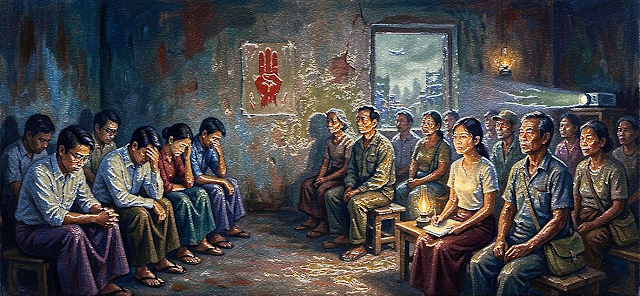
In recent days, Maung Lu Hmwe has had to attend quite a lot of meetings. At one of them, he noticed that the people who were actually supposed to do the real work were sitting huddled in the most tucked-away corner of the meeting place. This is not the first time he has seen such a scene. And every time he does, he feels dissatisfied and disheartened.
Because Maung Lu Hmwe spent nearly a decade as a volunteer teacher, he met many poor parents of students. Whenever a meeting was called regarding their children, almost all of them would sit pressed against the very back of the classroom or along the edges. At nearly every meeting, they had to be encouraged to sit in the middle or move closer to the front. In truth, they felt inferior because they were not formally educated. Many also felt inferior for a second reason as well: because they were poor.
Since the military coup, Maung Lu Hmwe has noticed that not only ordinary civilians, but even people regarded as educated, have begun competing for seats in the back of meeting halls. It is a revolutionary period, and nothing is free of danger. So people want to avoid the work that needs to be done. Maung Lu Hmwe sometimes thinks that when lack of courage continues for too long, it turns into a kind of inferiority.
He once read in an interview article by writer Marn (Taung Lone Pyan) that Saya Maung Wuntha had said: “I lived through a long period when the educated class turned its back on politics.” Because young people stayed away from politics for so long, the country suffered. Saya Maung Wuntha also said he resented certain forces that had made politics seem filthy and repulsive, pushing young people away from it.
Now, on the ground where Maung Lu Hmwe and others are working, he sees the same thing: people turning their backs on the issue of displaced civilians, turning their backs on education, and finally even shamelessly turning their backs on the work they themselves ought to be doing. The main force driving educated people away from the responsibilities they should be carrying is the military junta. Once aircraft fly low overhead with deafening noise and drop bombs, many people abandon the duties they are supposed to fulfill.
Among the reasons educated people withdraw from their work are also problems within the revolutionary social system itself: unnecessary control, lack of respect, lack of recognition, inability to provide support, poor management, jealousy toward those more capable than oneself, and other such difficulties. Maung Lu Hmwe says these are truths they must admit. These are also the nearest things that must be challenged. Revolution means change. Shooting with guns is only the last resort of revolution.
It is now necessary for people like Maung Lu Hmwe—both as individuals and as organizations—to strive for change and improvement. Educated people, too, need to stop avoiding responsibility and be willing to take at least some risks in carrying it out. Relevant organizations also need to create conditions in which educated people are able to participate.
He remembers the words of one of his female students:
“If I don’t die in an airstrike, teacher, I’ll definitely come teach at the classroom site without fail.”
He can also picture the sun-darkened face of a poorly dressed farmer telling battalion comrades:
“Just give me a little gasoline for my water pump. As for vegetables, come and pick whatever you need for cooking.”
In the revolutionary territories where Maung Lu Hmwe lives and works, there are still many young people who value learning without feeling inferior, and many poor people who, without any sense of inferiority, continue to support the struggle against military dictatorship.
To lead such people, those who are truly educated must not turn their backs on their responsibilities. They must not turn their backs on the revolution. No matter how difficult the circumstances, they must not lose heart or feel diminished. If educated people remain discouraged for a long time, the country’s future becomes too frightening to imagine.