
Myanmar Spring Chronicle – Scenes from March 11
(MoeMaKa), March 2, 2026
Local residents who had been detained by a military column in Nyaunglebin Township were rescued, while more than 100 people were killed in an airstrike on a prisoner-of-war camp in Rakhine State.
In recent days, during a military operation to rescue over a hundred local civilians who had been taken hostage by junta troops advancing into several villages in Nyaunglebin Township in eastern Bago Region, casualties were reported on both sides. According to statements released by the PDF and the KNLA, members of both the resistance forces (KNLA and PDF) and the junta forces were killed.
The eastern part of Bago Region—bordering northern Karen State—including areas such as Nyaunglebin, Mone, and Kyaukkyi on both the eastern and western banks of the Sittaung River, are territories where KNU/KNLA forces are active. These are predominantly Karen ethnic areas. Reports indicate that the areas currently targeted by junta columns are only a few miles east of the old Yangon–Mandalay highway.
Even before the 2012 ceasefire agreement between the KNU/KNLA and President U Thein Sein’s government, the eastern Sittaung River areas of Bago Region had already experienced frequent clashes, along with severe incidents of civilian arrests and killings. During those years, the military not only operated in formal units but also formed irregular groups—known locally as “shorts-wearing” militias—that were allowed to arrest and punish civilians with impunity, maintaining tight surveillance and control over local communities.
Because eastern Bago lies along the Yangon–Mandalay and Yangon–Naypyitaw highways and railway lines, it is strategically significant and capable of threatening key transportation and supply routes. For that reason, successive military governments granted security forces broad leeway to bypass legal procedures in the name of security.
After the 2021 military coup, People’s Defense Forces were formed in these areas with the aim of operating along the Yangon–Mandalay highway and railway, as well as extending activities toward northeastern Bago areas such as Yedashe, which borders Naypyitaw.
In recent months, the junta has launched offensives aimed at retaking territories, communication routes, and border outposts it had lost in upper Myanmar’s central dry zone and in KNU-controlled areas such as Myawaddy District. While it faces fierce resistance in Rakhine State, western Magway Region, the Bago–Rakhine border areas, and the Ayeyarwady–Rakhine border, it appears to be gradually attempting to reassert control over central, eastern, and dry-zone regions of the country.
The military columns advancing into villages in Nyaunglebin Township may be part of this broader strategy to reclaim lost territory. According to the statement, 11 resistance fighters were killed and 7 injured in the joint KNLA–PDF operation to rescue detained villagers, indicating significant losses during the roughly six-hour battle. The junta side reportedly suffered at least 10 fatalities and more than 20 injuries.
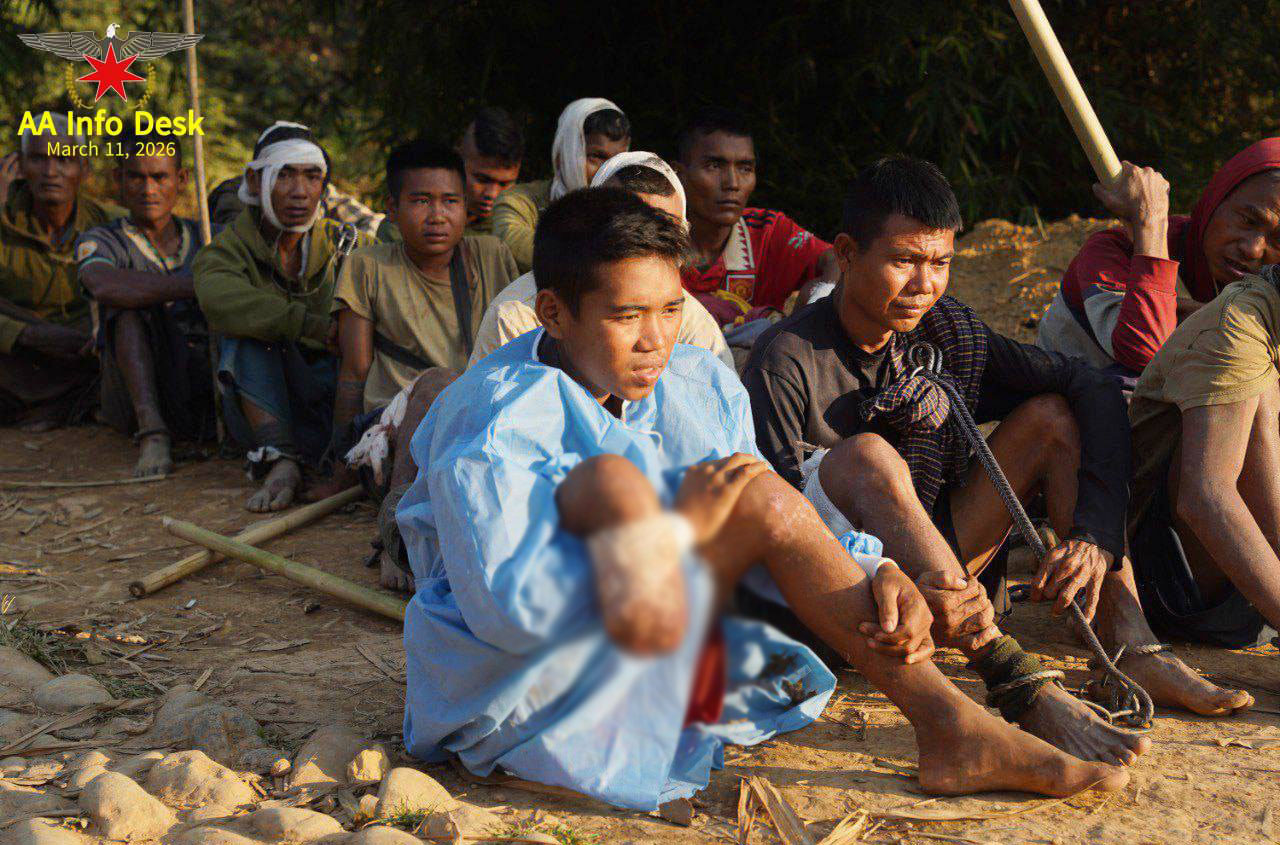
Another major development today concerns an airstrike carried out on March 8 by junta aircraft on a prisoner-of-war camp in the Darlat Chaung area of Ann Township, Rakhine State. The camp, operated by the Arakan Army (AA), held captured junta soldiers detained during fighting in previous years. According to an AA press release, 116 prisoners were killed and 32 injured in the bombing.
A death toll exceeding 100 is no small number. Three days after the incident, on March 11, the AA released photographs showing the burned-out remains of the detention facility, reduced to metal bars, as well as images of wounded prisoners—some with amputated limbs, bandaged heads, and shackled legs. The AA also published a video interview with a brigadier general who had served as deputy commander of the junta’s Western Command.
In the interview, it was stated that junta forces had conducted aerial reconnaissance about a week prior to the attack. Although the military regime has not explained its intention in bombing a site holding its own captured soldiers, this is not the first time it has carried out airstrikes on camps detaining prisoners of war and family members. A similar attack occurred last year in Mrauk-U Township.
For junta soldiers who had been detained as prisoners of war for years, it would be difficult to comprehend or forgive an attack carried out by the very military to which they had pledged allegiance. On the other hand, bombing an entire POW camp—possibly to target Arakan Army security personnel guarding the site—may be viewed as an excessively reckless act, even by some supporters of the military.