Myanmar Spring Chronicle – Scenes from March 5
(MoeMaKa), March 6, 2026
Junta Preparing to Launch IMEI Registration System Requiring Mobile Handset Registration
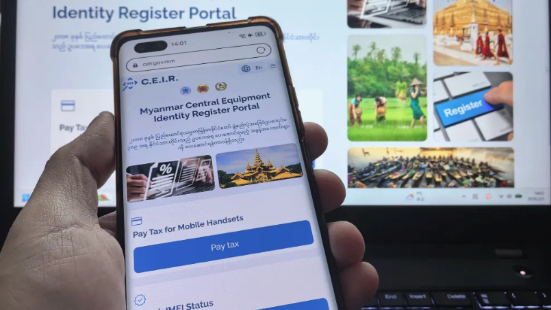
After tightening the registration system for mobile SIM cards used in Myanmar several years ago, the military junta has now announced that, starting April 1, it will implement a plan to tax not only SIM cards but also the mobile handsets in use.
The junta stated that it will require registration of mobile phones using the IMEI (International Mobile Equipment Identity) number embedded in each handset to determine whether the device has paid the required tax. According to the announcement, handsets currently in use with SIM cards from any Myanmar mobile operator before March 31 will not be subject to tax collection, even if taxes have not yet been paid. However, starting April 1, newly registered handsets that were imported without paying tax will be required to do so.
Although taxation on mobile handsets has long existed under customs laws and regulations, requiring registration of each individual handset raises concerns. Digital security monitoring groups suspect that the move is intended to collect users’ personal information — including names, national registration numbers, and addresses — in order to facilitate political surveillance or criminal tracking and arrests.
Some countries around the world use a centralized equipment identity register system known as CEIR (Central Equipment Identity Register) to register mobile handsets. This system is reportedly used for security monitoring related to terrorism, as well as to track crimes such as phone theft and financial fraud. Countries including China, India, the United Kingdom, Uzbekistan, Kenya, Azerbaijan, and Ukraine are said to implement such systems.
Myanmar already enforces SIM card registration. Since those opposing the military coup rely heavily on mobile phones and internet-based communications to coordinate activities and maintain contact, digital data has become crucial evidence. Mobile communications and app-based messaging serve as the lifeblood of modern political movements. At the same time, digital communication traces and tracking systems play a critical role in arrests and crackdowns in today’s political landscape.
In modern underground political movements, digital security and avoiding digital footprints have become matters of life and death. Today, when individuals are arrested on suspicion, authorities no longer need to conduct lengthy interrogations as in the past. Simply confiscating and examining phones and computers can provide access to contact names, numbers, and message contents. Because SIM cards and handsets can reveal precise location data, the arrest of even one member of an underground network can place all connected individuals at risk in this digital and IT-driven era.
While communication technologies offer convenience and efficiency, they also carry the risk that entire networks can fall into enemy hands overnight.
Following the military coup in Myanmar, SIM card registration has been enforced more strictly, and now a mobile handset registration system will also be implemented.
By requiring registration of both SIM cards and mobile devices, the military junta will gain access to two sets of identifying information — SIM registration names and handset registration names — enabling it to track political dissidents whenever necessary.
If a mobile handset is not registered, authorities will be able to block it from accessing mobile phone and internet data services.
For revolutionary activists and civilians living in liberated areas, it may be possible to avoid using military-controlled mobile networks. However, for those living in military-controlled territories or traveling between different areas, it will be necessary to exercise extreme caution when using the new mobile handset registration system.
Some observers believe that certain recent airstrikes in resistance-controlled areas may have been conducted by tracking targets through mobile phone communications. If the junta obtains the phone numbers used by key resistance leaders or individuals under military surveillance, it could result in serious security breaches.
Instead of relying solely on traditional methods such as visual informants to identify the location of an individual or armed group gathering, it is possible that attacks are being carried out through continuous monitoring of SIM cards and mobile device locations. This is a risk that must be taken seriously.
Another important aspect of digital security concerns the risks of traceability among revolutionary forces and in the use of social media platforms. When using Facebook and other social media platforms, it is crucial to avoid exposing location clues. Although there have been numerous incidents in which social media use led to security threats, there remains a failure to adequately learn lessons from those examples.