
Myanmar Spring Chronicle – Scenes from February 27
(MoeMaKa), March 1, 2026
Israel and the United States Launch Massive Airstrikes on Iran; Potential Implications for Myanmar
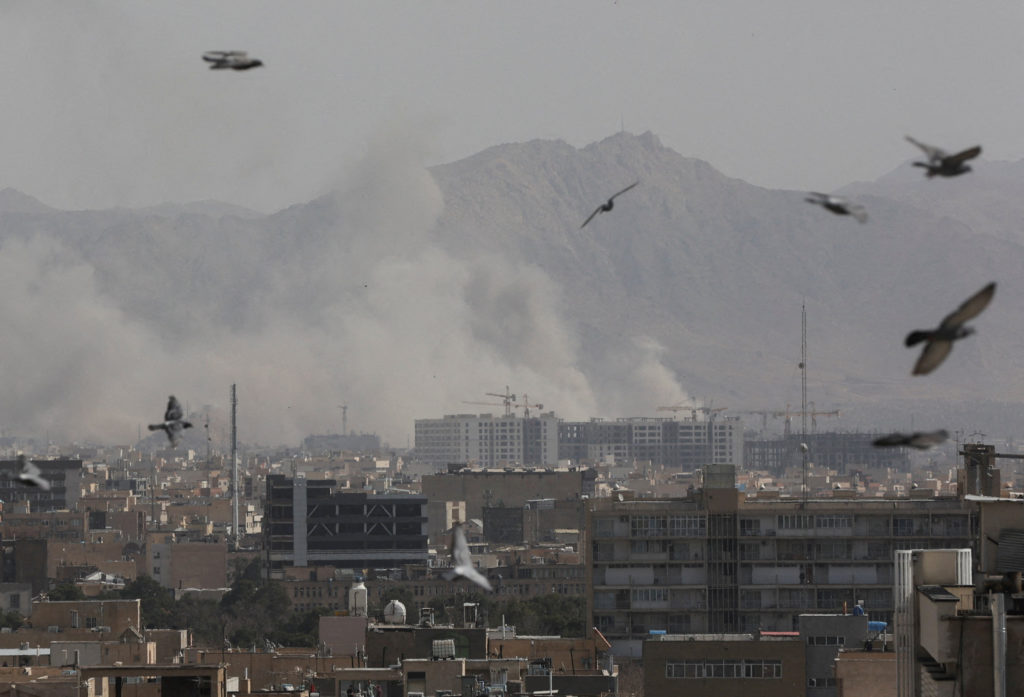
Eight months after last June’s war—during which the United States used powerful bunker-buster bombs to strike Iran’s uranium enrichment research facilities, and Israel carried out attacks with fighter jets and missiles against military, political, scientific, and other government-related targets—on February 28, coordinated airstrikes were launched simultaneously on targets including government buildings in Iran’s capital, effectively declaring war on Iran.
The U.S. president and Israeli leaders have justified the attacks by claiming the need to prevent Iran from acquiring nuclear weapons, to bring down the authoritarian Islamic leadership, and to “liberate” the Iranian people. These narratives have been promoted internationally as the rationale for military action.
However, many observers point to underlying motives: although not as resource-rich as Venezuela, Iran is still one of the oil-producing countries in the oil-rich Middle East, and major U.S. oil corporations lack access to its energy resources. This, critics argue, is a fundamental driver of the war.
For Israel, the objective is to weaken or dismantle Iran’s government, which for over 40 years has supported armed groups opposing Israeli dominance in the Middle East. Regime change in Iran is therefore seen as a strategic goal.
Other justifications—such as regional security concerns, Iran’s support for militant groups, and its nuclear ambitions—are viewed by critics as narratives used to obscure these deeper geopolitical and economic motivations. Much of the Western media has echoed these justifications. While Russia’s invasion of Ukraine was widely labeled an “unprovoked war,” the attack on Iran is being described with more sympathetic terms such as a “preemptive strike.”
Although the United States claims the war is intended to dismantle Iran’s theocratic authoritarian system led by Supreme Leader Ali Khamenei, past precedents raise serious questions. The Iraq War, justified on similar grounds of removing a dictator and securing weapons threats, ultimately resulted in Iraq’s destabilization, the rise of extremist groups such as ISIS, and nearly two decades of civil war and terrorist violence.
Similarly, in Afghanistan—bordering Central Asia—the U.S. armed and trained forces to counter the Soviet invasion, which had sought to prop up a communist government. The unintended consequence was the emergence of groups such as Osama bin Laden’s al-Qaeda. Following the September 11 attacks, the U.S. invaded Afghanistan to topple the Taliban government. After nearly 20 years of war, U.S. forces withdrew, and the Taliban ultimately regained control, reinstating an Islamic governance system.
U.S. rhetoric about regime change in countries like Iran and Afghanistan has repeatedly failed to achieve lasting stability. Instead, those countries endured civil wars, terrorism, sectarian killings, and deep economic decline.
Despite these historical examples, the United States—alongside Israel—has once again deployed its full military, financial, and technological power under the banner of regime change in Iran.
After the fall of the U.S.-backed Shah in 1979, the Shah’s son took refuge in the United States, where he continues to reside. Amid recent protests in Iran, U.S. officials have reportedly signaled openness to positioning him as a potential future leader of Iran.
A genuine political transformation in Iran—overthrowing its religious authoritarian system led by Ali Khamenei—would naturally arise from internal public movements. However, when external powers such as the United States and Israel intervene militarily in pursuit of their own strategic interests, the more likely outcome may not be democracy but instability or civil war.
It is surprising to hear that some Myanmar pro-democracy activists support the U.S. and Israeli military strikes against Iran’s authoritarian regime. While there is little dispute that authoritarianism must end, supporting invasions motivated by oil interests and geopolitical dominance—actions that risk plunging a country into civil war and chaos—reflects a simplistic political outlook.
The collapse of Iran’s religious authoritarian government cannot be viewed as a simple warning signal to dictators worldwide. Global politics is far more complex. The United States does not intervene in every country ruled by oppressive regimes; it acts where its strategic interests are at stake.
Even as renewable energy expands and electricity production increases for vehicles, industry, and households, oil remains a strategic resource.
Myanmar, lacking significant oil and gas reserves or abundant rare earth minerals, and bordering a major power like China, is unlikely—at least for now—to be considered a country of strategic interest to the United States. There is currently little indication that the U.S. would directly intervene in Myanmar’s affairs.