
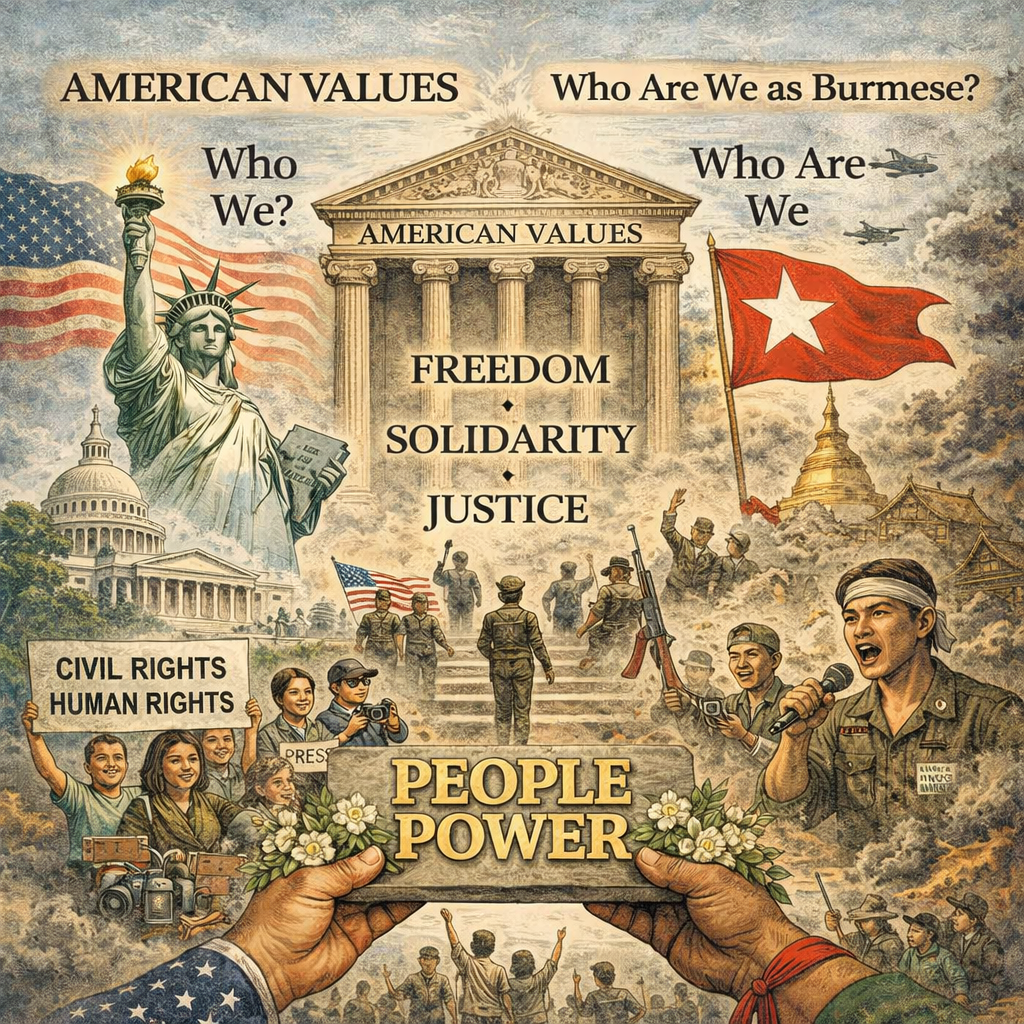
American TheGeek – What Are American Values, and What Are We as Burmese?
(Moemaka, March 19, 2026)
With the current U.S. president, Trump, launching a sudden strike against Iran, it feels as though both America and the world have been thrown into turmoil. Everywhere in the news, the dominant narrative is now the U.S.–Iran war.
What is most unfortunate is that the human values, moral principles, and historical legacy of the United States have become blurred in the public eye. Increasingly, America is being seen in simplistic terms—as lawless, authoritarian, domineering, uncultured, aggressive, racially supremacist, or driven by extremist religious nationalism. Criticism is growing.
Rather than viewing conflicts in their original regional context—such as the complex wars involving Israel and various ethnic and religious groups—people now tend to frame them simply as a U.S.–Iran war. History may well record it this way too.
The United States has carried out repeated military interventions in other countries—not only in the 20th century, but continuing well into the 21st. The idea that humanity would lay down bows and arrows upon entering a new century has proven false. Instead, we entered the 21st century carrying drones and missiles.
The Vietnam War is widely remembered as one of the ugliest chapters in history, and Americans themselves documented it through films and television. Yet wars did not stop there—Afghanistan, Iraq, and now Iran. In between, there have been numerous proxy conflicts across Eastern Europe, the Middle East, and parts of Africa. Even South America has not been free from the imprint of American military presence.
So, as criticism of the United States intensifies, it is worth reflecting: what were the values that once made people admire and respect America—especially before the Trump era?
America’s hard power—its military strength, weapons, and capabilities—is unmatched. That has long been recognized.
But in the past, such power was not exercised recklessly or excessively. When force was used, it was often accompanied by coalition-building, diplomacy, persuasion, and strategic calculation. Now, however, it appears to have crossed into overreach. One key value—that power should not always be used simply because it exists—seems to be fading.
People admired and followed America largely because of its soft power.
American film, music, and entertainment industries have long been dominant. Through them, people around the world consume and internalize aspects of American culture and society.
While earlier eras of American entertainment were often dominated by racial bias and exclusion, over time these industries evolved. They became more inclusive, incorporating contributions from Black artists, as well as from Latin American and Asian communities. This cultural openness is something few other countries have achieved to the same degree.
Another defining value is freedom of speech and expression.
In the United States, individuals are legally protected in expressing opinions, publishing ideas, and sharing information. This is enshrined in the Constitution. Few countries protect such freedoms as strongly.
Because people are allowed to speak freely—even to criticize leaders, expose wrongdoing, or challenge authority—fear is relatively diminished. The press can report on everyone: from government officials to criminals and ordinary citizens. This creates a society where people have access to information, the right to respond, and the ability to hold power accountable.
Americans not only speak for themselves, but often speak on behalf of others who cannot. This is a form of soft power embedded within the people themselves—something admired, even envied, by others around the world.
Even when government funding for public media is cut—when outlets like VOA, RFA, or public broadcasting are weakened—community-supported media such as NPR, PBS, and local stations continue to survive through public contributions.
This demonstrates an important truth: America’s soft power does not belong to the government—it belongs to the people.
(And as a side note—media like Moemaka and m.CDM, which operate through public support, also deserve contributions from the Myanmar community.)
Another example of these values is the belief in civil rights and human rights as inherent rights.
When the Trump administration carried out harsh crackdowns—detaining, abusing, and deporting people suspected of being undocumented immigrants—citizens across the country rose up in protest.
Even when faced with armed force, many responded with nonviolent resistance. Some paid with their lives. Lawmakers themselves joined the opposition. Eventually, senior officials lost their positions.
This demonstrates a powerful civic culture—citizens who are willing to stand up, resist injustice, and defend their rights, even against their own government.
Even in small towns, elderly Americans gather weekly, holding signs that read “NO KING,” protesting consistently without fail. Across generations, Americans show a willingness to challenge authority when it becomes unjust—and they do not burn out quickly like a passing flame.
Another core value is the ongoing effort to strengthen civil society.
Even when funding for international aid programs like USAID is cut, and support for social welfare organizations is reduced, Americans continue to sustain these efforts independently. They push local governments, organize communities, and keep these systems alive.
They advocate for immigrants, the homeless, and vulnerable populations. They continue to fight for environmental protection. They remain engaged in shaping their country through democratic participation.
At the same time, Americans continue to support people beyond their borders.
Even amid war, when civilians suffer, journalists report their stories—and volunteers and donors respond, providing aid and assistance. Refugees often say they know the world has not abandoned them—because after their stories are told, people come to help.
This is the enduring lesson of American soft power: even when governments act with force, the people themselves continue to act with humanity.
American values, ultimately, are not just state values—they are societal values.
For over 250 years, Americans have struggled against tyranny, greed, and authoritarian tendencies to build a nation for all its people. America is not defined solely by those born there—it is also shaped by those who arrive from elsewhere, bringing hopes, struggles, and aspirations, and becoming part of the nation.
At its core is a shared dream: that each generation should build a better future than the one before.
Conclusion
To the people of Myanmar:
No matter what governments, armies, or political parties impose… no matter how ideologies divide us…
Should we not also learn from the noble values of other societies—and build our own?
Rather than defining ourselves as followers of particular leaders or figures, we should define ourselves as the people of Myanmar.
We must lay the foundations of our own values—nurture them, cultivate them, and build them together.