
Myanmar Spring Chronicle – Scenes from March 9
(MoeMaKa), March 10, 2026
25 civilians killed by bombings during clashes in Kyaukkyi Township, Bago Region; conflict between two ethnic armed groups in northern Shan
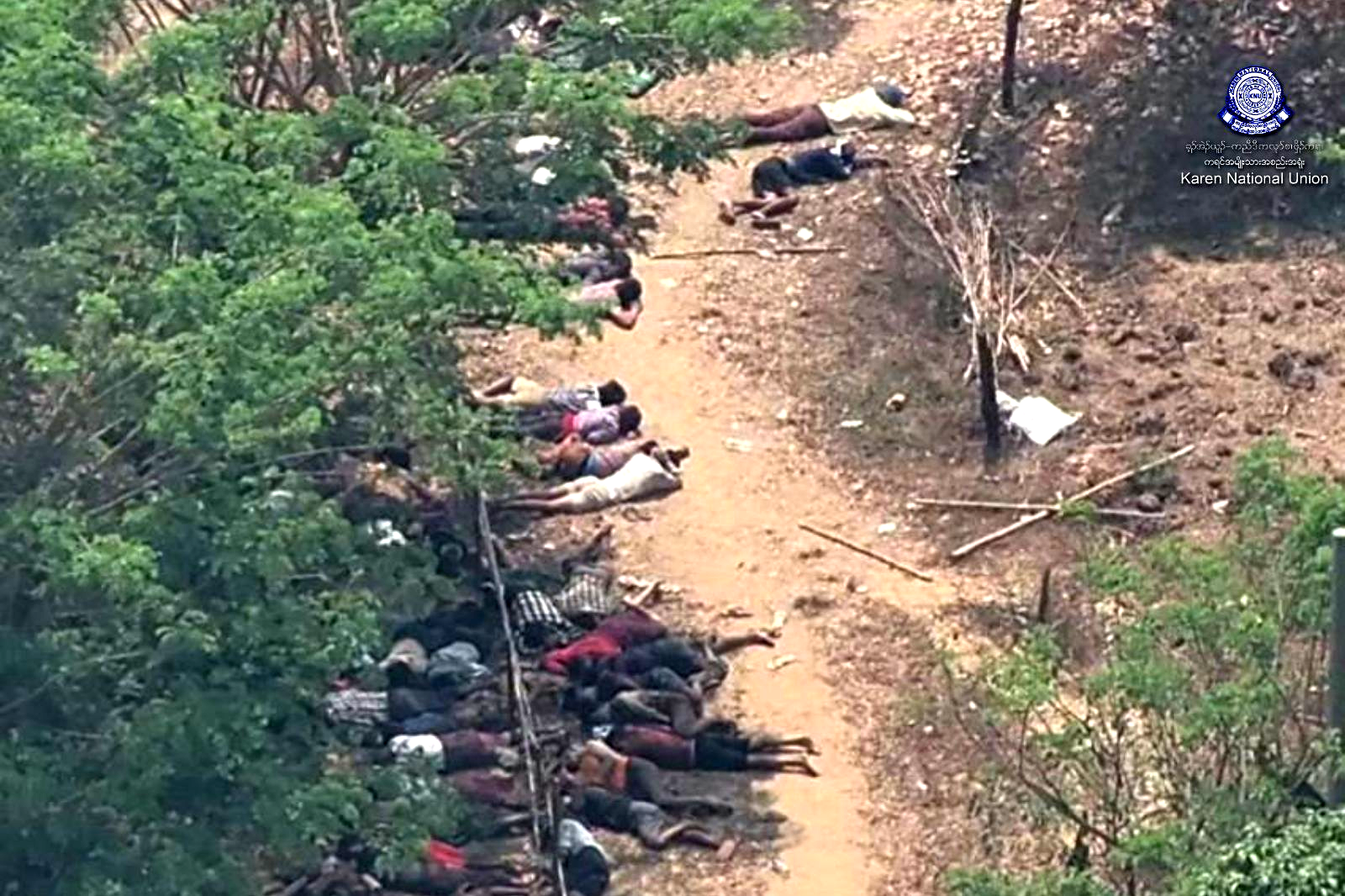
On March 5, in Kyaukkyi Township, Nyaunglebin District, Bago Region, junta troops entered Kaungkone and Darsate villages and detained more than 160 civilians.
While intense fighting was taking place near those villages between the military and the KNLA (Karen National Liberation Army), junta forces carried out airstrikes using drones and aircraft. According to local Karen news agency KIC, around 25 civilians were killed in the bombings.
Among the নিহত were children as young as six and adults up to around 60 years old, including 17 women and 8 men. On the same day, junta troops also entered Htee Phyu Lo village in the same area and killed five local men aged between 35 and 53. In total, around 30 civilians were killed in a single day, according to KIC.
This incident adds to the growing list of cases in which dozens of civilians have lost their lives due to airstrikes and arbitrary arrests and killings. In recent weeks alone, dozens were killed or injured in an airstrike by junta forces on a town in northern Rakhine State. Prior to that, successive airstrikes by the military in Rakhine State, Kachin State, Mogok in Mandalay Region, Sagaing Region, and other areas had resulted in repeated civilian casualties.
The deadliest incidents have occurred in Kachin, Rakhine, and Sagaing Regions. One of the worst single घटनाओं was the April 11, 2023 airstrike on Pazigyi village, in which around 160 people were killed.
Unable to launch effective ground offensives everywhere, the military has increasingly relied on daily airstrikes across the country — from south to north, east to west, including central Myanmar. It gathers intelligence on areas with active fighting, as well as on the movements, gatherings, and supply routes of resistance armed groups, and then carries out aerial attacks.
Although airstrikes alone may not decisively determine the outcome of ground battles, they exert enormous pressure not only on armed resistance forces but also on civilians living in conflict areas and territories controlled by resistance groups.
For ethnic armed organizations such as the MNDAA and TNLA — which participated in Operation 1027 and were able to seize and defend significant territories on the ground — relentless airstrikes were reportedly one of the key factors that pushed them to agree to a ceasefire.
More than five years after the military coup, resistance forces still lack an effective air defense capability. Current protective measures include digging bomb shelters, establishing early-warning communication systems when aircraft are detected, and avoiding mass gatherings to reduce casualties. However, acquiring weapons capable of destroying fighter jets, bombers, helicopters, and gyrocopters remains extremely difficult.
⸻
Tensions between TNLA and MNDAA in northern Shan
Another major development today concerns tensions between two members of the Three Brotherhood Alliance in northern Shan State: the Ta’ang National Liberation Army (TNLA) and the Myanmar National Democratic Alliance Army (MNDAA).
In recent weeks, clashes have reportedly broken out between lower-level armed units of the two groups. As a result, the transport of food supplies, fuel, and goods has been blocked.
Last month, the TNLA removed CCTV surveillance cameras installed on some streets in Kutkai. Following disputes, physical altercations, and even exchanges of gunfire between MNDAA and TNLA personnel, the MNDAA began blocking the transport of food, goods, and fuel into TNLA-controlled areas — a restriction that has now lasted for weeks.
Transport of supplies from Lashio to Kutkai, a town controlled by the TNLA, has been prohibited. Initially, the MNDAA blocked only fuel and rice shipments, but later expanded the ban to other goods as well, according to the local media outlet Shwe Phee Myay.
Among the three groups that formed the Northern Brotherhood Alliance for Operation 1027, two are based in northern Shan — the Kokang (MNDAA) and the Ta’ang (TNLA). Frictions have emerged between them over issues such as territorial control, transit rights, taxation, and administrative authority, leading to the current blockades of goods, fuel, and food.
In previous years, similar lower-level disputes also occurred between the TNLA and the KIA over territorial passage and the placement of security checkpoints. Those tensions were eventually resolved through negotiations between the leadership of the two armed groups.
Political observers note that an effective dispute-resolution mechanism or organizational structure is needed to manage such lower-level conflicts, which risk undermining alliances among forces fighting against military dictatorship. However, no such mechanism currently exists.
Although the Federal Political Negotiation and Consultative Committee (FPNCC), formed during the 2017 peace process and comprising seven ethnic armed groups from northern and northeastern Myanmar, has not been formally dissolved, it is no longer actively functioning.
Throughout Myanmar’s political history, many alliances have been formed. Depending on their founding objectives, authority, and the political context of their time, these alliances have often been suspended, dissolved, or transformed in various ways.