
Myanmar Spring Chronicle – January 31 Scene
(MoeMaKa) February 1, 2026
The Suffering of the Myanmar People Over the Past Five Years
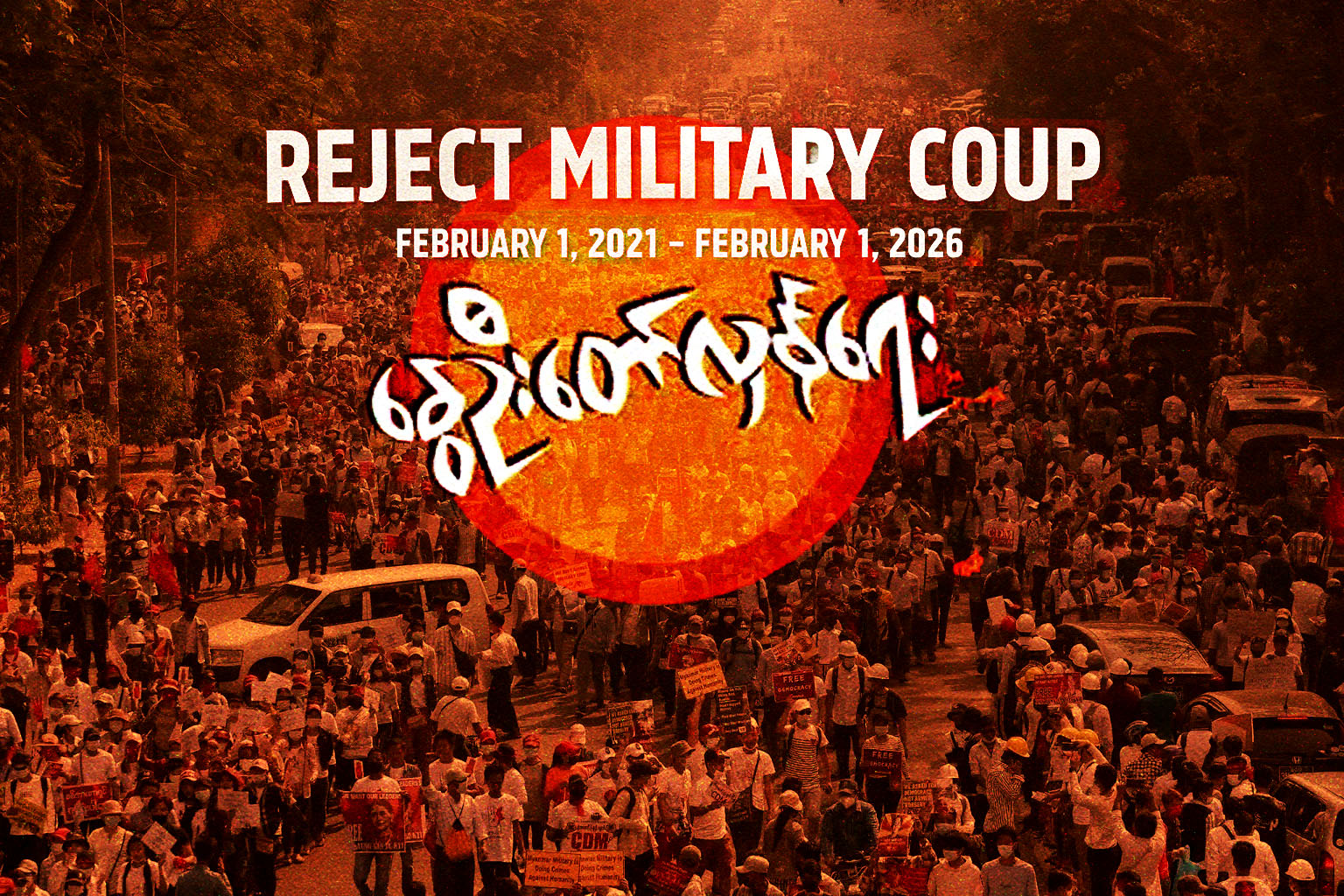
February 1, 2026 marks exactly five years since the military coup of February 1, 2021. Late on the night of January 31, five years ago, the military simultaneously detained most members of the then Union government, some state and regional government officials, and senior figures such as the chair of the NLD, in Naypyidaw as well as in state, regional, and some district capitals. The following morning, security forces and the military surrounded the compound in Naypyidaw where members of parliament were staying in preparation for attending the parliamentary session, effectively preventing them from leaving.
After 22 years of direct military rule, Myanmar had entered what was often described as a decade-long democratic transition from 2011 to 2021. That period came to an abrupt end with the coup, plunging the country once again into a deep abyss—this time into the abyss of a nationwide civil war.
A few months after the 2021 coup, the National Unity Consultative Council (NUCC) was formed. About a month later, the National Unity Government (NUG) was established, followed by the creation of the People’s Defense Force (PDF).
Now, five years on, UN Secretary-General António Guterres has stated that the suffering of the Myanmar people has grown even more severe. He has called for the release of Daw Aung San Suu Kyi, U Win Myint, and other political prisoners, and has pointed out that the Myanmar military continues to openly violate international human rights and humanitarian law without facing accountability. According to the UN Secretary-General’s statement, at least 3.6 million people have been displaced from their homes inside the country, while nearly 5.2 million Myanmar nationals are living and working abroad after fleeing the crisis.
These figures are statistics, but behind each number lies an individual life—stories of hardship, crushed hopes, and people who were forced to leave the world prematurely because they could no longer survive amid relentless suffering. Each of these personal tragedies is far more heartbreaking than numbers alone can convey.
What impact will such statements from the UN’s highest official have on the situation in Myanmar? Realistically, there appears to be little chance of any significant or immediate effect. Although calls and appeals are made to the key actors involved, there are few signs that those actors—especially the coup leaders—are inclined to seriously heed the UN’s words. Here, the “key actors” primarily refer to the military that seized power, and secondly to the armed groups that emerged after the coup, as well as some ethnic armed organizations that existed even before the takeover.
Over the past five years of civil war, how much have these actors achieved their stated objectives? In terms of territorial control, the coup regime has lost control over an estimated 40 to 50 percent of Myanmar’s territory. Large areas of Rakhine State, Chin State, northern and eastern Kachin State, northern Shan State, Kayah (Karenni) State, Karen State, Tanintharyi Region, Sagaing Region, Magway Region, and Bago Region are no longer fully under junta control. In many of these areas, safe and unrestricted travel is no longer possible.
This clearly demonstrates the military’s inability to exercise full control over the country. Many areas where people once maintained stable livelihoods are now unable to sustain farming, livestock rearing, or trade. Ongoing fighting in towns and villages, the destruction that follows battles, insecurity along transport routes, and road blockades have made agriculture and commerce impossible in many places. For local communities, these conditions pose a daily threat to survival and basic food security.
Looking back over the past five years, some ethnic armed organizations have managed to gain control over areas they had not been able to govern for decades. This is particularly evident in Kokang, Ta’ang (Palaung), Karenni, Chin, Rakhine, Kachin, Karen, and Shan areas. After the coup, large numbers of young people who opposed military rule—either voluntarily or under pressure and recruitment by armed groups—joined these forces. With the support of local defense groups, this influx of fighters enabled resistance forces to capture and hold significant territory.
At the same time, the military has launched repeated offensives to retake some of the areas it lost, leaving civilians in these regions unable to live in safety or stability. Many parts of Myanmar remain highly volatile and insecure. Towns that change hands repeatedly and regions frequently subjected to military raids and destruction can be found across Sagaing, Mandalay, Magway, Kachin, Karen, Shan, and Chin areas.
Over the past five years, Myanmar’s natural resources—jade, timber, gold, rare earth minerals, and other ores—have been rapidly depleted. Rare earth mining, considered strategically important on a global scale, has expanded significantly in Kachin State and eastern Shan State, with severe environmental consequences. Gold mining has also spread widely along the upper reaches of rivers such as the Ayeyarwady and Chindwin, as well as across many parts of Shan State.
The consequences of gold mining—river sedimentation, increased flooding during the monsoon season, and the destruction of farmland—are not only immediate but will continue to affect communities for years to come.
In Sagaing Region, even forests within the Alaungdaw Kathapa Wildlife Sanctuary have been heavily logged and sold over the past five years.
Another major consequence of the civil war is the expansion of drug cultivation and production. As the conflict has intensified nationwide, efforts to suppress poppy cultivation and drug manufacturing have collapsed. Revenue from drug production and trafficking has become a significant source of funding for armed groups. While authorities frequently announce seizures of narcotics—whether opium, methamphetamine pills, or synthetic drugs—the true scale of production and trafficking that goes undetected remains unknown.
Five years after the coup, the country has suffered immense regression, destruction, and loss. At the same time, a pressing question remains: how much longer can the people endure these conditions?
In the early months after the coup, some leaders declared that if the people could hold on for just two or three months, victory would be assured. In subsequent years, leaders repeatedly claimed that each new year—or the next—would be the decisive year for the revolution. At times, it seems there is also a responsibility for these leaders to return to the public, explain what has happened, and offer apologies for unmet expectations.
Political leaders and public figures who claim to lead the people must now reflect honestly on the past five years—critically reassessing their organizations, strategies, and paths forward. It is time to set future plans, methods, and goals with empathy for the people’s suffering. Policies based solely on reliance on others, waiting for salvation to fall from the sky, or interpreting every situation through a one-sided lens must be reexamined.