
Myanmar Spring Chronicles, February 1
The Fate of Anti-Dictator Revolutions and Anti-Dictatorship-System Revolutions
One may ask: what is the difference between opposing a dictator and opposing a dictatorship system? How do the terms anti-dictator revolution and anti-dictatorship-system revolution differ?
Wanting to overthrow the current dictator who has seized and is exercising power can be called an anti-dictator revolution. The latter term—anti-dictatorship-system revolution—means wanting to oppose the existing authoritarian system itself and replace it with another, non-authoritarian system.
One is driven by opposition to a particular individual or a specific group, aiming to bring them down or defeat them. The other reflects rejection of the system rather than the individual.
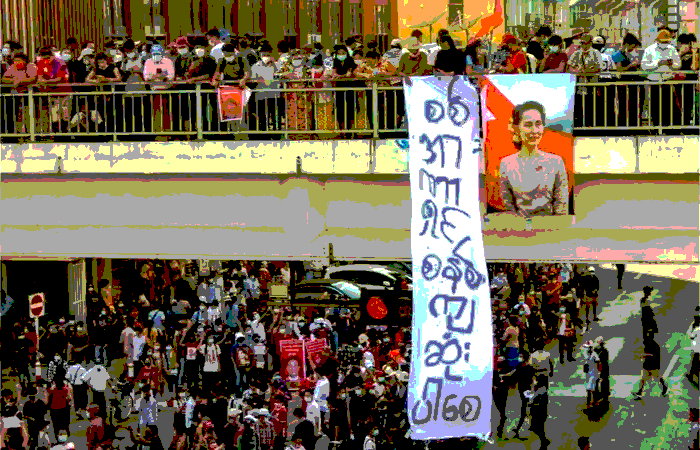
In Myanmar, it has now been five years since people began resisting the coup leader Min Aung Hlaing and the military, whether through protests or armed struggle, after the military coup. Similarly, after the 1988 coup, people used protests, underground movements, and armed resistance to bring down General Saw Maung, who led the coup at that time—engaging in both anti-dictator and anti-system struggles.
During the so-called “Burmese Way to Socialism” military dictatorship era, and later during the periods when the country was ruled under the name of a military government after 1988, some resistance forces focused their mobilization on a single dictator, centering their message on removing that one person. In particular, political forces with right-wing ideas (ideologies that accept capitalist economic systems and values) tended to mobilize in this way, while groups with left-wing beliefs primarily targeted the dictatorship system itself.
Campaigns that frame the problem as being caused by a single individual are often easier for mass mobilization. It is relatively easy to persuade people that the country’s decline and the public’s suffering are due to one dictator’s personal desires, decisions, ego, or family interests. Those who hold left-wing views, however, argue that a dictator is merely a representative produced by a dictatorship system, and that even if one individual is removed, another similar figure can emerge as long as the system remains.
During the BSPP military dictatorship era, many people believed that Myanmar had become one of the poorest countries because of Ne Win, and that once he was removed, the country would change. In reality, after the 1988 coup, other figures representing the same military dictatorship system—Than Shwe and Khin Nyunt—rose to power and ruled for more than another 20 years.
A coup merely changes the outer appearance or uniform of the dictatorship system and passes it on.
This is not meant as praise or advocacy of left-wing ideology. Left-wing analysis tends to approach political systems and events with minimal emotional bias and from a materialist perspective, helping to reveal the nature and inner workings of authoritarian and military dictatorship systems, and to analyze historical events accordingly. At the same time, left-wing thought also includes groups that advocate establishing a classless authoritarian system (communism), so this is not an attempt to promote left-wing ideology. Rather, the point is that it is important to analyze historical and political events based on what actually exists, not on what one wishes to exist.
Related to this is a short introductory post written on Facebook by an account named Maw Thaw Aye Lae, titled “Authoritarian Systems, Military Coups, and Political Transitions (Why Is Democracy So Hard to Achieve?)” (original post link provided). The article argues that when authoritarian systems collapse, the main reason democracy is difficult to achieve is the lack of strong institutions.
Based on research into 280 cases worldwide between 1946 and 2010, the article states that only about 25% of collapsed dictators or authoritarian systems transitioned to democracy. According to the authors’ criteria, even if a dictator or leader falls, the dictatorship system has not collapsed if the governing structure remains intact.
In Myanmar’s case, from the Revolutionary Council and the Burma Socialist Programme Party after the 1962 coup, through the SLORC and SPDC eras after 1988, although individual dictators changed, the military dictatorship system continued uninterrupted.
This also suggests that even when attempts are made to dismantle the dictatorship system, there has not been a fully prepared, organized institution or governing force ready to step in and replace it. During the 1988 uprising—from August 8 (8-8-88) through about a month and ten days—there were periods of power vacuum. Although strike committees and local community leaders maintained order in towns and villages, there was no unified, vertically organized national organization. In that context, U Nu attempted to form an interim government, but other forces did not cooperate or opposed it, and within days another military coup was announced.
After the 2021 coup, the uprising took the form of armed resistance. While there is broad agreement on dismantling the military dictatorship system, it would not be wrong to say there is still no shared consensus on what kind of state should be built afterward. Looking back on the past five years, some events are still too recent and too close to be assessed clearly. Personal involvement or emotional ties to respected individuals or organizations also make objective analysis difficult.
However, one question must be asked: is there truly 100% commitment to dismantling the military dictatorship system itself? While there is a clear desire to defeat Min Aung Hlaing’s military, is the vision afterward one in which a different kind of army—still armed and decisive in all matters—rules the country? Or is the aim genuinely democratic governance?
It is crucial to avoid marching under a nationalist banner toward a militarist system where an armed force governs without democratic substance. What matters is not merely changing rulers, but changing the system and building democracy.
If that is the goal, then the replacement must be ready immediately after dismantling the military dictatorship. It is also vital to prevent a power vacuum from being filled by another dictatorship system with new faces.
In recent years, countries in South Asia such as Bangladesh, Sri Lanka, Nepal, and Madagascar have seen mass protests and movements that brought down corrupt governments and authoritarian leaders. After violent protests with hundreds of deaths, leadership changes occurred. Interim leaders or trusted figures were appointed as prime ministers to organize elections. Whether protesters’ aspirations will be fulfilled and whether they will reach their intended goals remains to be seen.
History also shows many examples where, after mass uprisings remove dictators, the power vacuum is filled by military leaders—already part of a strong, hierarchical organization—who step in and take control. It is extremely important to remain aware of this recurring pattern in contemporary history.