
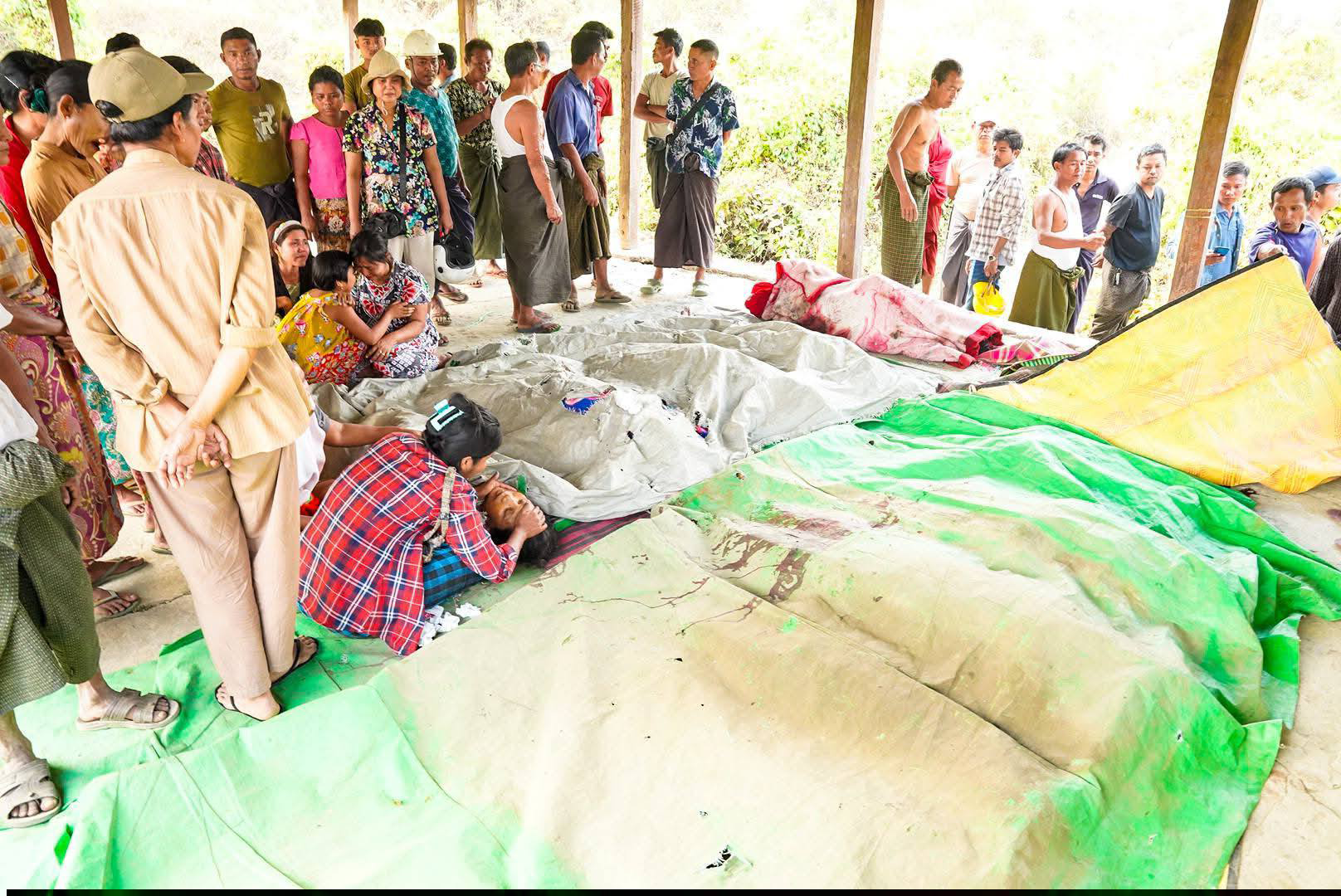
Myanmar Spring Chronicle – Scenes from February 24
MoeMaKa), February 25, 2026
The Coup Military Seeking Advantage Through Relentless Airstrikes
Since 2024 and 2025, the frequency of airstrikes has increased to roughly two to three times compared to the early coup years of 2021 and 2022. In 2026 as well, the military has increasingly adopted airstrikes as a strategic tool to regain territory, weaken revolutionary armed forces, and minimize casualties on its own side.
Following the sharp escalation of the civil war in 2023, the military dramatically intensified its use of air power — deploying available troops, aircraft, financial resources, and munitions nationwide — reaching approximately 1,200 airstrike incidents per year, according to research by ISP Myanmar.
After the October 27, 2023 “Operation 1027” in northern Shan State, followed weeks later by the Arakan Army (AA) offensive in Rakhine State and the “Operation 1111” in Karenni State, the coup military suffered consecutive ground defeats and repeated losses in positional warfare.
In central Myanmar (Anyar region), despite limited weaponry, PDF units and local defense forces (LPDFs) were able to significantly challenge the military using manpower and improvised explosive devices. As a result, the military’s territorial control visibly weakened, leading it to rely more heavily on airstrikes.
Before the enforcement of the conscription law — during late 2023 and early 2024 — the military was facing severe manpower depletion and insufficient troop deployment capacity. During that period, airstrikes became a primary method of warfare.
In the early coup period, airstrikes were typically used only during active battles or when defending bases under intense attack. Recently, however, the military has expanded their use to areas without active fighting, targeting locations believed to house or gather revolutionary forces based on collected intelligence.
While it is unclear exactly how the military gathers its intelligence, airstrikes have frequently targeted schools, monasteries, hospitals, and gathering places.
For example, in Pazigyi village in Kanbalu Township, Sagaing Region, an airstrike occurred during a community event held for the opening of a local defense office. Hundreds of villagers had gathered, and more than 170 people were killed in a single incident — one of the deadliest air attacks recorded.
Similarly, the airstrike on the school in Let Yet Kone village, where children were studying, was another deeply tragic incident.
From 2024 through 2025 and into early 2026, airstrikes have occurred almost daily in central Myanmar, Rakhine, northern Shan, Kachin, Karenni, and Mandalay regions. With over 1,000 airstrikes annually out of 365 days, this amounts to an average of at least three airstrikes per day.
In areas bordering China, some ethnic armed groups have faced sustained airstrikes. At the same time, with China’s assistance, border trade restrictions were reportedly used as pressure to push for ceasefire agreements.
Airstrikes are viewed as one of the major factors behind the ceasefires reached by TNLA and MNDAA.
The question of how to defend against the military’s one-sided airstrike strategy has been raised for years. Proposed responses include:
- Strengthening early warning systems
- Building bomb shelters
- Avoiding large public gatherings
- Acquiring anti-aircraft weapons
- Lobbying internationally to restrict aviation fuel supplies to the military
Early warning systems have some effectiveness, but limitations remain. There is often insufficient time to predict aircraft direction and intended targets accurately. Communication tools are limited, often relying on walkie-talkies, while internet and radio systems are unavailable in many areas.
After years of conflict, internet and mobile networks have been damaged or cut off. Satellite systems like Starlink are not widely accessible to civilians.
Although early warning systems exist to some degree, the inability to predict which town or village will be targeted remains a serious vulnerability.
Recently, air attacks are no longer limited to fighter jets and helicopters. Gyrocopters, powered paragliders, and drone-dropped bombs are increasingly being used in combination. Military regional commands can launch attacks on revolutionary-controlled areas within less than an hour.
While airstrikes may not directly determine territorial control, their indirect consequences are significant. Prolonged exposure to airstrike threats over months and years creates severe hardship for civilians, making survival difficult and potentially weakening public support for the revolution.
For revolutionary armed forces, it is urgently necessary to strengthen air defense protection, reduce civilian harm, and intensify efforts to limit airstrike capabilities through strategic mobilization and advocacy.