
Myanmar Spring Chronicle – Scenes from February 25
MoeMaKa), February 26, 2026
Myanmar will purchase soybean meal from the United States.
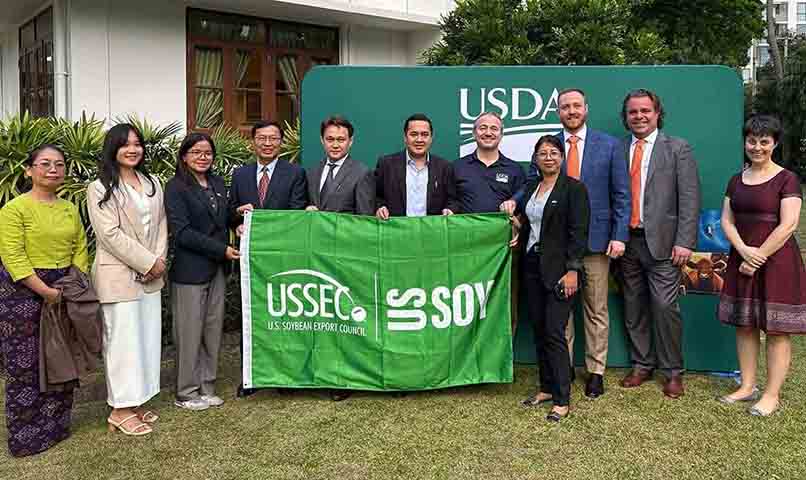
Myanmar Agribusiness Public Corporation Limited (MAPCO) has signed an agreement with the U.S. Soybean Export Council, the organization responsible for selling U.S. soy products, to buy approximately $60 million worth of soybean meal produced in the United States. The news was published yesterday on the website of the U.S. Embassy in Myanmar.
Although this purchase of soybean meal from the United States is not a new development, in previous years Myanmar has imported U.S.-produced soybean meal either directly or indirectly through intermediary countries such as China and Thailand.
Following the 2021 military coup, financial sanctions imposed by the United States on Myanmar, as well as procedural obstacles related to imports, may have led to imports being conducted through intermediary countries as mentioned above.
Soybean meal is primarily used in the production of animal feed. Both domestic and foreign companies operating in Myanmar use soybean meal as a raw material for manufacturing feed for livestock. Normally, Myanmar imports around $40–50 million worth of soybean meal annually.
Amid strained relations between the U.S. government and Myanmar’s military regime after the coup, observers view it as unusual that the U.S. Embassy in Myanmar specifically highlighted the signing between MAPCO and the U.S. Soybean Export Council.
The U.S. government, which had consistently criticized the military regime and provided non-lethal and technical assistance to the National Unity Government (NUG) opposing the military, has undergone major shifts in international aid policy since President Trump took office. It is also apparent that, unlike former President Biden, the current administration shows less interest in Myanmar’s affairs.
The United States has suspended temporary protected status for people from Myanmar residing in the U.S., and Myanmar has also been included on the list of countries subject to visa restrictions.
Late last year, the U.S. formally notified the military council government regarding increased tariffs. This move was criticized by revolutionary forces, as it was seen as implicitly recognizing the military regime.
It is widely known that President Trump prioritizes actions aligned with U.S. national interests over supporting forces that oppose authoritarian regimes or governments committing repression and violence against their own citizens.
Under such circumstances, questions arise as to why the embassy website deliberately highlighted the soybean meal purchase. Some observers speculate that Myanmar may be acting as an intermediary to facilitate exports to China.
In reality, however, China can directly purchase from the United States if it wishes. There would be no need to route purchases through Myanmar. In fact, since mid-last year, when trade tensions between China and the United States escalated and the U.S. decided to impose high tariffs, China retaliated by deciding to stop purchasing soybeans grown by American farmers. Instead of importing from the United States, China bought from Latin American countries such as Brazil as part of its countermeasures.
China’s reduction in soybean purchases significantly lowered demand for U.S. farmers’ produce, a move intended to create friction between American farmers and the U.S. president.
As a result of these circumstances, the United States has been seeking new markets to sell soybeans and soybean-related products such as soybean meal.
Therefore, the news that Myanmar will purchase soybean meal can be seen as part of the reason the U.S. Embassy chose to publicize the matter.
Some political analysts speculate whether this “soybean meal diplomacy” could lead to improved relations between Myanmar’s military regime and the U.S. government, or whether Washington is shifting toward greater engagement with the junta. However, in reality, there are no other signs yet indicating that such developments are taking place.