
Myanmar Spring Chronicle – Scenes from February 20
MoeMaKa), February 21, 2026
Drop Bomb Hits Passenger Plane at Myitkyina Airport; KIA’s Future Outlook
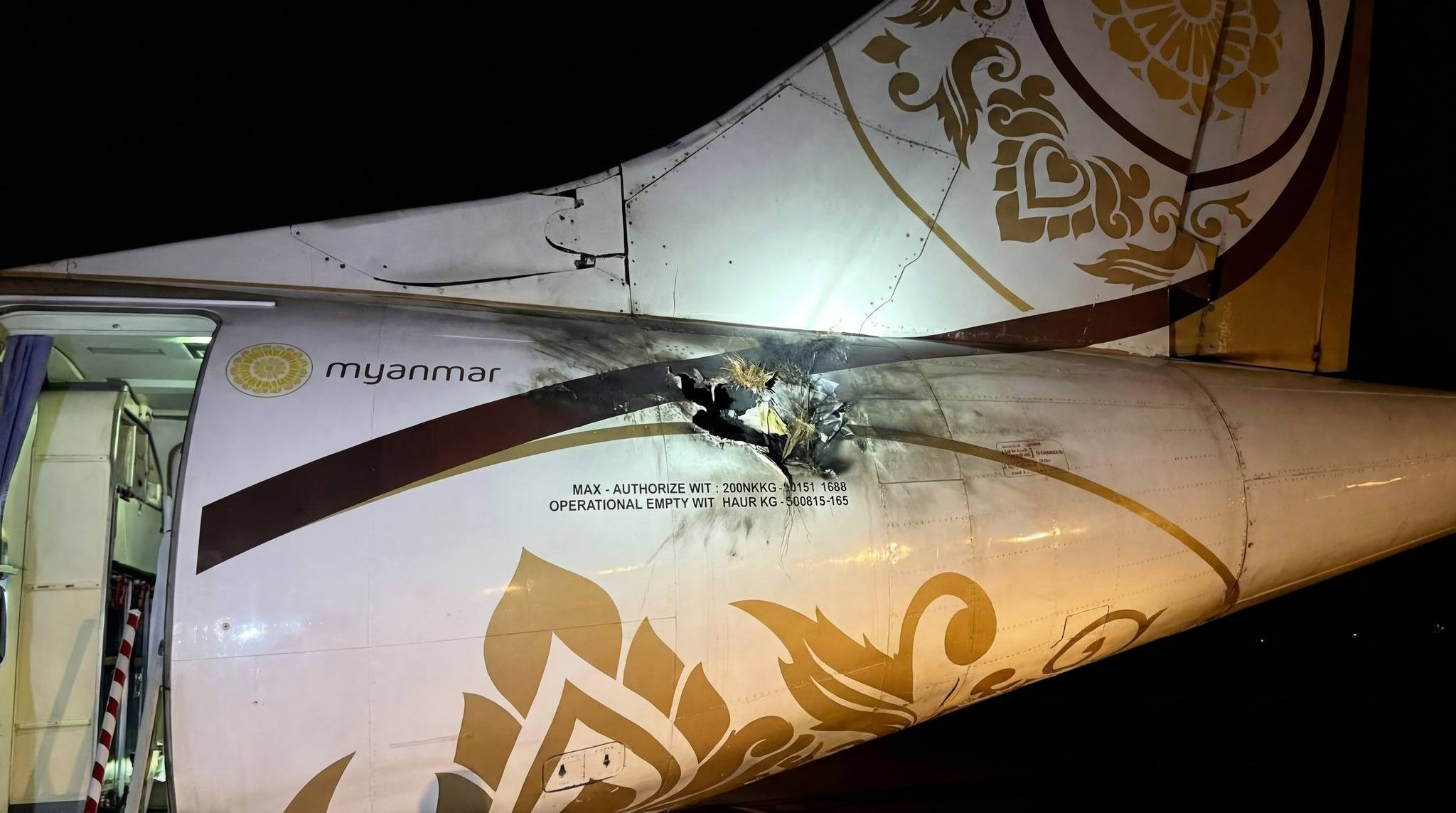
A state-owned Myanmar National Airlines (MNA) passenger aircraft preparing to depart from Myitkyina to Mandalay was struck by a suicide drone bomb at around 8:45 p.m. on February 20, just as it was getting ready for takeoff. The explosion caused minor fire damage to the aircraft. According to a statement released by the military junta and reports from other media outlets citing eyewitnesses, no passengers were injured.
On the same night, around midnight, artillery shells reportedly landed in three locations in the Sitar Pu ward of Myitkyina. One shell struck a house, injuring a mother and her child, according to news reports.
Although fighting has occurred across Kachin State over the past five years, this appears to be the first time that artillery shells have landed in Myitkyina city and that the airport has been attacked with suicide drones.
The military junta has accused the Kachin Independence Army (KIA) and People’s Defense Force (PDF) units of carrying out the attack on the MNA passenger aircraft. However, KIA spokesperson Major General Naw Bu said they do not yet know which group was responsible. He added that the KIA has no reason to attack a civilian passenger plane.
In recent years, the KIA has seized large areas previously controlled by Border Guard Forces led by Zahkung Ting Ying in northeastern Myitkyina, including Panwa and surrounding territories. The KIA has also captured significant territory in the Hpakant region, as well as areas such as Mansi and Momauk southeast of Myitkyina. However, there had been no indication of an intention to attack Myitkyina itself. The recent attack on Myitkyina Airport has led to speculation about whether the city could become a target.
Currently, the KIA is engaged in clashes with junta forces in Hpakant and has been fighting the battle to capture Bhamo for over a year.
In recent weeks, during an online speech marking Kachin Revolution Day, KIO/KIA Deputy Commander-in-Chief Lieutenant General Gun Maw discussed the history of the KIO/KIA’s armed struggle and outlined certain military and political objectives and approaches following the 2021 military coup.
He recalled that during peace negotiations in 2016 and 2018, they had told military and government leaders that if a meaningful peace result could be achieved before 2025, they should pursue it. Otherwise, after 2025, the aspirations of ethnic armed organizations would change.
He stated that before 2025, they could accept the objective of a “Union of Myanmar.” However, after that period, the goal would shift toward a “Federal Union.” Lieutenant General Gun Maw had previously mentioned this position in interviews with media outlets in past years.
Gun Maw also emphasized KIA’s engagement with other ethnic armed organizations in northern and northwestern Myanmar, including relations with the Chin National Front (CNF) and armed groups in the Naga region, during the Kachin Revolution Day event.
An analysis of these remarks suggests that the KIA is prioritizing the interests of the Kachin national revolution. There are signs of reassessment and strategic recalibration regarding its headquarters along the China–Myanmar border, communication routes, logistics, consumer goods supplies, arms and ammunition, and the export of Kachin State’s natural resources through neighboring China. He also indicated that the stability and security of neighboring regions bordering Kachin State, such as Sagaing Region, are being closely monitored in consideration of Kachin State’s interests.
The KIA may consider relocating its base, if necessary, from the China–Myanmar border westward toward the India border region, or positioning itself to maintain connections with both the China and India borders. It may also seek to mitigate potential threats from Myanmar military forces advancing from the south by strengthening relations with allied armed groups in Sagaing Region, which could serve as a buffer zone.
These could be preparations for post-2025 strategic objectives and potential risks.
For the National Unity Government (NUG), which has forces stationed in Sagaing, Magway, and Mandalay regions, maintaining a strong alliance with the KIA is important. At the same time, it should also develop and maintain its own strategic vision.