Myanmar Spring Chronicle – Scenes from February 9
(MoeMaKa), February 10, 2026
Could talks between the NUG, ethnic armed organizations, and the military become possible?
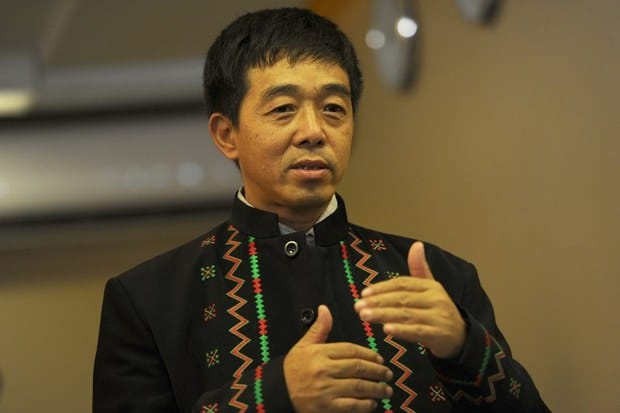
In recent days, at Kachin Revolution Day held in the U.S. state of Texas, the Vice Chairman (1) of the Kachin Independence Council (KIC), Lieutenant General Gun Maw, delivered an online speech in which he said that they had asked the military regime in Naypyidaw whether it had the desire to talk with the NUG. This statement has been highlighted as one of today’s top news stories.
According to the Myitkyina News Journal page, Lieutenant General Gun Maw’s exact words were as follows:
“Up to today, the principle we have followed is to work together with revolutionary forces. We speak openly to the Naypyidaw government. Talking only with the KIO alone will not be sufficient. We have asked whether Naypyidaw has the desire to talk with the NUG. We have already made it clear to the international community and neighboring countries that the KIO will not accept a model of talking separately with individual groups.”
When examining the phrase “we speak openly to the Naypyidaw government,” it also suggests that the KIA has existing channels of communication with Naypyidaw. From a political perspective, it is not unusual for an ethnic armed organization to maintain communication channels with the military. However, in the eyes of the public, this appears to contradict the widely held belief that armed struggle would continue until a decisive and final victory is achieved.
During the fighting over the capture of Bhamo last August, reports also emerged about discussions regarding possible talks between the KIA and Naypyidaw. At that time, disputes arose over the location of a potential meeting and over which side had made the first approach.
On the one hand, the KIA appears to be fighting to gain military advantage; on the other hand, it is also keeping channels of communication with the military open.
It can be assumed that the KIA understands the nature of a civil war that has lasted for decades—namely, that neither side is likely to achieve a complete and absolute victory. For other ethnic armed organizations as well, rather than pursuing total victory, the primary objectives are likely to be maintaining control over their territories and, when possible, creating buffer zones to prevent fighting from reaching their controlled areas and to avoid territorial losses.
For the current coup-installed military regime, engaging in talks with ethnic armed organizations would be aimed solely at gaining advantages in the military situation it is facing. Rather than negotiating simultaneously with all groups, it is likely to adopt differing stances and bargaining approaches toward each armed group individually.
Looking at historical records from more than 70—nearly 80—years of civil war, as well as the five years since the coup, simultaneous negotiations with both ethnic armed organizations and non-ethnic armed groups can only be found during the period from 2011 to 2020.
During the AFPFL era and the 1963 peace talks initiated by the Revolutionary Council that seized power in the 1962 coup, negotiations were conducted separately with individual groups. After 1963, talks with armed groups were rare. Although there were negotiations with the Communist Party of Burma in 1981 at China’s urging, they did not produce any significant results.
After the 1988 coup, under the State Law and Order Restoration Council (SLORC), special regions were established and ceasefires that did not require disarmament were implemented. This led to the emergence of many so-called “peace armed groups.” Numerous ethnic organizations—including Kokang, Pa-O, the KIA, the NDA-K led by U Zahkung Ting Ying, Mong La, Mon, and the DKBA—became ceasefire groups. However, they were unable to engage in political dialogue until 2011–2012.
After 2011–2012, preparations and discussions leading to the Nationwide Ceasefire Agreement (NCA) can be regarded as the first genuine political negotiations in more than six decades. However, these talks came to a halt after the 2021 military coup, pushing many armed groups back toward military means.
With the emergence of numerous armed groups not only among ethnic minorities but also among the Bamar majority, the flames of civil war across the country intensified rapidly.
In reality, armed groups do not rely solely on military methods such as launching offensives and capturing towns and territories; they also make use of political methods, including dialogue and negotiations, depending on circumstances. When in a weak position, negotiations may be used as a tactic to prevent further loss of ground. Even when in a strong position, talks may be used to preserve existing gains by engaging with the opposing side.
Dialogue is also an unavoidable stage or process that ruling governments and armed revolutionary forces must pass through at some point. Negotiations can even serve as a lifeline for an organization or an armed force. Whether the enemy is stronger or one’s own side holds the advantage, there are situations in which dialogue is employed as a political, rather than purely military, strategy.
By studying historical events, one can understand that negotiations should not be automatically equated with abandoning the revolution or surrendering to the enemy.
Therefore, Lieutenant General Gun Maw’s recent question to Naypyidaw—whether it wishes to talk with the NUG—does not imply that revolutionary forces have become weak, nor can engagement in dialogue be automatically judged as a betrayal of the revolution. A study of history makes this clear.