
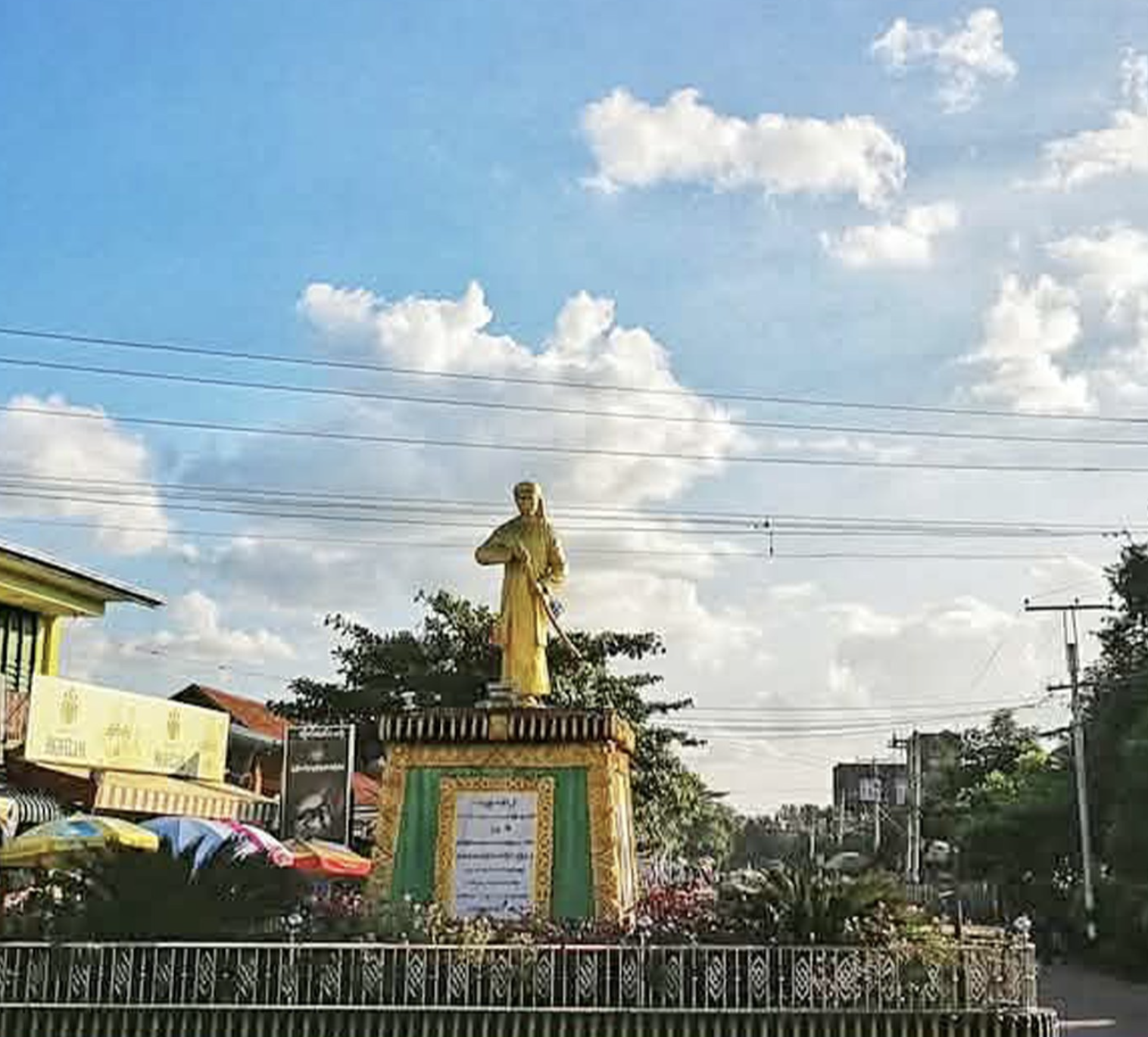
Myanmar Spring Chronicle – January 6 Scene
January 7, 2026
PDF forces announce they will also attack Wuntho while fighting to seize Katha
While efforts were underway to hold the first phase of the election scheduled for December 28, PDF forces under the National Unity Government (NUG), together with allied forces, launched an offensive to seize Katha town in northern Sagaing Region. Nearly ten days later, the Wuntho PDF force announced on January 5 that PDF units would also carry out an offensive to seize Wuntho town, which is part of Kawlin District, and urged local residents to evacuate no later than January 9.
This announcement came even though Katha town, which has been under attack since December 28, has not yet been fully captured. Instead, PDF forces declared that they would open another town-seizure battle in Wuntho, located southwest of Katha in upper Sagaing Region.
To the south of Wuntho lies Kawlin town, which was seized by NUG-aligned PDF forces in November 2023, but after a few months, junta troops counterattacked and recaptured it in early 2024 and have controlled it up to the present. Although NUG-aligned PDF forces also launched attacks on Kawlin again in mid-last month, junta forces still retain control.
In upper Sagaing Region—Kawlin, Wuntho, Banmauk, and Katha—NUG-aligned PDF battalions, ABSDF armed units, and their ally, the Kachin Independence Army (KIA), are operating jointly. It is believed that NUG-aligned PDF forces deliberately launched the Katha offensive to coincide with the election date. Katha town had been included in the first phase of the election planned by the coup regime for December 28, but due to the PDF-led town-seizure offensive, the election could not be held there.
After around nine days of fighting, PDF and allied forces have not yet been able to fully seize Katha town. They have taken control of some wards and are still attacking junta Infantry Battalion Light Infantry Battalion (LIB) 309 stationed in the town.
According to reports, large numbers of civilians are fleeing toward Kachin State, other towns within Sagaing Region, and Mandalay Region. Katha town is located on the western bank of the Ayeyarwady River, and most evacuees are reportedly traveling via Nabar town along the Mandalay–Myitkyina railway line toward Mohnyin, Mogaung, and Myitkyina in Kachin State.
Katha is situated along the Ayeyarwady River and lies on the river route between Mandalay and Myitkyina. It also occupies a geographically strategic position connecting to Momauk and other areas in northern Shan State to the northeast.
Although Katha has a population of over 150,000, the exact number of people who have fled is still unknown. Observers are also considering whether the KIA intends to open a new front to support the Banmauk town-seizure battle, which the KIA has been fighting for over a year without either side achieving a decisive victory. Although NUG-aligned PDF forces and units belonging to the recently formed Spring Revolution Alliance (SRA) are involved, it is also possible that KIA support and strategic guidance are playing a role in military operations in these areas bordering northern Kachin State.
The prolonged Banmauk battle has become a matter of prestige not only for the coup regime but also for the KIA. It is therefore worth considering whether the offensives in Katha and Wuntho are being conducted as part of a strategy to prevent junta forces stationed in Banmauk, Katha, Wuntho, and Kawlin from consolidating their strength, thereby facilitating a successful capture of Banmauk.
Seizing territory—especially towns that control enemy supply routes and possess easily exploitable natural resources such as jade and gold—has been a key strategy of the coup military. It is almost certain that the NUG and other ethnic armed organizations are also adopting similar strategies. However, it is not yet possible to say whether the offensives in Katha and Wuntho are directly related to such strategic objectives.
If NUG-aligned PDF forces and allied units are indeed conducting town-seizure battles based on such a strategy, then it is inevitable that local residents will have to flee and suffer the loss of property. However, if these offensives are merely conducted to support other military operations, without the ability to hold the towns for the long term and resulting in the towns falling back into enemy hands, there is a serious risk that local populations will become disillusioned with such offensives and that public support will decline. This is a concern that should be carefully taken into account.