Myanmar Spring Chronicle – January 13 Snapshot
January 14, 2026
Myanmar at the ICJ over the Rohingya Genocide
In connection with the genocide committed by Myanmar’s armed forces in northern Rakhine State during August and September 2017, the African country of The Gambia filed a case against Myanmar at the International Court of Justice (ICJ). The Court held admissibility and preliminary hearings twice, in December 2019 and February 2022, and is now conducting the main hearings in January 2026.
There are two international courts in the world. The first is the International Court of Justice (ICJ), which is linked to the United Nations and has jurisdiction over disputes involving UN member states. The second is the International Criminal Court (ICC). The ICC is not part of the UN system and has jurisdiction only over states that are parties to the Rome Statute.
By its nature, the ICJ hears cases brought against states, meaning the responsibility lies with governments as such. The ICC, by contrast, prosecutes individuals. In addition, special international criminal tribunals—such as an “International Criminal Tribunal for …”—can be established by UN Security Council resolutions to prosecute individuals. A well-known precedent is the tribunal for the former Yugoslavia, which prosecuted those responsible for war crimes and genocide committed in regions such as Serbia, Croatia, and Bosnia, including former Serbian President Slobodan Milošević, former Bosnian Serb leader Radovan Karadžić, Serbian military commander Ratko Mladić, and many others. These tribunals—such as the International Criminal Tribunal for the former Yugoslavia (ICTY), created by the UN Security Council—are ad hoc courts established for specific situations and have the authority to prosecute individuals.
With regard to the genocide and war crimes committed against the Rohingya minority in northern Rakhine State in 2017, the case is not being heard by a special ad hoc tribunal like that for the former Yugoslavia. Rather, it is a case brought against a state before a standing court, the ICJ.
In November 2017, The Gambia filed the case against Myanmar as the applicant state over the Rohingya genocide. At the time the alleged genocide occurred, Myanmar’s government was led by President U Htin Kyaw, State Counsellor Daw Aung San Suu Kyi, and Commander-in-Chief of the Defence Services Min Aung Hlaing. When the case was filed, however, the president was U Win Myint.
In December 2019, Daw Aung San Suu Kyi—then State Counsellor and also responsible for foreign affairs—led Myanmar’s delegation to The Hague to present the country’s defense at the first hearing.
Following the initial hearings in December 2019, during which The Gambia presented its application and Myanmar submitted its counter-arguments, the ICJ issued provisional measures in January 2020, ordering Myanmar to take steps to protect the Rohingya. At the first hearing, the Myanmar delegation led by Daw Aung San Suu Kyi submitted arguments rejecting the allegation of genocide. In essence, Myanmar denied the charge of genocide, arguing that while the military may have used force and that war crimes might possibly have occurred, the actions did not amount to genocide.
Daw Aung San Suu Kyi’s personal appearance at the ICJ on Myanmar’s behalf drew criticism from some international and domestic political and human rights activists, who viewed it as a grave mistake. They argued that there was no need to shield the military from responsibility and called for the truth about what happened in northern Rakhine State to be brought to light. Many Western governments and institutions subsequently revoked awards and honors that had been bestowed on Daw Aung San Suu Kyi.
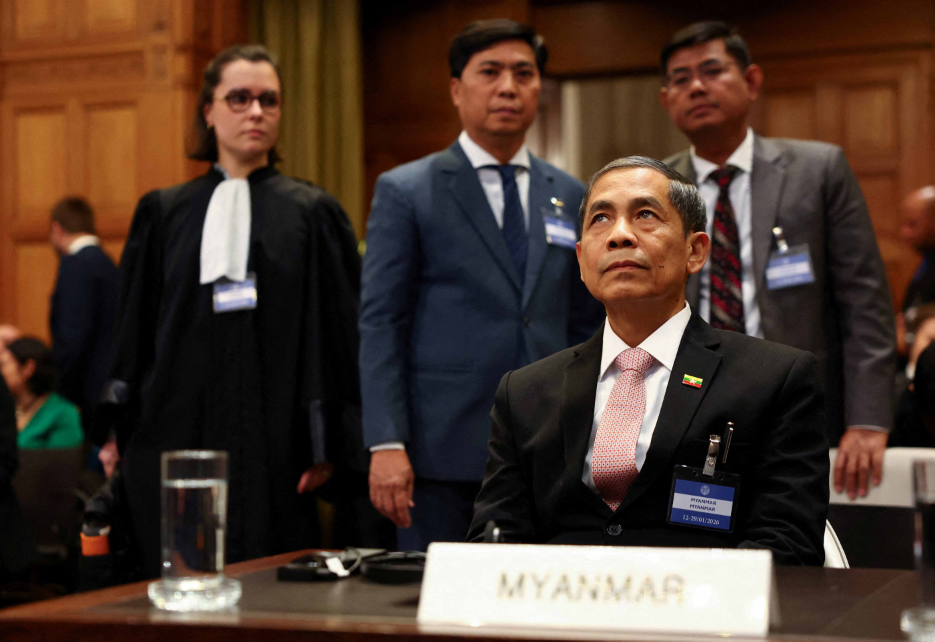
After the military coup in 2021, while Daw Aung San Suu Kyi was detained, the National Unity Government (NUG)—formed by the NLD and many lawmakers elected in the 2020 election—announced that it was withdrawing the defense submitted by Daw Aung San Suu Kyi to the ICJ in 2019. Ahead of the second hearing in early 2022, the NUG also sent a letter to the ICJ stating that only the NUG represented Myanmar and urging the Court not to recognize the coup regime. However, because the case is against the state of Myanmar, the ICJ accepted and heard submissions only from the delegation sent by the military regime, which it treated as the de facto government.
Some observers found it difficult to understand statements by the NUG indicating that it would represent Myanmar at the ICJ. They argued that civilian government members who were not military generals had not fully known the truth of what happened during the 2017 northern Rakhine operations before the coup, and that they should learn lessons from having defended the military. They further contended that in the second hearing in 2022, responsibility for killings, sexual violence, arson, and the destruction of villages lay solely with the military, and that there was no need for the NUG to intervene in defense in a case already filed. Even if the intention was not to defend the military but to seek international recognition as the legitimate government, critics argued that in a case like this, responsibility lay with the military that committed the crimes, and there was no need for the NUG to step in.
After the initial hearing in 2019 and the second hearing in 2022, the hearings at the beginning of 2026 constitute the core phase of the case and are expected to be the longest in duration. Witness testimony will be heard, and some legal experts involved in the case have commented that the Court may issue a judgment following the conclusion of these hearings.
If the Court were to rule that Myanmar committed genocide, it would leave a deep stain on the country’s history and have long-lasting consequences. A finding of responsibility for genocide could have diplomatic and international repercussions not only for the state but also for those who bore responsibility, gave orders, or directly participated in the crimes.
Because there is currently no clear prospect of establishing a special tribunal like the ICTY—where arrest warrants were issued against those responsible for genocide in the former Yugoslavia—for the Rohingya genocide in Myanmar, there is, for now, no immediate, concrete threat that Myanmar’s military leaders will be arrested in practice.