Myanmar Spring Chronicle – January 7 Scene
January 8, 2026
Is American democracy setting on Myanmar’s Spring journey?
“What should we write today?” Two editors asked each other.
Should we write about the attacks on security outposts in western Bago Region? Or what is happening along the Pyay highway near the Minhla battlefield? The discussion started with questions like these.
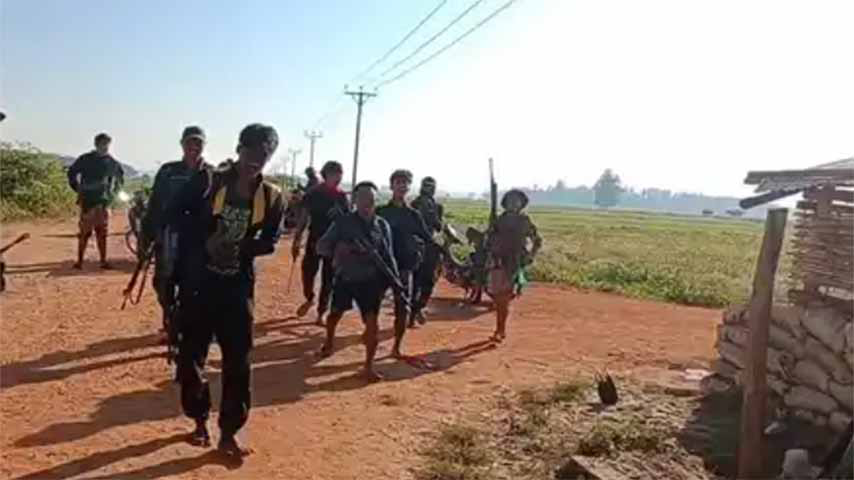
Yes—after Part One of the military’s election process, fighting has intensified. It has intensified everywhere. The Myanmar military’s airstrikes have grown more frequent and more severe, increasingly targeting civilian areas. From Chin State, a young schoolteacher told us that Chin resistance forces have stepped up their counter-offensives against junta columns. Casualties are high; bombing is frequent. However, people say that the junta’s losses are extremely heavy across the country. On the NUG and ERO allied side, military engagements against the Myanmar army have increased even more as the second phase of the election approaches.
By the way, someone from m.CDM mentioned that the military has announced on its websites and Facebook pages that it will now issue passports very quickly. At a time when young people are being forcibly conscripted—rounded up and pushed into military service—the regime is suddenly providing expedited passport services. Does this suggest that, under military rule, certain social classes or groups are being enabled to leave the country in large numbers? Or does it mean Myanmar can still supply labor to meet demand in Asian countries? This is something domestic reporters would need to investigate directly on the ground; for now, we cannot write it definitively.
Should we instead write about a world entering 2026 without leaving even bows and arrows behind? On January 3, the United States launched a sudden armed strike on Venezuela, captured the authoritarian president Nicolás Maduro, and abducted him away. Some newspapers and politicians have described it as the kidnapping of a sitting head of government. What they mean is the unjust abuse of U.S. military and political power. The U.S. administration has been criticized for violating procedures and the Constitution by failing to inform Congress and its special committees on military and foreign affairs in advance. The question is now being asked: has might-makes-right politics—where the powerful seize the initiative and bully others—become the new reality?
Has the era arrived in which the U.S. government can simply do whatever it wants by virtue of its power? President Trump claimed that abducting Venezuela’s president by force was necessary to bring peace to the Venezuelan people. However, the next day, in a closed-door briefing to lawmakers, Trump reportedly admitted that what he really wanted was Venezuela’s oil market. He is said to have acknowledged that instead of consulting Congress, the U.S. first consulted major oil companies before moving to seize another country. After abducting a foreign head of state, the U.S. has now demanded that Venezuela’s oil be handed over as a form of tribute. Trump reportedly said he would manage the sale of that oil at market prices.
While the U.S. president acts with authoritarian freedom, he did make one admission. He warned his puppet-like lawmakers of one thing: Republicans must win the 2026 midterm elections. If you lose and the Democrats win, he said, the Democrats will impeach and remove me. In other words, Trump himself knows that the acts he has committed are serious crimes.
Trump accuses Venezuelan president Maduro of refusing to step down after losing an election. Yet Trump himself refused to accept his defeat in the November 2020 presidential election and incited his supporters to violently storm the Capitol. Around 1,500 insurgents were prosecuted and imprisoned by the U.S. justice system, but when Trump returned to the presidency in 2025, he granted them all pardons. Now, at the fifth anniversary of January 6 in 2026, he has ordered history to be rewritten—portraying the January 6 attack as a disgraceful event fabricated by Democrats, in which Capitol police provoked and assaulted the public.
So, the question of whether American democracy has reached sunset arises at the start of 2026. Does the sunset of American democracy mean the entire country—and the whole world—has fallen into darkness, with people panicking, running, and hiding as if the world were ending? Not quite. The U.S. and global stock markets have shown no major instability. Oil prices have not spun out of control. Market indices, analysts say, have reacted calmly and steadily. The general assessment is that global leaders, activists, and scholars have now recognized that the United States can no longer safeguard its own democratic values and norms—and that the civilized parts of the world are adjusting and recalibrating toward a new equilibrium. Whether the single vote of the American voter still holds real value will be tested again in the 2026 midterm elections. Many say we have entered a period in which both Americans and the international public can only watch events unfold, like spectators at a fire.
American citizens themselves—as well as immigrants—are experiencing threats and attacks from the armed forces, police, and security agencies of the Trump administration. Across healthcare, social welfare, education, and employment, abuses of power and lawless repression are widespread. Rights and entitlements are being restricted. Disinformation and fabricated news are being used to divide society. Just yesterday, the government’s public information office was forced to dissolve itself due to lack of budget. International aid agencies like USAID are gone. Media outlets like VOA and RFA are gone. Funding for education and scientific research is gone. Social security, educational assistance, programs for women, mothers, and children have been cut; healthcare subsidies have disappeared. For American citizens, this is a period in which the values of their democracy are fading.
From the perspective of the people of Myanmar, we can at least express sympathy and compassion for the American people. In Myanmar, people living under dictatorship are striving, struggling, and fighting to reclaim and rebuild democracy and a federal system. The United States, long a model of democracy and federalism, now finds itself at a crossroads—anxiously wondering whether its own democracy is slipping away.