
Myanmar Spring Chronicle – January 1 Scenes
January 2, 2026
City-capture battles and strategy
From late 2023 through the end of 2025, revolutionary armed groups fighting against the coup regime were able to attack and capture more than 80 or 90 towns. During that period, they did not only seize towns; they also attacked and captured military targets such as regiments, operational command headquarters, regional command headquarters, and regional military commands. Some of these targets were located in or attached to towns, while others—such as regiment bases, operational command bases, and border-guard outposts—were not directly linked to any town.
After capturing more than 90 towns—nearly 100—over a little more than two years, some were later retaken by the coup military through renewed offensives, while a few towns were handed back under ceasefire agreements. For example, Lashio, Mogok, and Momauk/Momeik were towns that were transferred back under ceasefire arrangements between the MNDAA/TNLA and the coup military.
Separately from ceasefire-related handovers, the number of towns that have been lost again due to the coup military’s counteroffensives has now risen to around ten. Towns such as Kawlin, Kawkareik, Naungcho, Kyaukme, Hsipaw, Madaya, Thabeikkyin, Singu, Sisai, Moebye, and Demoso were captured by revolutionary forces and ethnic armed organizations, but were later lost again after months—or even years. There were also towns that could only be held for a matter of days, such as Pale (Sagaing Region) and Loikaw (Karenni/Kayah State), as well as places where the entire town could not be fully seized. And there are towns like Bhamo (Kachin State) where, even after more than a year, neither side has secured a decisive victory and fighting continues.
There is not just one single reason why towns are targeted for capture. In some cases, once surrounding areas have been taken, it becomes impractical to leave a town isolated, so attacking and capturing it becomes the next step. In other cases, towns are attacked because they host major military bases or regiments; once those bases become targets, capturing the town can become part of the operation. And in some cases—even when neither of those reasons applies—capturing a town may be pursued for its symbolic value.
To wage city-capture campaigns, revolutionary armed groups need sufficient weapons and ammunition, enough manpower, and a sound military strategy. They also need to assess in advance the enemy’s defensive capacity, logistics and supply routes, and support methods.
For example, in the prolonged campaign to capture Loikaw, revolutionary forces launched offensives for months but ultimately had to withdraw after they were unable to overcome the military’s defenses and supply lines. In cases like the battle for Kawlin in Sagaing, the town’s geography made it difficult to hold, because the military could launch counteroffensives from multiple directions, creating major challenges for defense and long-term control.
Beyond these factors, the coup military’s ability to call in air support, and to use aircraft for logistical resupply, is another major disadvantage for revolutionary forces.
When it comes to capturing towns, some ethnic armed organizations may already be operating with a broader strategic framework. They may prioritize capturing and governing territory that aligns with the principle of protecting areas where their people predominantly live, building administration once they seize such areas. Second, they may pursue a strategy of taking buffer zones, either on their own or jointly with allied forces. Finally, in situations where a ceasefire becomes unavoidable, they may even be prepared to hand back towns that lie within those buffer zones. In other words, they may capture such areas when conditions are favorable for later bargaining.
However, city-capture operations that are driven by a “buffer zone” logic—or pursued mainly for symbolic reasons—can also fuel public perceptions that reduce understanding and support among local residents. For example, the fact that Mogok was captured in 2024 and then handed back more than a year later in November 2025 raises questions about the purpose and intent of the city-capture campaign.
In recent days, there have been new offensives aimed at capturing certain towns, including Sinphyukyun in Magway Region and Katha in Sagaing Region. The push toward Sinphyukyun has been led by the Salin People’s Defense Forces, while the campaign to seize Katha involves joint operations by KIA-linked PDF units from the Katha and Mohnyin areas, along with the ABSDF.
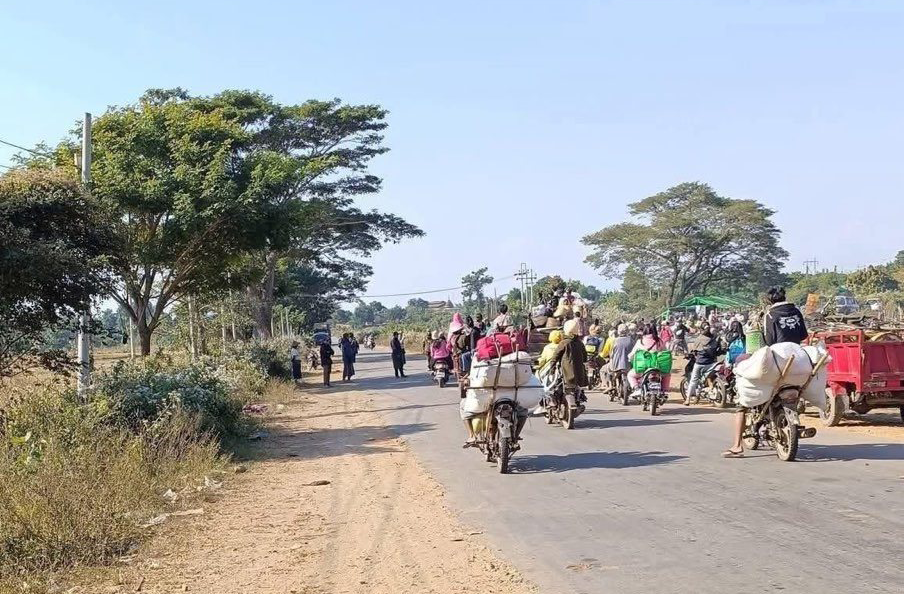
Whenever city-capture battles occur, tens of thousands of residents are often forced to flee, and many lose property and livelihoods. Some argue that this is unavoidable in wartime, but it has increasingly become a key concern that must be weighed. People are also beginning to ask whether forces launching city-capture operations have the capacity and long-term strategy to hold these towns sustainably. Many residents do not want to face repeated cycles of displacement—fleeing once, returning after months or a year, and then being forced to flee again after another round of fighting within one or two years. In towns like Naungcho and Kyaukme, and in places like Kawkareik in Karen State, repeated displacement has made it harder for families to recover their livelihoods and rebuild stable lives.
These real-world experiences are also a warning sign for revolutionary forces: when planning future city-capture campaigns, they should recognize that such patterns may make the public increasingly reluctant to offer support and encouragement for these operations.