
Myanmar Spring Chronicle – Viewpoint of 29 November
(MoeMaKa) 30 November 2025
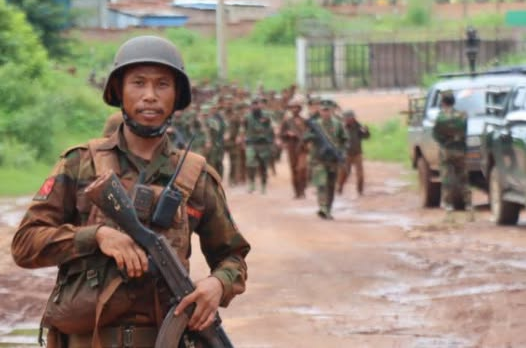
With TNLA as escort, junta troops re-enter and take positions inside Mogok
One year and four months after the town was first captured, junta troops have now re-entered Mogok in full force on 28 November.
For the past month, the Ta’ang National Liberation Army (TNLA), which has been in charge of administering and controlling the town, has been implementing arrangements to hand Mogok back to the junta, with whom it signed a ceasefire agreement.
In the days leading up to the handover, TNLA notified the PDF units that had fought alongside it when Mogok was captured — the Mandalay PDFs and local Mogok-area PDFs — that they should pull out of the town, so that there would be no clashes when junta troops came in to take positions.
Counting from 28 October, the date TNLA and the junta signed their ceasefire agreement, the junta’s return to the town on 28 November comes exactly one month later. It can thus be inferred that both sides agreed to a one-month timetable for transferring control of Mogok.
One of the main points of criticism is that TNLA did not openly consult or clearly inform its PDF allies about the details of how the town would be handed over. While it is true that TNLA led the offensive to capture Mogok, local PDF forces like MDY PDF and other Mogok PDFs fought side by side, and yet they were not properly briefed or consulted regarding the ceasefire terms and the handover.
Relations between TNLA and the PDF units have not completely broken down, but it is difficult at this point to answer whether, and to what extent, joint operations and trust will be possible in the future.
Some observers conclude that ethnic armed organizations tend to prioritize their own military and political strategy and their own organizational survival. At the same time, there is another way of looking at it: that they must distinguish between what is essential for holding their territory long-term and what is secondary, and sometimes make hard, unpopular decisions for the sake of practical outcomes.
From some angles, people highlight pressure from China. Questions are being asked:
-
How much does TNLA depend on China?
-
Why was it unable to refuse?
But there are no clear answers. It is not clear whether the issue is access to arms and ammunition, or that if cross-border trade were blocked or restricted, it would be extremely difficult for the Ta’ang region to sustain itself.
Why, then, does the handover of Mogok feel so significant? During the 1027 offensive and subsequent campaigns of the Spring Revolution, several towns were captured and then lost again in northern Shan, Karen State, Sagaing Region, and elsewhere.
Most of those losses came from being pushed out by junta counter-offensives. But in the case of Lashio, Mogok, and Moe Meik, the losses came through ceasefire agreements and negotiated handovers, not through direct defeat on the battlefield.
In comparison with towns like Naungcho, Kyaukme, and Hsipaw, which were lost due to junta offensives, people feel more resentment and reluctance about towns like Lashio, Mogok, and Moe Meik, which were handed back under ceasefire deals.
Lashio is strategically important, serving almost as a capital of northern Shan, both militarily and administratively. Mogok is a resource-rich town, and one whose people enthusiastically welcomed and supported the revolutionary forces. Losing such towns is emotionally very hard to accept.
When Lashio was handed back, such public criticism from PDFs was not widely seen. But in the case of Mogok, because local PDFs themselves took part in the capture of the town, their sense of dissatisfaction and disappointment over handing it back is now much more openly expressed.
There is an old saying: “Capturing a town is easy; holding it is hard.”
Why is holding harder than taking?
Is it because of the difference between offensive and defensive warfare?
Is it due to limitations in manpower, weapons, and the ability to withstand airstrikes?
These are military questions that need serious reflection.
From the perspective of armed organizations, these are hard choices made within the constraints they face. But for local civilians, the situation looks very different:
-
They saw revolutionary forces capture their town,
-
Then watched that town later be surrendered.
This produces fear that they may again have to endure another urban battle in the future, and also deep anxiety about reprisals and collective punishment once the junta returns.
TNLA has not provided clear public explanations to the people of Mogok about the mode and timing of the handover. Fearing possible clashes and reprisals during the transition, an estimated 60–70% of Mogok residents fled, taking the Mogok–Kyaukme and Mogok–Mandalay routes.
Bus fares on the Mogok–Mandalay route reportedly rose to 600,000–800,000 kyat per person, which is a huge amount even for a town like Mogok where people generally have better access to cash.
Photos circulating on social media show Mogok’s streets nearly deserted even in daytime. Some reports say there are still workers in certain mining pits, but the city as a whole looks desolate.
Going forward, revolutionary forces will need to give much greater weight to long-term control and administration when planning town offensives, more than in the past. And on the side of local civilians, there will likely be more cautious, measured forms of support, rather than purely enthusiastic, unreserved backing.