
Myanmar Spring Chronicle – Scenes from December 11
(MoeMaKha) December 12, 2025
The military junta that deliberately bombed Mrauk-U Hospital
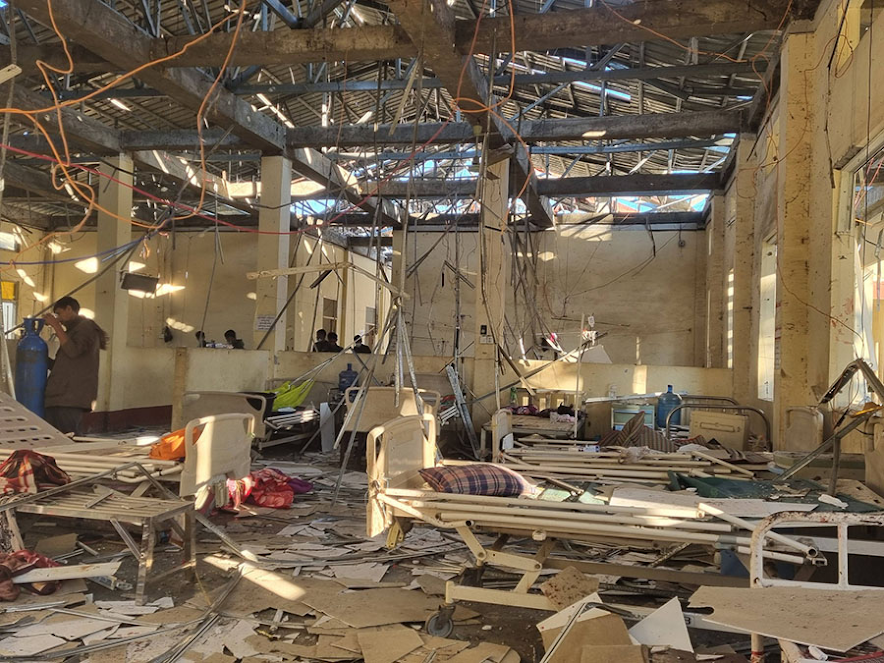
At around 9 p.m. on December 10, fighter jets belonging to the coup military junta dropped two 500-lb bombs on the main public hospital in Mrauk-U, Rakhine State – a town under the control and administration of the Arakan Army (AA).
One bomb hit the hospital buildings directly. The other landed on an open area in front of the hospital. According to an AA statement, 33 people – patients receiving treatment, family members staying with them, and hospital staff – were killed on the spot, and 76 others were injured.
Videos from the scene show the hospital burning after the strike. Photos taken that same night show bodies wrapped in blankets and tarpaulins, including the corpse of an infant still wearing a diaper. On the morning of December 11, at the cemetery, rows of bodies laid out on the ground, wrapped in cloth with parts of their faces visible, blood soaking into blankets and clothing. From the images alone, there is no room for doubt: the victims were civilians.
This is far from the first time the coup military has bombed places that clearly serve civilians, such as schools and hospitals.
In Depayin Township, schools in several villages have already been hit by airstrikes more than once. In Karenni (Kayah) State, schools have also been bombed. About two years ago, when the junta air force bombed Let Yet Kone School in Depayin, more than a dozen children were killed or wounded. And in May this year, an airstrike on the school in Oe Tit Twin Village, also in Depayin Township, killed 22 people.
In Rakhine State, a school in Kyauktaw Township was hit by an airstrike about three months ago, in September, killing 20 students. These are just some of the attacks with large numbers of casualties that we can list; there have been many more airstrikes with fewer reported deaths, and many of those also involve schools and hospitals.
This latest bombing of Mrauk-U General Hospital is a direct attack on a facility that international rules of war explicitly classify as protected – a place that must not be targeted.
Spokespersons for the junta and retired officers who publicly defend the military often try to justify such attacks in media interviews. They describe them as “war actions,” or argue that if an armed group is providing security or using a location, then that location becomes a “legitimate military target.”
Globally, it is not the case that hospitals and schools are never attacked in armed conflicts.
During Israel’s ongoing campaign in Gaza, launched more than two years ago to “eliminate Hamas,” hospitals have been hit by rockets and airstrikes, and there have been incidents where dozens of people were killed at a time. Despite the fact that thousands upon thousands of civilians have died in these operations, no country – including the United States and certain Western European states that fund and arm Israel – has been able or willing to stop these actions.
In the Russia–Ukraine war, where fighting has been extremely intense, schools and hospitals have generally been avoided as deliberate targets. When there have been concerns around those sites, human rights organizations have criticized both attacks and the stationing of troops or weapons near such facilities.
What I want to point out here is this:
Even in the case of Israel’s Netanyahu government, which stands accused of genocide, and despite the many war crimes and inhumane acts committed against civilians, no state has meaningfully intervened to stop it.
From that reality, it is difficult to expect the international community to make any serious move to halt the kinds of war crimes now being committed in Myanmar. I say this with a heavy heart.
Since the coup, the junta has:
-
Fired live ammunition into peaceful protesters
-
Brutally dispersed and crushed demonstrations
-
Carried out extrajudicial killings, including returning bodies the day after arrests
-
Bombed and shelled civilians and displaced people, killing large numbers
-
Arrested and massacred villagers by the dozens
Hopes that the international community might step in to prevent these crimes began to fade in the early years after the coup.
That is why it is crucial to document war crimes, preserve all possible evidence, and store it in ways that cannot easily be destroyed.
At the same time, we need to think seriously about how to reduce the dangers of airstrikes. The territories considered “liberated” on the ground still remain exposed from the air, with no real air defense.
Without the involvement of powerful states, it is extremely difficult to obtain air defense systems or weapons capable of shooting down fighter jets and attack helicopters. Such weapons are not easily acquired even on the black market.
On the other hand, local forces have been doing what they can: issuing air-raid warnings, tracking flight paths, and sending alerts along likely routes. But there is still a pressing need for broader, more systematic and effective warning mechanisms.
It is time to begin preparing practical measures to reduce casualties:
-
Avoid large gatherings in schools, hospitals, and public-service offices where people naturally congregate
-
Prepare sufficient air-raid shelters or bomb shelters so that, when warnings are issued, large numbers of people can take cover quickly
Unless steps like these are taken, the number of civilian deaths from airstrikes on schools, hospitals, and other public places will only continue to grow.